
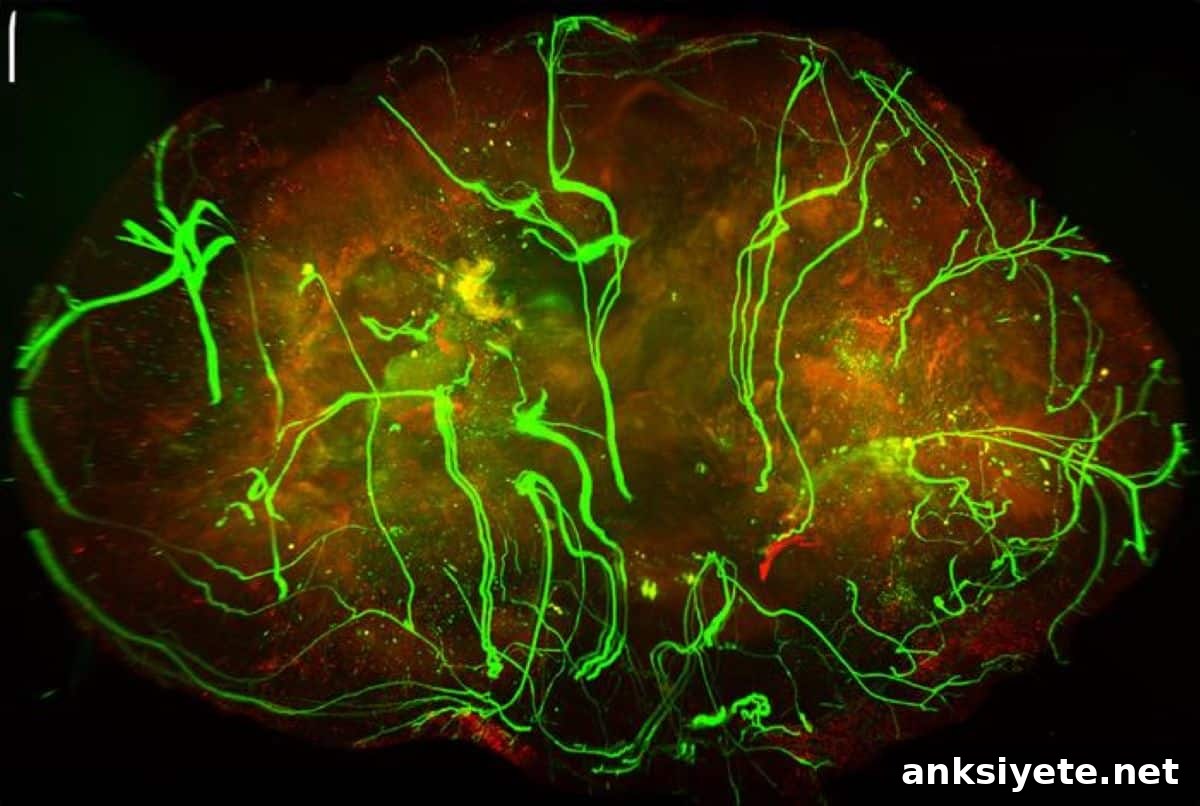
Summary: In the growing field of cancer neuroscience, the nervous system has often been described as a “gas pedal” that speeds tumor progression. New research, however, reveals a surprising counterpoint: certain nerves can act as a biological “brake” and slow melanoma growth.
Using mouse models of melanoma, investigators at Weill Cornell Medicine found that sympathetic nerve fibers—those involved in the fight-or-flight response—can inhibit tumor expansion. These nerves release norepinephrine, which engages specific adrenergic receptors on immune cells and prevents the tumor from recruiting macrophages that normally support cancer growth.
Key Facts
- The Sympathetic Brake: While sensory (pain) nerves promoted melanoma growth in the models studied, sympathetic nerve fibers produced an opposing effect and slowed tumor progression.
- Whole-Mount Immuno-Labeling: Researchers applied an optical-clearing technique to make entire tumor-bearing tissue samples transparent, enabling three-dimensional tracing of nerve fibers as they infiltrated melanomas.
- Targeting Macrophages: The anti-tumor action is mediated through alpha-adrenergic receptors on macrophages. Sympathetic signaling reduced the number of tumor-supportive macrophages, limiting the tumor’s ability to thrive.
- Norepinephrine’s Local Role: In the skin, sympathetic nerves release norepinephrine. Although commonly linked to systemic stress responses, local norepinephrine inside tumors promoted an anti-tumor immune environment in these experiments.
- Drug Repurposing Potential: Alpha-adrenergic drugs are already FDA-approved for conditions such as high blood pressure, suggesting a possible route to repurpose existing medications to influence tumor-associated macrophages.
Source: Weill Cornell Medicine
Nerve fibers within melanomas can slow tumor growth, according to new mouse-model research led by investigators at Weill Cornell Medicine.
These findings refine our understanding of cancer neuroscience and point toward new directions for therapy development. Published April 29 in Neuron, the study mapped peripheral nerve infiltration into skin melanomas and examined how different nerve types influence tumor behavior.
The researchers observed abundant sympathetic axons within melanomas and showed that these fibers can act as a physiological brake on tumor growth by reducing the number of macrophages that adopt pro-tumor roles. Conversely, pain-sensitive sensory nerves tended to promote tumor expansion, consistent with earlier studies.
“The nervous system is often regarded as a driver of cancer growth, but in this context it can function as a brake,” said study senior author Dr. David J. Simon, assistant professor of biochemistry and biophysics at Weill Cornell Medicine. “The next steps are to determine how widely this mechanism applies to human cancers and how it might be harnessed clinically.”
The peripheral nervous system includes sensory nerves that detect temperature, pain and itch, and sympathetic nerves that convey brain signals to organs and tissues. In skin, many sympathetic fibers release norepinephrine, which affects immune cells, sweat glands and other local targets.
Although peripheral nerves are commonly observed inside tumors, only recently have scientists begun to untangle their roles in cancer progression. Most prior work emphasized pro-tumor effects—nerves releasing molecules that suppress anti-tumor immunity—but hints have also emerged that nerves can sometimes slow tumor growth. This study systematically examined those opposing effects in melanoma models.
Dr. Simon’s laboratory specializes in studying peripheral axon growth and survival. With early support from the Pershing Square Sohn Cancer Research Alliance, the team explored nerve–tumor interactions using whole-mount immuno-labeling to visualize all axons within intact tumor samples. That approach allowed precise counting, identification and 3D tracing of nerve fibers as tumors developed.
The data showed that both sensory and sympathetic nerves increase as melanomas grow, particularly in slower-growing tumors. Removing sensory nerves slowed tumor growth, confirming their pro-tumor role. In contrast, depleting sympathetic axons accelerated melanoma progression, while activating these axons optogenetically slowed tumor growth—evidence that sympathetic innervation acts as a growth brake.
Mechanistically, sympathetic axons release norepinephrine, which activates adrenergic receptors on nearby cells. The team traced the anti-tumor effect to alpha-adrenergic receptors on tumor-associated macrophages. Tumors commonly reprogram macrophages into an immunosuppressive, tumor-supportive phenotype; alpha-adrenergic signaling restricted the number and distribution of these pro-tumor myeloid cells, slowing tumor expansion independently of T cell activity.
These results raise the possibility of therapeutic strategies that enhance sympathetic signaling within tumors or target alpha-adrenergic receptors on macrophages. Because alpha-adrenergic drugs are already used clinically for cardiovascular conditions, translational studies could progress relatively quickly, though confirmation in human tumors is required before clinical application.
“There is still substantial basic biology to uncover,” Dr. Simon emphasized. Ongoing work will probe how adrenergic receptors are engaged and signal in human cancers and whether similar sympathetic-immune axes exist across tumor types.
Funding: This research was supported in part by the National Cancer Institute (grants R01CA256188, R01CA272717, P30CA08748, P30CA014520 and R37CA300434), the U.S. Department of Defense (grant ME240045), the Fernholz Family Foundation, and the Pershing Square Sohn Cancer Research Alliance.
Key Questions Answered:
A: Not exactly. The study distinguishes local norepinephrine release from nerve fibers inside the tumor from systemic effects of chronic stress. Chronic stress typically elevates circulating hormones that can suppress immunity, while the observed anti-tumor effect depends on local sympathetic wiring and norepinephrine acting on nearby immune cells.
A: Different nerve types release distinct molecules that have different effects on immune cells. Sensory nerves release factors that can blunt anti-tumor immunity, while sympathetic nerves release norepinephrine, which in these models limited the tumor’s ability to recruit macrophages that promote growth.
A: Because alpha-adrenergic drugs are already approved for other indications, repurposing and clinical testing could proceed more rapidly than for a novel compound. However, key preclinical and clinical studies are needed to confirm that these mechanisms operate similarly in human melanomas.
Editorial Notes:
- This article was edited by a Neuroscience News editor.
- Journal paper reviewed in full.
- Additional context provided by the editorial staff.
About this neuroscience and cancer research news
Author: Corinne Esposito
Source: Weill Cornell Medicine
Contact: Corinne Esposito – Weill Cornell Medicine
Image: Image credited to Dr. David J. Simon
Original Research: Open access. “A local sympathetic-immune axis inhibits melanoma growth in mice by dictating adrenergic control” by Tingting Liu et al., Neuron. DOI: 10.1016/j.neuron.2026.04.016
Abstract
A local sympathetic-immune axis inhibits melanoma growth in mice by dictating adrenergic control
The nervous system influences tumor growth both via local axons inside tumors and through systemic hormones. Contexts in which neural input inhibits tumor growth are less well defined. Using optical reconstruction of axonal innervation in mouse models of cutaneous melanoma, the study revealed progressive sympathetic axon infiltration. Local depletion of these axons accelerated tumor growth, while local optogenetic activation slowed it, consistent with a physiological growth brake.
Although β-adrenergic signaling is often implicated in tumor promotion, these results show that initial tumor conditions can shift responses toward α2-adrenergic receptor–driven growth inhibition. Activation of α2-adrenergic receptors by axons restricted the number and distribution of pro-tumor myeloid cells independently of T cell activity. Overall, the data reveal context-dependent, bidirectional neural control of tumor progression.