
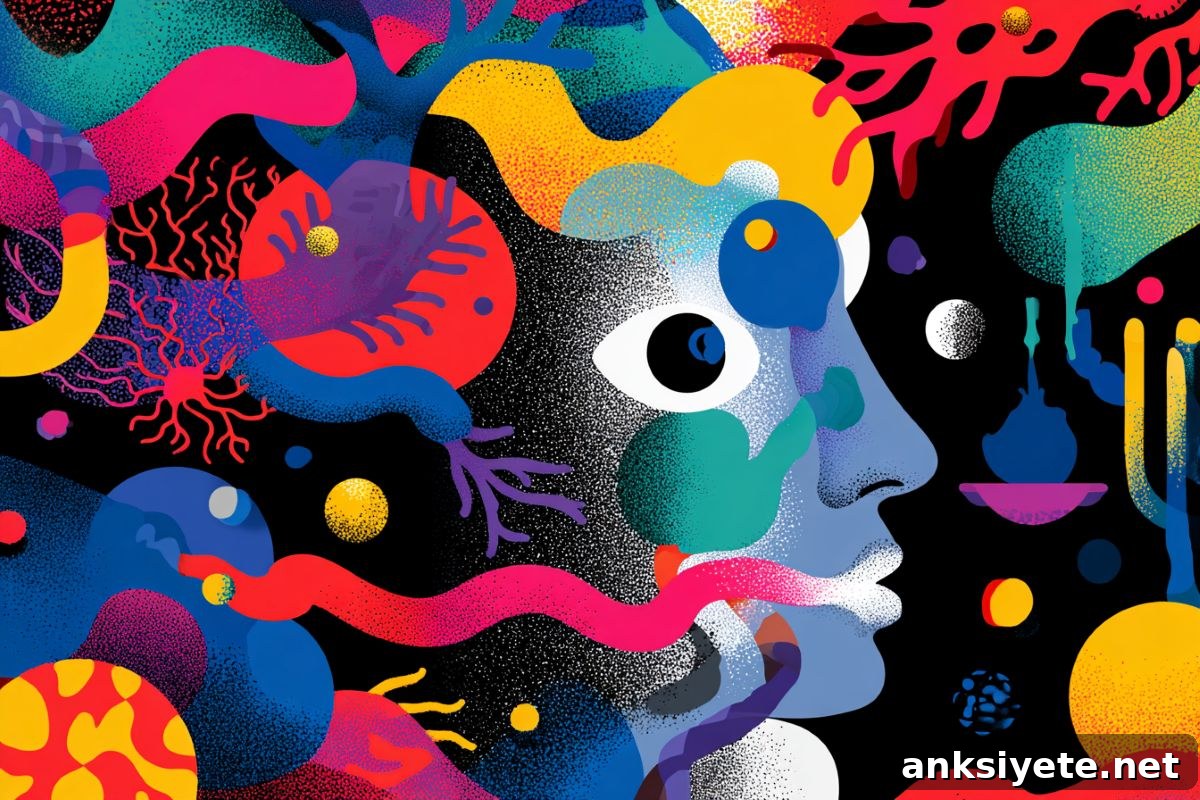
Summary: Imagine “tasting” a word or “seeing” a blue note during a jazz solo. For an estimated 1% to 4% of people, this is not a metaphor but a lived neurological reality known as synaesthesia. In this phenomenon, activation of one sense automatically and involuntarily produces a concurrent experience in another, unrelated sense.
Research indicates synaesthesia is reported more often by women and appears disproportionately common among creative professionals. It is not a disorder; rather, it reveals how differently human brains can be wired, producing vivid, intertwined sensory experiences that enrich perception for those who have them.
Key Facts
- Common forms: Well-known types include grapheme-colour (seeing specific colours for letters or numbers), auditory-visual (hearing sounds as colours or shapes), and mirror-touch (feeling sensations on one’s own body when observing another person being touched).
- Consistency: Synaesthetic associations are remarkably stable over time. If a synaesthete experiences the letter “A” as crimson today, they are likely to perceive that same shade for decades.
- Leading theories about brain mechanisms:
- Cross-activation theory: Proposes that additional physical connections between brain regions persist, possibly because some early developmental pruning did not occur.
- Disinhibited feedback theory: Suggests that typical brain connections are present, but certain pathways are more active or less inhibited, allowing cross-sensory signals to surface as conscious experiences.
- Links with creativity: Although roughly 2% of the general population work in creative occupations, surveys suggest about 24% of synaesthetes report creative careers such as musicians, visual artists, designers, or architects, indicating a strong association between synaesthesia and creative expression.
Source: The Conversation
Have you ever tasted a word or seen colours while listening to music?
If so, you may be among the estimated 1% to 4% of people who experience synaesthesia. This neurological trait means that stimulation of one sensory pathway—such as hearing—automatically triggers another sensory perception, such as visual colour or a taste. These additional sensations are involuntary, vivid, and generally consistent over a person’s life.
Scientists have spent considerable effort studying synaesthesia because it offers a unique window into how perception is built by the brain. While research continues, current findings show that perception can vary dramatically between individuals: what is a neutral stimulus for one person can carry rich, multi-sensory meaning for another.
What is synaesthesia?
People who experience synaesthesia, called synaesthetes, report automatic cross-sensory associations. These can take many forms. In auditory-visual synaesthesia, sounds evoke colours or shapes. In grapheme-colour synaesthesia, letters or numbers consistently appear in particular colours. In mirror-touch synaesthesia, observing someone else being touched produces a tactile feeling in the observer’s own body.
Everyone integrates sensory information to some degree: combining sight and sound helps us read lips or appreciate film dialogue. In synaesthesia, these cross-modal links are amplified or altered so that a stimulus in one modality reliably produces a percept in another. Synaesthetes cannot control these experiences; they arise spontaneously and typically persist unchanged for years.
Synaesthesia is not an illness and does not inherently impair functioning. Some people may find particular situations overwhelming—such as feeling pain when watching a painful scene—but for most, synaesthesia simply adds an extra layer to everyday perception. Many synaesthetes are unaware their experience is unusual until they learn that others do not perceive the same cross-sensory associations.
What causes it?
The precise cause of synaesthesia remains under investigation, but two main explanations dominate current thinking.
1. Extra connections in the brain
The cross-activation theory argues that synaesthetes retain additional connections between brain regions that in most people would be reduced during development by synaptic pruning. Under this model, areas that recognise symbols (like letters) might be directly linked to colour-processing areas, so perceiving a symbol automatically evokes a colour sensation.
2. Different patterns of neural activity
An alternative view is that synaesthetes have similar anatomical connections to others but that those pathways are more active or less inhibited. This idea emphasizes that synaesthesia may build on ordinary brain mechanisms of association and prediction: the brain often fills in or links information across senses to make sense of ambiguous input, and in synaesthesia those links reach conscious awareness as consistent sensory experiences.
In short, the debate centers on whether synaesthesia arises from structural differences in the brain or from differences in how existing networks are used.
Does synaesthesia make you more creative?
Famous artists and musicians have long described experiences resembling synaesthesia, and empirical studies show the trait is more frequent among people in creative careers. One large survey of synaesthetes found a far higher percentage working in creative fields compared with the general population. The reasons are not fully understood, but synaesthesia may foster creativity by encouraging novel links between ideas, enhancing imagery, or supporting distinctive memory strategies.
Research indicates synaesthesia can be associated with stronger memory for certain types of information and with vivid imagination, though these advantages are not universal across all types of synaesthesia or all tasks.
Overall, synaesthesia highlights that perception is an active construction by the brain. It shows how individual differences in neural wiring and processing can lead to strikingly different but valid ways of experiencing the world.
Key Questions Answered:
A: Neither. Synaesthesia is a perceptual trait. Unlike hallucinations, which are often disordered and disconnected from consistent reality, synaesthetic experiences are structured, repeatable, and consistent. For most synaesthetes, it provides an additional, reliable layer of sensory information.
A: Genuine synaesthesia typically develops naturally, often with a developmental or genetic basis. People can learn to create associations—such as assigning colours to letters—but these trained associations rarely reach the automatic, involuntary vividness experienced by innate synaesthetes.
A: Generally, no. Because synaesthesia is tied to how the brain is wired or functions, it tends to remain stable throughout life. Some individuals report slight changes with age or during periods of stress, but for most the experience remains a lasting characteristic.
Editorial Notes:
- This article was edited by a Neuroscience News editor.
- Journal papers were reviewed in full where applicable.
- Additional context was added by editorial staff to clarify findings and implications.
About this synesthesia research news
Author: Sophie Smit and Anina Rich
Source: The Conversation
Contact: Sophie Smit and Anina Rich – The Conversation
Image: Image credit: Neuroscience News