
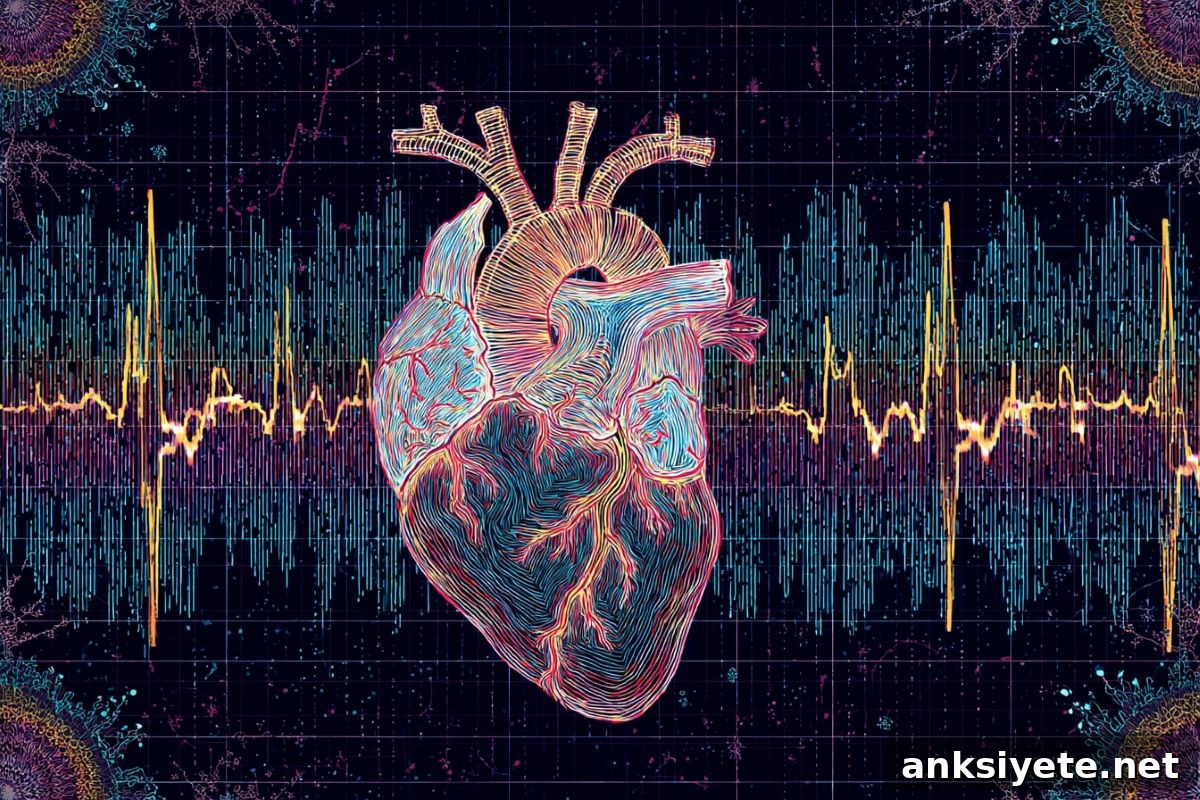
Summary: Researchers at Kyoto University have found that the seemingly “chaotic” fluctuations in a person’s heartbeat are specifically tuned to cognitive brain activity. While standard heart rate variability (HRV) metrics often fail to show clear responses during mental tasks, nonlinear, chaos-based analysis reveals consistent changes that reflect heart–brain coupling.
This study shows that complex, nonlinear heartbeat rhythms are not mere physiological noise but carry meaningful information about the central nervous system under cognitive load. Chaos-based measures provide a reproducible, non-invasive indicator of brain–heart integration during mental activity.
Key Facts
- Sensitivity to chaos: Conventional HRV measures in time and frequency domains showed little or no consistent response to cognitive effort. In contrast, chaos-based indices derived from nonlinear dynamics demonstrated distinct, reproducible changes during task engagement.
- Brain–heart link: Chaotic heartbeat dynamics encode real-time information about higher-order brain processes, offering a non-invasive window into system-level integration between the cardiovascular system and the brain.
- Interdisciplinary approach: The discovery emerged from combining chaos theory and nonlinear physics with advanced signal processing techniques developed in collaboration with Toshiba Information Systems.
- Clinical and practical potential: Chaos-based HRV analysis could enable new continuous monitoring tools for mental health, neurorehabilitation, stress management, and high-demand professional settings.
Source: Kyoto University
Overview of the study
The Kyoto University team investigated how heartbeat variability responds to cognitive tasks by comparing standard HRV indices with chaos and complexity measures. Participants completed tasks designed to engage higher-order cognitive functions while researchers recorded R–R interval (RRI) time series. The authors then applied both linear HRV analyses (time-domain and frequency-domain metrics) and nonlinear chaos-based analyses to the same data.
Results showed a clear distinction: traditional HRV measures remained largely unchanged during mental tasks, while chaos and complexity indices increased significantly and consistently. These changes suggest that chaotic components of HRV are sensitive to cognitive load and reflect dynamic interactions between brain and heart that linear metrics miss.
According to team leader Ken Umeno, “Only chaos responded under cognitive load. This implies chaotic dynamics are a sensitive window into brain–heart coupling that conventional measures cannot capture.” The researchers argue that chaotic heartbeat variability should be regarded as a functional signature of the central nervous system at work, not as mere physiological noise.
The collaboration with Toshiba Information Systems provided advanced signal-processing expertise that helped identify subtle nonlinear patterns, underscoring the value of combining engineering and life sciences for physiological discovery.
Because HRV can be measured non-invasively with existing sensors, chaos-based analysis could be integrated into wearable devices and clinical systems to track mental workload, cognitive strain, and recovery in real time without invasive procedures.
The Kyoto University group is inviting international research partnerships to validate these findings across broader populations and clinical settings, including intensive care, neurological disorders, and psychiatric conditions. Continued validation is essential before clinical deployment.
Key Questions Answered:
A: No. In nonlinear dynamics a healthy heart often exhibits complexity and controlled unpredictability. A reduction in this complexity can indicate stress or disease; the study suggests that chaos helps the heart adapt to the brain’s changing cognitive demands.
A: Most standard analyses focus on linear properties like average rate or simple frequency bands. Chaos-based methods examine complexity and unpredictability in beat-to-beat intervals—features where cognitive signatures appear to be encoded.
A: Potentially yes. Many wearables already collect HRV data; applying validated chaos-based algorithms to that data could allow more accurate, continuous tracking of mental workload, attention, and cognitive strain without brain imaging.
Editorial Notes:
- This article was edited by a Neuroscience News editor.
- The journal paper was reviewed in full for accuracy.
- Additional context was provided by editorial staff.
About this neuroscience research news
Author: Whitney Hubbell
Source: Kyoto University
Contact: Whitney Hubbell – Kyoto University
Image: Image credited to Neuroscience News
Original Research: Open access. “Chaotic fluctuations mark the sign of mental activity in task-based heart rate variability” by Tomoyuki Mao, Hidetoshi Okutomi & Ken Umeno. Scientific Reports
DOI: 10.1038/s41598-026-43385-z
Abstract
Chaotic fluctuations mark the sign of mental activity in task-based heart rate variability
Heart rate variability, regulated by the autonomic nervous system, is typically assessed using time-domain and frequency-domain methods to evaluate autonomic function. Conventional linear analyses, however, capture only part of HRV’s behavior because the cardiovascular system operates with intrinsic nonlinear dynamics.
This study performed a comprehensive comparison of time-domain, frequency-domain, and chaos/complexity indices derived from R–R interval analysis during both physical and mental tasks. The findings demonstrate a robust increase in chaos and complexity measures during cognitive tasks while conventional indices remain largely unchanged. These results underscore the unique sensitivity of nonlinear measures to cognitive processing and highlight chaotic dynamics as a valuable perspective for understanding brain–heart interactions.
Based on these experimental results, the authors propose a hypothesis consistent with prior work to explain why chaotic features emerge in HRV during cognitive activity, and they call for further research to test and extend this framework across populations and clinical contexts.