
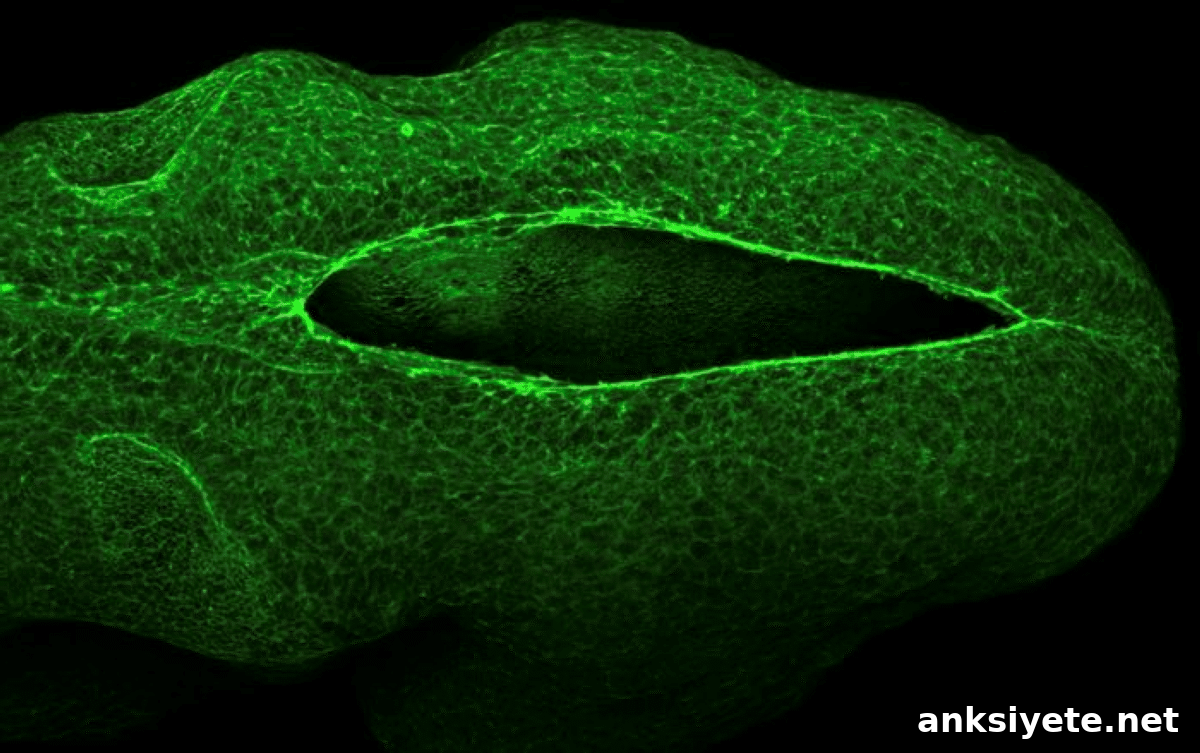
Summary: In a collaborative study, researchers decoded the mechanical forces that close the neural tube during early pregnancy. Rather than closing solely by growth, the neural tube is pulled shut by an actin-based “purse-string” mechanism driven by cellular motors. This mechanical insight provides a quantitative framework for understanding why neural tube closure fails in roughly one in 1,000 pregnancies, causing serious birth defects such as spina bifida.
Combining live biological imaging with theoretical physics and computational modeling, the team mapped how cells generate, transmit, and respond to forces during neural tube closure. Their results show that coordinated force generation and mechanosensitive feedback — not only genetic or nutritional factors — are essential for reliable closure, and that mechanical failure or loss of coordination can produce developmental defects.
Key Findings
- Interdisciplinary breakthrough: Integrating physics-based modeling with detailed biological imaging allowed researchers to link distinct developmental stages and show how physical forces drive tissue-scale outcomes.
- Mechanical origins of birth defects: The study indicates neural tube defects can arise from mechanical failure — for example, weakened actin tension or disrupted cell coordination — in addition to genetic or environmental factors.
- Broad applicability: This physics-first approach can be applied to other stages of human development and tissue repair where force, motion, and timing are critical, such as heart morphogenesis and wound healing.
Source: Georgia Tech
Problem and approach: Neural tube closure is a pivotal early event in vertebrate development. When closure fails in cranial regions like the hindbrain neuropore, it leads to severe congenital malformations. To investigate the physical mechanisms behind reliable closure, researchers at Georgia Tech collaborated with University College London (UCL). The UCL team provided detailed imaging of mouse embryos, and Georgia Tech used those data to build and test cell-based computational models that capture how forces and feedback shape tissue dynamics.
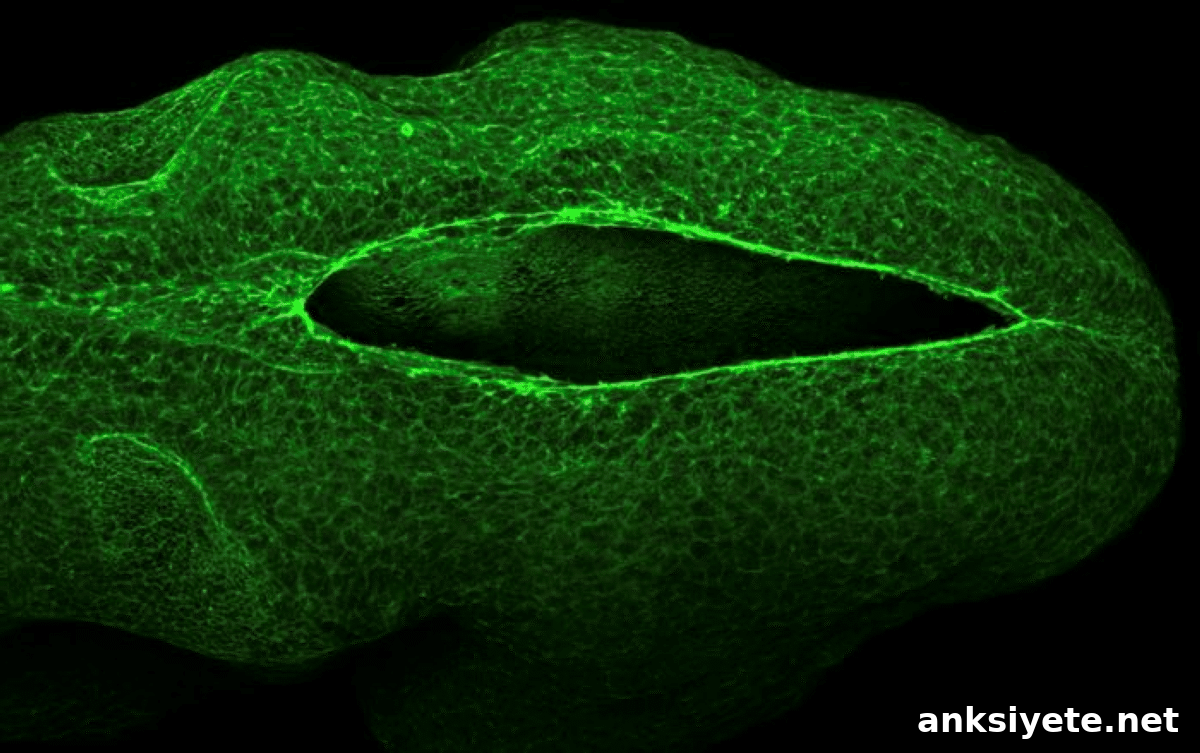
Closing the gap: The data and models reveal that actin filaments form a circumferential ring at the opening of the neural tube. Molecular motors engage these filaments and generate contractile forces, tightening the ring like a drawstring. As the actomyosin “purse-string” contracts, it increases tension at the tissue border and drives the edges together.
Actin filaments provide shape and rigidity to cells. During closure, these filaments organize into supracellular structures around the gap, and motor-generated tension converts local cytoskeletal activity into large-scale tissue movement. The computational model reproduces how a tightening actin ring and motor activity coordinate to close the neural tube reliably in the observed developmental window.
Stretching to fit: As purse-string tension rises, cells at the leading edge elongate, align, and move in a coordinated fashion. This alignment reduces resistance and creates a positive feedback loop: increased alignment promotes faster, more directed movement, which further raises tension and accelerates closure. The model demonstrates how mechanosensitive feedback between cell shape, cytoskeletal alignment, and force generation produces the emergent patterns necessary for successful morphogenesis.
Where closure fails, the model suggests two likely mechanical causes: insufficient contractile tension in the actin ring, or a breakdown in the synchronization of cell movements and alignment. These mechanical failure modes can coexist with genetic or environmental contributors, and identifying them opens new avenues for prevention and intervention.
According to the authors, physics-based modeling complements biological experiments by allowing simulation of mechanical perturbations that are difficult or impossible to recreate in vivo. The approach also provides quantitative predictions about the “mechanical sweet spot” necessary for closure, which could help guide future experimental and clinical studies.
Funding: The computational research at Banerjee Lab is funded by the National Institute of General Medical Sciences.
Key Questions Answered:
A: Embryonic development involves moving matter, generating force, and managing tension. Treating the embryo as a mechanical system lets physicists quantify loads and stresses on cells and explain how forces guide cellular motion and tissue shaping beyond what imaging alone can reveal.
A: Potentially. By defining the mechanical conditions required for closure, researchers can investigate environmental or chemical factors that weaken actin tension or disrupt cellular coordination and target those factors for prevention strategies.
A: Yes. Similar force-driven coordination appears in other contexts, such as wound closure and the shaping of organs like the heart, suggesting a conserved mechanical strategy in development and tissue repair.
Editorial Notes:
- This article was edited by a Neuroscience News editor.
- The journal paper was reviewed in full by the editorial team.
- Additional context was added by staff to clarify the study’s significance.
About this neuroscience research news
Author: Tess Malone
Source: Georgia Tech
Contact: Tess Malone – Georgia Tech
Image: The image is credited to Georgia Tech
Original Research: Open access. Mechanosensitive feedback organizes cell shape and motion during hindbrain neuropore morphogenesis by Fernanda Pérez-Verdugo, Eirini Maniou, Gabriel L. Galea, and Shiladitya Banerjee. Current Biology. DOI: 10.1016/j.cub.2026.02.068
Abstract
Mechanosensitive feedback organizes cell shape and motion during hindbrain neuropore morphogenesis
Neural tube closure is a critical morphogenetic event in vertebrate development; failure to close cranial regions such as the hindbrain neuropore produces severe congenital malformations. Although actomyosin purse-string contraction and directed cell crawling have been implicated in closure, how these forces translate into consistent patterns of cell elongation, alignment, and large-scale tissue remodeling has remained unclear.
Using live and fixed imaging of mouse embryos combined with cell-based biophysical modeling, the study shows that force generation alone cannot fully explain the reproducible patterns of cell shape and nematic alignment at the hindbrain neuropore border. Instead, local anisotropic stress and organized cytoskeletal structure are required to produce these patterns and to promote coordinated midline cell motion.
The model captures key features of cell-shape dynamics and emergent nematic order, which the authors confirm experimentally, including alignment of actin fibers with cell shape and enhanced midline cell speed. Comparative analysis with chick embryos, which lack supracellular purse strings, supports a conserved relationship between tension generation and cellular patterning. These results establish a physical framework linking force generation, cell-shape anisotropy, and tissue morphodynamics during epithelial gap closure.