
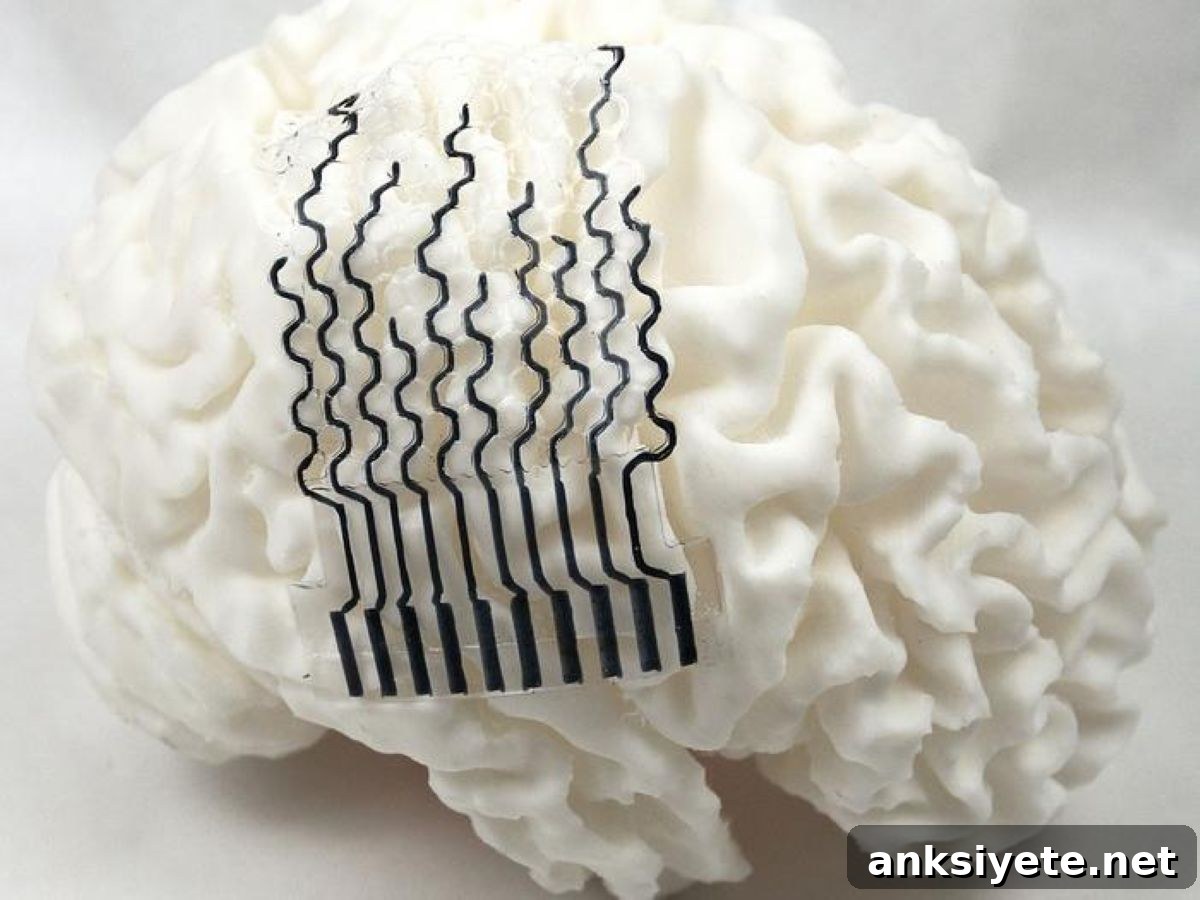
Summary: No two brains are shaped exactly the same, yet many neural implants follow a one-size-fits-all approach. Penn State researchers report a method to 3D print soft, stretchable, patient-specific bioelectrodes that conform to the unique ridges (gyri) and grooves (sulci) of an individual brain.
These hydrogel-based sensors achieve near-perfect contact with the cortex, improving signal quality while avoiding tissue damage and preserving fluid transport around the brain.
Key Findings
- Improved Signal Quality: Electrodes tailored to each brain’s surface geometry maintain highly reliable electrical contact, yielding higher-quality recordings for monitoring neural activity and disease.
- Biocompatibility: In rat studies the sensors functioned for 28 days without eliciting an immune response, indicating strong compatibility for chronic use.
- Large, Folded Surface: An adult human brain, when flattened, covers roughly 2,000 cm²—about the area of two large pizzas. The 3D-printed mesh design is the first to comfortably accommodate this highly folded anatomy.
- Scalable Manufacturing: The workflow combines MRI-based modeling, finite element design optimization, and direct ink writing to enable faster, lower-cost production of patient-specific electrodes at scale.
Source: Penn State
Soft electrodes that match a person’s brain surface may advance neural interfaces for monitoring and treating neurodegenerative disease, according to a Penn State-led study.
Neural interfaces rely on bioelectrodes—tiny sensors that detect electrical and physiological signals. Traditional electrodes are often rigid and generic in shape, which limits contact with the brain’s complex, folded surface and can lead to poor signal fidelity and tissue irritation.
Penn State researchers developed a new approach to 3D print hydrogel-based bioelectrodes that stretch and morph to fit each brain’s individual topography. Their platform integrates MRI-derived anatomical models, finite element analysis (FEA) for mechanical optimization, and direct ink writing (DIW) 3D printing to produce honeycomb-inspired, tissue-like electrodes customized to the patient.
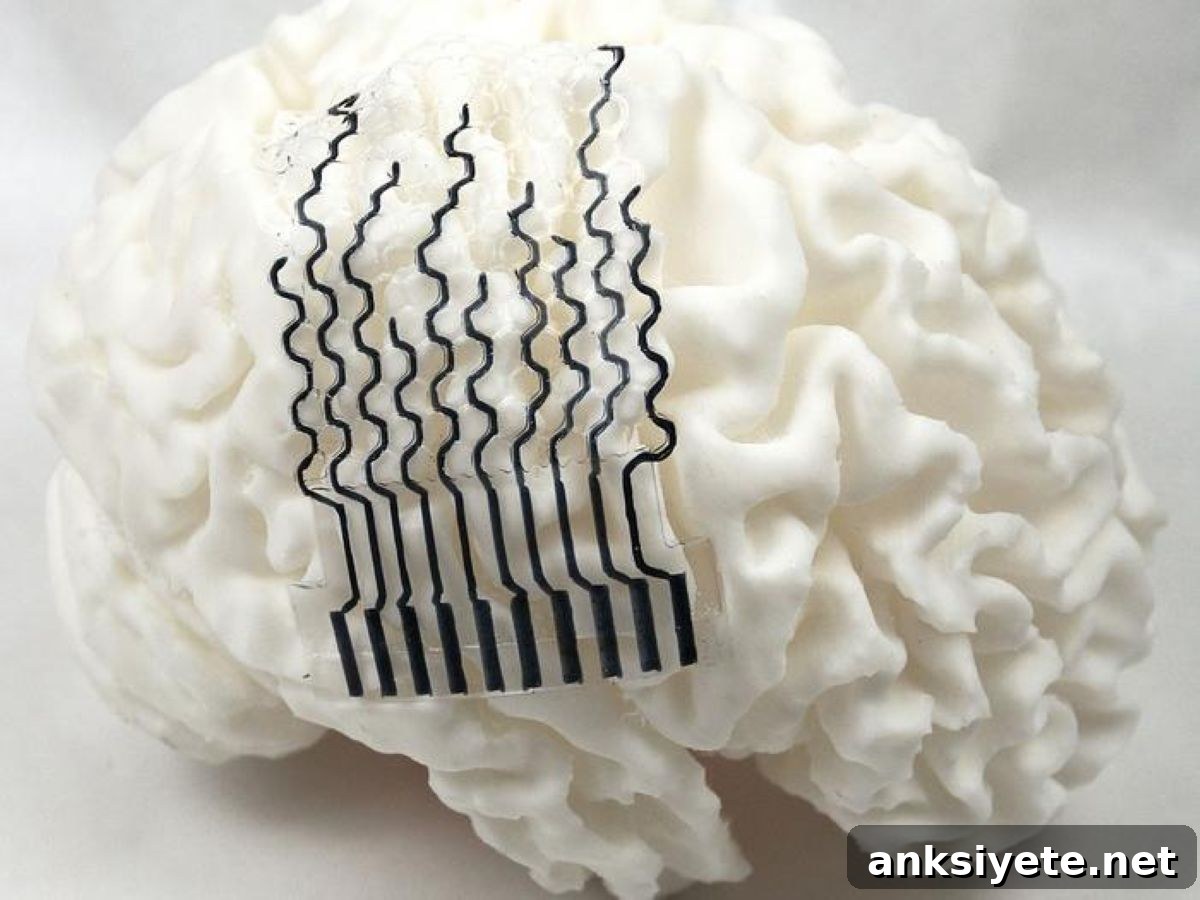
The team simulated cortical geometry from MRI scans of 21 human participants and used those models to design electrodes that match individual gyri and sulci. They 3D printed both the hydrogel electrodes and physical brain models to test how closely the devices conform to the surface.
Published in Advanced Materials, the study shows these honeycomb-inspired printable gel electrodes (HiPGE) conform far better than standard designs while maintaining mechanical strength, signal sensitivity, and long-term stability—even in animal tests.
Gyrification—the folding of the cortical sheet into gyri and sulci—allows a large cortical surface to fit within the skull and supports rapid neural communication. While major folding patterns are broadly similar across people, the exact layout of gyri and sulci differs considerably between individuals. Those fine differences motivated the team to pursue patient-specific electrode geometries rather than off-the-shelf shapes.
Hydrogel was chosen as the base material because its water-rich composition matches the softness of brain tissue. The honeycomb lattice reduces effective stiffness while preserving strength, lowering material use and printing time and improving conformability to deep grooves without tearing.
Workflow begins with an MRI scan used to produce a 3D anatomical model. Finite element analysis informs the electrode design so its bending stiffness aligns with cortical tissue (in the range of roughly 0.1–10 kPa). The optimized pattern is then printed by direct ink writing, creating a thin, stretchable mesh that can be applied to the cortical surface.
Compared with fabrication methods that require clean-room lithography, direct 3D printing enables rapid, low-cost customization. In physical tests on 21 printed brain models, the hydrogel electrodes closely matched surface geometry and maintained electrical connectivity across the cortex.
Because the electrodes are soft and malleable, they can contact the brain with less mechanical mismatch than rigid arrays, reducing the risk of tissue injury. The design also preserves fluid transport at the brain surface, an important factor often disrupted by stiffer implants.
In rodent experiments, the devices provided stable recordings for 28 days with no detectable immune response and no loss of performance, demonstrating both sensitivity to physiological signals and long-term compatibility in vivo.
The authors suggest this integrated platform could serve as a blueprint for commercial-scale production of patient-specific neural interfaces. While initial applications focus on clinical monitoring and treatment of conditions such as Parkinson’s disease and epilepsy, the method also opens possibilities for more comfortable consumer neural interfaces over time.
“Personalizing electrodes to match each brain’s surface improves connectivity and signal quality,” said Tao Zhou, corresponding author and Wormley Family Early Career Professor. “We aim to refine the technology to detect disease-specific signals and to move toward clinical collaboration with patients.”
Additional Penn State contributors include Nanyin Zhang, Sulin Zhang, doctoral candidates Marzia Momin, Luyi Feng, Salahuddin Ahmed, Jiashu Ren, Xiaoai Chen, Hyunjin Lee, Samuel R. Cramer, Xinyi Wang, Basma AlMahood, Li-Pang Huang, and others listed in the published paper.
Funding: Supported by the U.S. National Science Foundation and the National Institutes of Health.
Key Questions Answered:
A: They are primarily hydrogel, a water-rich material whose softness and stretchability let the electrode move with the brain’s natural motion so it behaves more like tissue than a foreign object.
A: The current emphasis is medical—monitoring and treating neurological disorders—but the low cost and speed of 3D printing make consumer-oriented, custom-fit interfaces a plausible future direction.
A: The honeycomb geometry provides high mechanical efficiency—good strength with minimal material—so the electrode is robust enough to handle while remaining flexible enough to conform to deep cortical sulci.
Editorial Notes:
- This article was edited by a Neuroscience News editor.
- The journal paper was reviewed in full.
- Additional context was provided by editorial staff.
About this neurotech research news
Author: Ty Tkacik
Source: Penn State
Contact: Ty Tkacik – Penn State
Image: Credit to Tao Zhou
Original Research: Open access. “3D-Printable, Honeycomb-Inspired Tissue-Like Bioelectrodes for Patient-Specific Neural Interface” by Marzia Momin et al., published in Advanced Materials. DOI: 10.1002/adma.202516291
Abstract
3D-Printable, Honeycomb-Inspired Tissue-Like Bioelectrodes for Patient-Specific Neural Interface
The brain’s individualized gyral patterns require patient-specific neural interfaces to improve neuromodulation precision, minimize adverse tissue reactions, and enhance therapeutic safety and efficacy. Conventional rigid electrocorticography (ECoG) electrodes, produced by lithographic methods, lack conformability to the cortex’s variable topography, leading to poor contact, signal loss, and foreign-body responses.
To overcome these limits, the team combined MRI-based anatomical mapping, finite element analysis–guided mechanical optimization, and direct ink writing 3D printing to fabricate honeycomb-structured, ultra-soft hydrogel electrodes that match cortical bending stiffness while remaining durable and scalable. This platform offers a pathway to more precise, biocompatible, and functionally robust neural interfaces for neuromodulation and neuroprosthetic applications.