
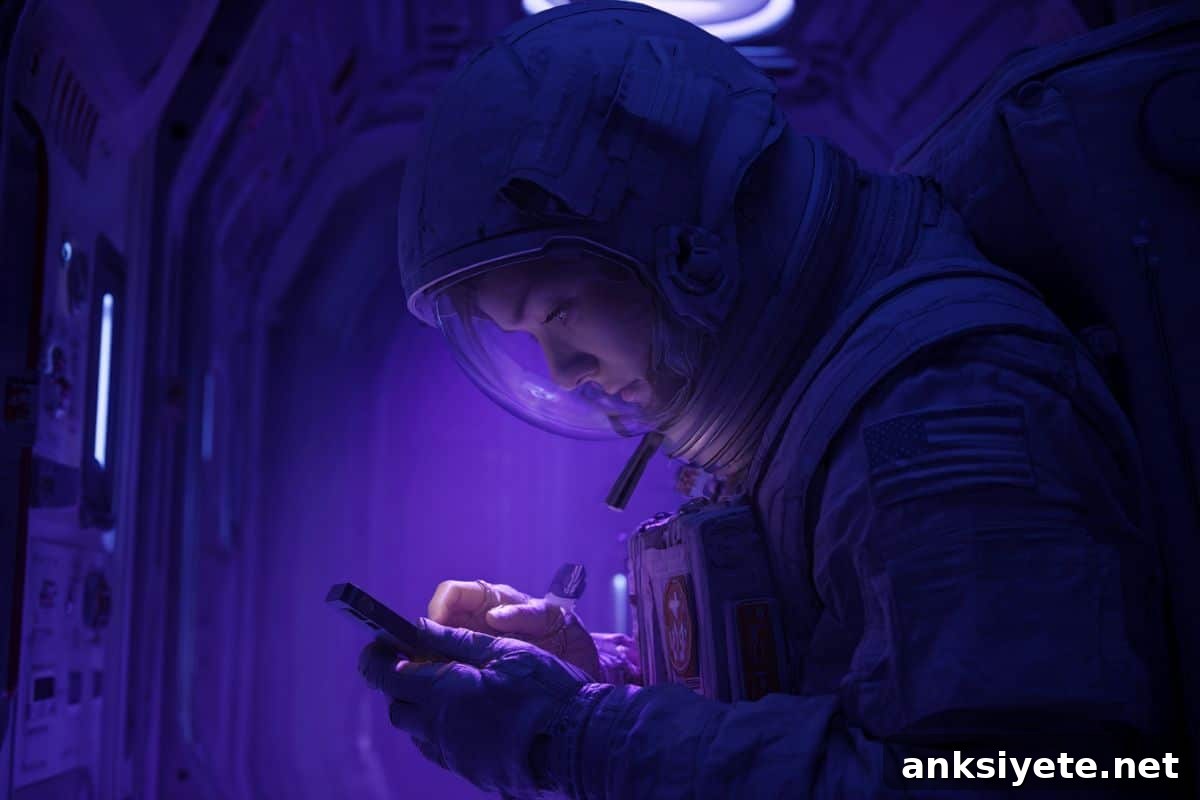
Summary: Maintaining sharp cognitive performance during space missions or overnight shifts depends on knowing your internal clock. Researchers have created an inexpensive, 15-minute blood test that lets astronauts and shift workers check their circadian timing with a single drop of blood, a paper strip and a smartphone-based reader.
The method is a paper-based lateral flow test strip that uses bright europium fluorescent nanoparticles to measure melatonin with laboratory-grade sensitivity, pinpointing the start of a person’s physiological night.
Key Facts
- Target users: The technology was developed with NASA astronauts in mind, because spaceflight disrupts the normal 24-hour light/dark cycle and can cause circadian dysregulation that impairs brain function.
- Physiological night (DLMO): The test detects the dim-light melatonin onset (DLMO) — the precise moment the biological clock shifts from supporting alertness to signaling night — which is crucial for planning high-stakes tasks.
- Immediate results: Unlike current melatonin assays that require specialized labs, this system provides on-the-spot results suitable for use on stations, in the field, or at emergency response sites.
- Wider uses: Beyond spaceflight, the test is being validated for clinical applications such as diagnosing and treating circadian rhythm sleep disorders and monitoring first responders exposed to smoke or irregular schedules.
- Future goal: The team envisions evolving the platform into a continuous melatonin-monitoring solution similar to continuous glucose monitors used by people with diabetes.
Source: Washington State University
A compact melatonin test developed at Washington State University can measure an individual’s circadian timing in under 15 minutes using only a drop of blood, a lateral flow test strip and a smartphone reader.
An interdisciplinary WSU team engineered a low-cost assay that combines europium-based fluorescent nanoparticles with a paper strip and a 3D-printed fluorescence reader that attaches to a smartphone. The reader quantifies melatonin levels at concentrations relevant to identifying the onset of physiological night.
Circadian rhythms govern daily cycles across the body — from sleep and alertness to metabolism and cognitive performance. When natural light-dark cues are absent or irregular, as in spaceflight or many shift-work environments, the central clock can become misaligned, reducing reaction time and decision-making ability. Accurate, rapid measurement of melatonin — the hormone that signals biological night — provides objective data about that alignment.
Published in Nanoscale Horizons, the study presents a europium nanoparticle lateral flow immunoassay (EuNP-LFIA) integrated with a 3D-printed smartphone fluorescence reader. The system delivers quantitative melatonin readings rather than a simple positive/negative result, enabling precise determination of an individual’s dim-light melatonin onset (DLMO).
“A main motivation is monitoring astronauts’ circadian cycles,” said Annie Du, research professor in the College of Pharmacy and Pharmaceutical Sciences and corresponding author. “We focused on a sensing method combined with a smartphone reader so measurements can be taken immediately without sending blood to a lab.”
Melatonin is secreted by the pineal gland, rising in the evening and falling in the morning. Under dim-light conditions, the time when plasma melatonin rises above about 10 pg mL−1 is widely accepted as the start of physiological night. Detecting these low concentrations in blood has historically required expensive equipment and trained personnel, or suffered from insufficient sensitivity for point-of-need use.
To overcome those limits, the WSU team used europium nanoparticles because of their strong fluorescent signal. The nanoparticles, combined with an optimized lateral flow strip and a light-shielding 3D-printed phone reader, enabled sensitive detection at levels comparable to laboratory assays. The optimized platform achieved a limit of detection of 9.99 pg mL−1 and delivered reliable recovery rates for melatonin-spiked plasma, demonstrating repeatability and robustness for real samples.
Researchers are now validating the device using plasma samples collected through WSU’s Sleep and Performance Research Center. The broader aim is to translate this approach into routine clinical and operational use — from diagnosing circadian sleep disorders and tailoring light or melatonin therapies, to helping shift workers and emergency responders manage sleepiness and performance.
The project combined expertise in pharmaceutical sciences, engineering and sleep research. Co-authors include Zhansen Yang, Xinyi Li, Hans Van Dongen, Yuehe Lin, Yang Song and Dan Du. Funding was partially provided by the NASA-supported Washington Biology in Space Consortium, BioS-ENDURES.
Key Questions Answered:
A: In orbit an astronaut may experience many sunrises and sunsets each day, which can desynchronize the brain’s internal clock. An individual can feel alert yet perform like someone who is sleep-deprived. This test provides objective, biological evidence of when the brain is entering “night mode.”
A: Potentially yes. Many treatments for circadian rhythm sleep disorders rely on estimated timing of melatonin or light exposure. Direct measurement of DLMO would let clinicians and apps time interventions more precisely.
A: In this system, the accuracy is achieved by combining very bright europium nanoparticles with a 3D-printed reader that blocks stray light. That combination enables detection of melatonin at concentrations on the order of picograms per milliliter, comparable to lab assays.
Editorial Notes:
- This article was edited by a Neuroscience News editor.
- The journal paper was reviewed in full.
- Additional context was added by editorial staff.
About this neurotech and circadian rhythm research news
Author: Shawn Vestal
Source: Washington State University
Contact: Shawn Vestal – Washington State University
Image: The image is credited to Neuroscience News
Original Research: Closed access. “Europium nanoparticle label/lateral flow test strip integrated with a 3D-printed fluorescence smartphone reader for detection of melatonin in human blood” by Zhansen Yang, Xinyi Li, Hans P. A. Van Dongen, Yuehe Lin, Yang Song, and Dan Du. Nanoscale Horizons
DOI: 10.1039/D5NH00853K
Abstract
Europium nanoparticle label/lateral flow test strip integrated with a 3D-printed fluorescence smartphone reader for detection of melatonin in human blood
Melatonin secretion by the pineal gland occurs mainly at night, but bright ocular light suppresses its release. Measured under dim light, plasma melatonin is a reliable marker of the central circadian pacemaker. The evening onset of melatonin secretion — typically defined when plasma concentration exceeds about 10 pg mL−1 — is considered the gold-standard indicator of physiological night.
Conventional melatonin assays require costly instrumentation and trained personnel, or they lack the sensitivity and resistance to interference needed for point-of-need applications. To address these limitations, the authors developed a europium nanoparticle-based lateral flow immunoassay integrated with a 3D-printed smartphone fluorescence reader for on-site plasma melatonin detection.
Six parameters — readout time, europium nanoparticle size, antibody conjugation density, Tween-20 concentration, nanoparticle deposition volume, and the concentration of melatonin–bovine serum albumin on the nitrocellulose membrane — were optimized. After optimization, the platform demonstrated high sensitivity with a limit of detection of 9.99 pg mL−1. For melatonin-spiked plasma samples, recovery rates ranged from 82.58% to 114.70%, indicating strong repeatability and reliability.
Overall, the method provides a sensitive, accurate, portable and rapid (<15 min) approach for real-time plasma melatonin monitoring, suitable for operational and clinical point-of-need settings.