
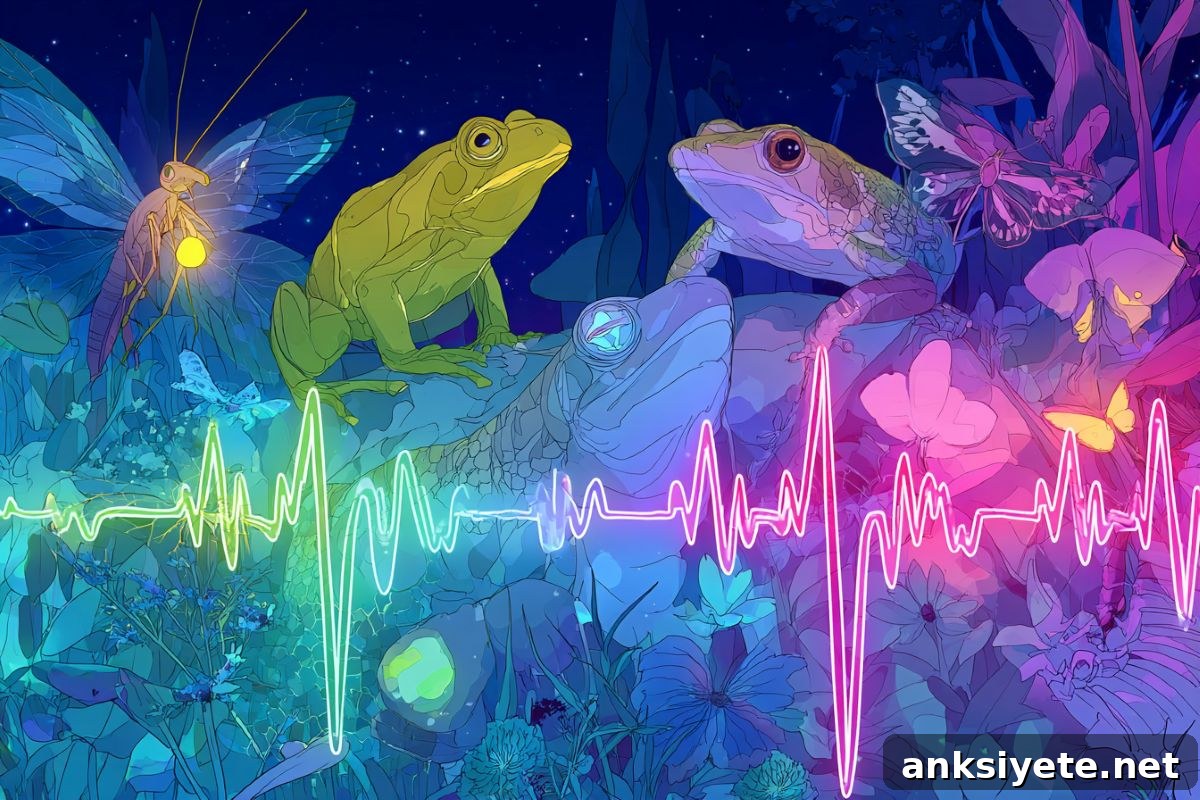
Summary: From the blinking of fireflies and the chirping of crickets to the steady pulse of pop music, many communication signals in nature appear to follow a shared rhythm. New research suggests a common tempo — close to 2 hertz (two pulses per second) — may reflect a neural preference shared across diverse species.
A Northwestern University study analyzed rhythmic signals from animals that communicate with light, sound, movement and touch. The researchers found a consistent concentration of signaling tempos near 2 Hz and propose that this pattern arises because nervous systems are especially well suited to process inputs at that pace. In other words, around two beats per second may be a biologically efficient “sweet spot” for sending and receiving information.
Key Facts
- Body size is not the driver: The clustering near 2 Hz appears across very small and very large animals, implying the limit is neural rather than mechanical.
- Faster is possible but less common: Many species can produce much faster signals (for example, a startled firefly flickers rapidly), but they default to a slower tempo for routine social communication.
- Human rhythms align: Popular music and human walking cadence often fall near 120 beats per minute (2 Hz), matching the tempo band observed in animal signaling and in neural responsiveness.
- Modeling support: Simple computational models of neural circuits show the strongest responses to inputs in a narrow band roughly between 0.5 and 4 Hz, consistent with the empirical observations.
Source: Northwestern University
Overview
Although animals use very different modes of signaling — flashing lights, calls, trills, visual displays and dances — the tempo at which many of these signals repeat clusters in a surprisingly narrow range. The new study reports that many communication rhythms center around about 2 hertz, suggesting a widespread neural tuning that favors this timing. This shared tempo could help receivers detect and interpret signals more reliably, and it may partly explain why human music and speech rhythms are perceived as natural or compelling.
The study, published in PLOS Biology, was led by Guy Amichay and senior author Daniel M. Abrams at Northwestern, with co-author Vijay Balasubramanian from the University of Pennsylvania. The team combined field observations, literature surveys and computational modeling to test the hypothesis that a common neural timescale underlies the prevalence of these tempos.
“We observed an abundance of organisms signaling within a relatively narrow band of tempos,” said Guy Amichay. “They cluster around 2 or maybe 3 hertz. Physically, many could signal faster, yet they do not for social communication.”
Amichay and Abrams argue this pattern reflects a resonance between signal timing and neural processing. “The tempo itself may not carry the message,” Abrams said, “but it creates a carrier rhythm that captures attention, allowing the content layered on top to be transmitted more effectively — much like notes in a song follow a beat.”
Interactions between light and sound
The investigation began during fieldwork in Thailand, where the researchers filmed swarms of flashing fireflies and noticed the nearby crickets chirped at a similar pace. Detailed analysis showed the animals were not synchronizing with each other; rather, independent species commonly produced signals at similar tempos — roughly two to three pulses per second.
Expanding their scope, the team reviewed published data on many species — fireflies, crickets, frogs, birds, fish and mammals. Despite differences in communication mode, habitat and body size, many species repeat signals within about 0.5 to 4 Hz. This convergence across modalities supports the idea of a shared constraint rooted in receiver physiology rather than in the mechanics of signal production.
“When a firefly is threatened it can flicker much faster, so biomechanics are not the limiting factor,” Amichay noted. “That suggests a deeper, possibly neural, reason for the common tempo used in social messaging.”
From crickets to concerts
The team connected these behavioral patterns to basic neuronal biophysics. Individual neurons need time to integrate inputs before firing again, creating a natural timescale on the order of hundreds of milliseconds. The researchers built simple models of neural circuits and found these circuits responded most strongly to periodic inputs occurring about twice per second — the same band seen in animal communication.
The observation helps explain why human cultural rhythms, such as much of popular music at 120 BPM, feel natural: our nervous systems are tuned to a similar temporal window. “We walk roughly at this pace and find it easy to move or dance to music at this tempo,” Amichay said, adding that more experimental music can and does use different tempos.
The authors encourage additional research to broaden species sampling and to measure brain responses directly to different communication rhythms. Such work could clarify whether this tempo is a fundamental feature of neural systems and how it shapes social behavior across the animal kingdom.
Funding: The study, titled “A universal animal communication tempo resonates with the receiver’s brain,” received support from the Northwestern Institute on Complex Systems (NICO), the Buffett Institute for Global Affairs and the National Institute for Theory and Mathematics in Biology (NITMB).
Key Questions Answered:
A: Biologically speaking, yes. Many animals’ nervous systems process signals most easily near 2 Hz, just as human neurons favor that timing. That shared neural timing can make rhythms feel natural across species, even if the animals are not consciously matching each other.
A: Human speech and other communications often use rhythms near 2–3 Hz, but content, context and communicative goals vary. The tempo serves as a scaffold; content such as words or melodic notes is layered on top and can stretch faster or slower when needed.
A: The findings suggest a practical starting point. Using signals that fall near the 2 Hz band may be more likely to attract and hold an animal’s attention because it aligns with the temporal preferences of their nervous systems.
Editorial Notes:
- This article was edited by a Neuroscience News editor.
- The journal paper was reviewed in full by the editorial team.
- Additional context was added by staff to clarify the study’s methods and implications.
About this neuroscience research news
Author: Amanda Morris
Source: Northwestern University
Contact: Amanda Morris, Northwestern University
Image: The image is credited to Neuroscience News
Original Research: Open access. A widespread animal communication tempo may resonate with the receiver’s brain by Guy Amichay, Vijay Balasubramanian, and Daniel M. Abrams. PLOS Biology. DOI: 10.1371/journal.pbio.3003735
Abstract
A widespread animal communication tempo may resonate with the receiver’s brain
During fieldwork in Thailand, researchers observed similar tempos in co-located flashing fireflies and chirping crickets. Motivated by this finding, they surveyed published data and found that many evolutionarily distinct species communicate isochronously in a roughly 0.5–4 Hz range, suggesting a tempo “hotspot.” The authors hypothesize this timescale may originate in the biophysics of receiver neurons and test the idea with simple receiver circuit models that show heightened responsiveness within the observed tempo band.