
Summary: Adding more robots to a task usually speeds things up—until it doesn’t. In crowded environments robotic swarms often reach a tipping point where they block one another and progress grinds to a halt. A new study finds a counterintuitive fix: introduce the right amount of randomness, or “noise,” into each robot’s motion. That small, deliberate variability prevents persistent jams, letting the group self-organize and complete tasks far more efficiently.
Researchers combined mathematics, large-scale simulations, and physical experiments to show that a tunable amount of wandering in individual paths reduces long-lived traffic jams while preserving high throughput. The result is a simple, local strategy for coordinated swarms that avoids heavy central planning and performs well across many real-world scenarios.
Key Facts
- Randomness increases predictability: When noise is significant, average behaviors emerge that can be captured with mathematical formulas. Those averages let researchers derive explicit estimates for how quickly goals are attained by the swarm.
- No central supercomputer required: The study shows that straightforward local navigation rules, augmented by modest random perturbations, can produce coordinated outcomes without a top-down planner or highly sophisticated onboard AI.
- Validated in theory and practice: Findings are supported by analytical work, extensive simulations, and laboratory tests with small wheeled robots.
- Self-organization at work: This behavior is an example of active matter—systems like ant colonies or animal herds—where simple interactions generate functional group-level patterns.
- Practical impact: The formulas and principles developed could guide the design of automated warehouses, environmental cleanup swarms, and safer pedestrian flow in crowded public spaces.
Source: Harvard
Imagine a fleet of robots tasked with cleaning an oil spill or assembling parts under time pressure. At first, adding robots speeds the job, but beyond a certain density they begin to obstruct one another and the system slows. The central question is: given a fixed workspace, how many robots and what motion strategy maximize task throughput?
Led by applied mathematics doctoral student Lucy Liu in the lab of L. Mahadevan, this research demonstrates that introducing a controlled level of stochasticity into each agent’s trajectory resolves the gridlock problem. Agents that incorporate small, random deviations—what the team calls “noise” or “wiggle”—can pivot and slip past one another instead of forming permanent blockades.
The approach blends analytical models with simulation and hands-on experiments. In simulations, agents repeatedly started at random positions and received new random target locations upon arrival, mimicking continuous task assignments. With no noise, agents traveled straight to targets and frequently became trapped in dense, stable jams. With very high noise, agents avoided jams entirely but wasted time wandering. Between these extremes lies a “Goldilocks” zone where short-lived congestion forms and quickly dissolves, maximizing the number of goals reached per unit time.
From these observations the team derived formulas for the swarm’s goal attainment rate and identified optimal combinations of agent density and noise level. These formulas make it possible to predict and tune system performance for different operational constraints.
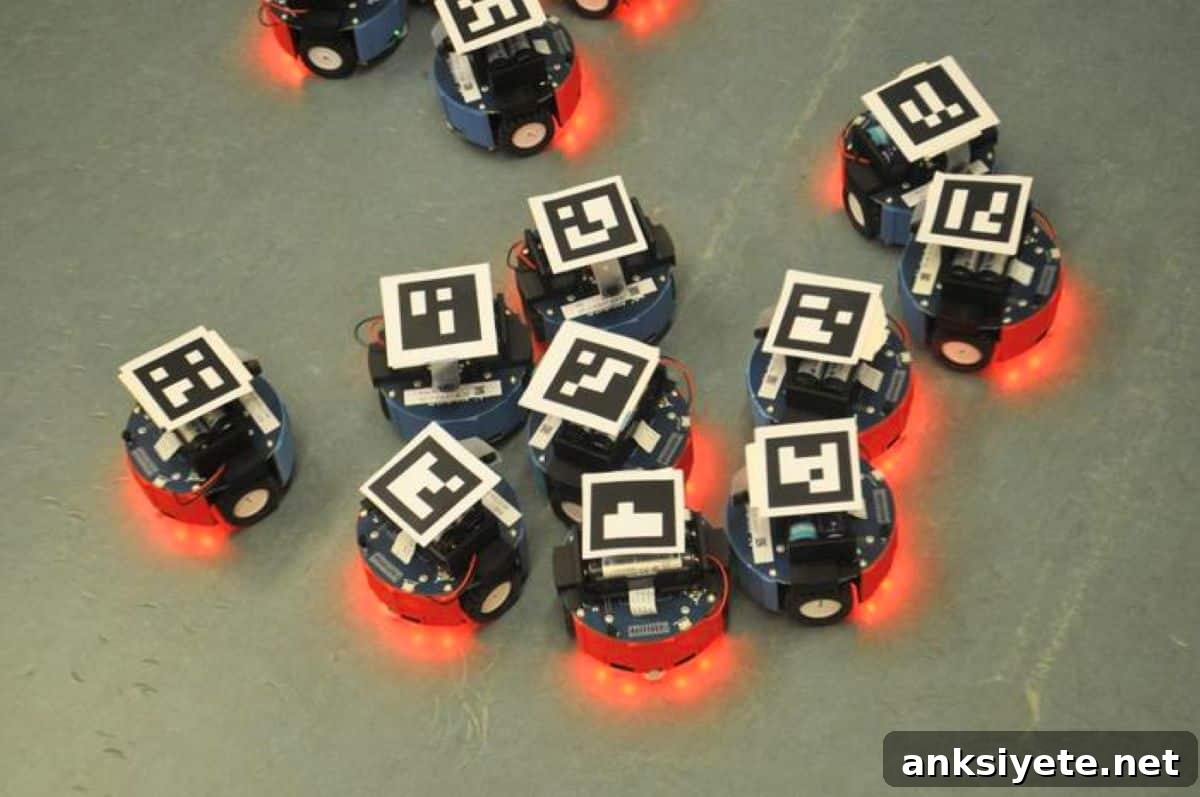
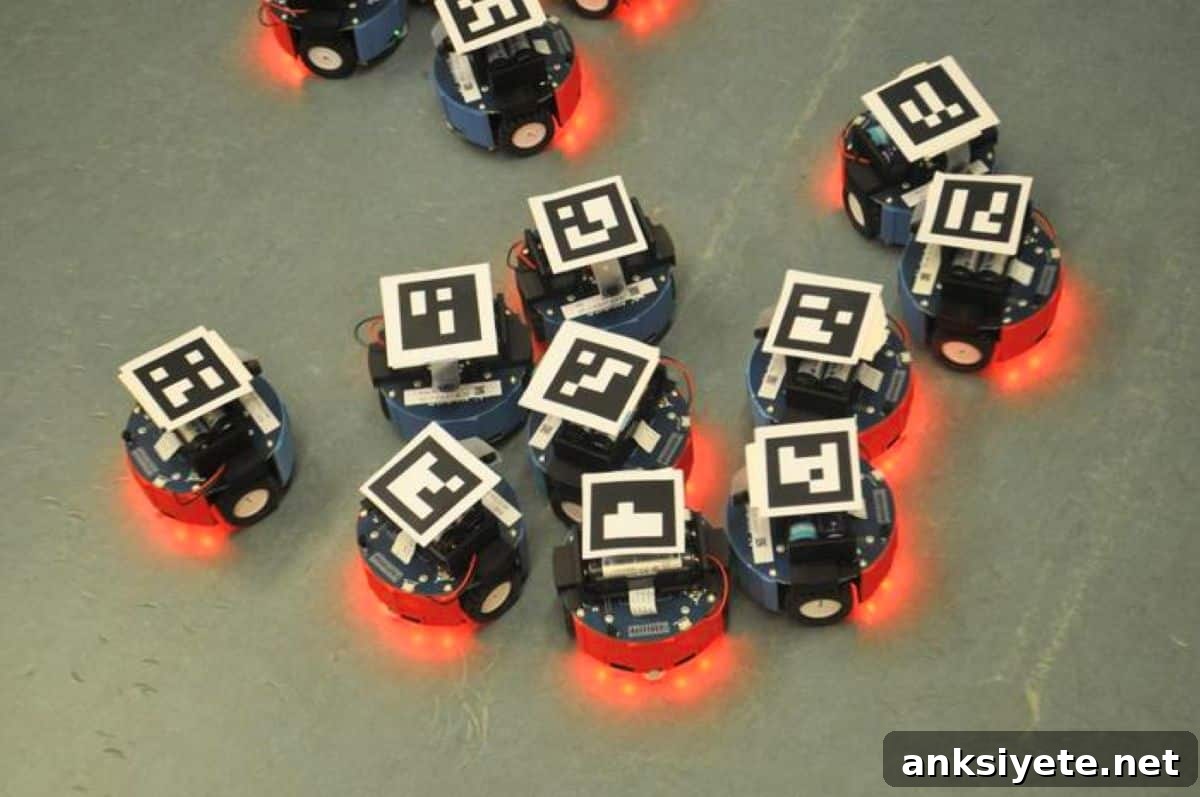
To test whether the theory holds in real hardware, Liu collaborated with physicist Federico Toschi at Eindhoven University of Technology, working with small wheeled robots tracked by an overhead camera. Each robot carried an identification marker so positions could be monitored and new targets assigned. Although physical robots move more slowly and noisily than simulated agents, the qualitative behaviors matched the models: an intermediate noise level reduced persistent jams while preserving overall efficiency.
A central insight is that decentralized, reactive strategies can match or exceed more computationally expensive centralized planners up to moderate densities. A simple local rule plus tuned randomness yields robust, scalable coordination and far less computational overhead than calculating many simultaneous collision-free paths from a single controller.
“Understanding how active matter—whether swarms of robots, animal groups, or crowds of people—becomes functional in crowded settings through self-organization is relevant across fields,” said L. Mahadevan. The team suggests the approach could inform designs that intentionally nudge systems into the efficient operating region, whether for robots, vehicles, or human crowds.
Lucy Liu emphasizes the safety and design applications: mathematically predicted crowd dynamics could guide architects and engineers in tuning physical spaces and control policies to avoid dangerous crushes or delays while preserving throughput.
Funding: The research was supported by the National Science Foundation Graduate Research Fellowship Program (Grant No. DGE 2140743), the Simons Foundation, and the Henri Seydoux Fund.
Key Questions Answered:
A: It’s not aimlessness but flexibility. In tight spaces, straight-line motion can create immovable barriers. Small, random deviations let agents pivot and slide past each other, turning permanent jams into transient clusters and keeping traffic flowing.
A: Often, yes. The study indicates that simple, local navigation rules combined with controlled noise can achieve high performance without heavy central computation, especially at moderate densities.
A: Potentially. The principles apply to active systems broadly. By designing spaces and guidance systems that encourage the right amount of local variability, planners could nudge crowds toward the efficient “Goldilocks” regime and reduce dangerous congestion.
Editorial Notes:
- This article was edited by a Neuroscience News editor.
- Journal paper reviewed in full.
- Additional context added by editorial staff.
About this robotics and neurotech research news
Author: Anne Manning (Harvard)
Source: Harvard
Contact: Anne Manning, Harvard
Image credit: Lucy Liu / Harvard SEAS
Original Research: Closed access. “Noise-enabled goal attainment in crowded collectives” by Lucy Liu, Justin Werfel, Federico Toschi, and L. Mahadevan. PNAS. DOI: 10.1073/pnas.2519032123
Abstract
Noise-enabled goal attainment in crowded collectives
In crowded environments, individuals must navigate around others to reach their destinations. Controlling traffic in these settings matters for coordinating robot swarms and designing infrastructure for dense populations. Using simulations, theory, and experiments, this study shows how adding controlled stochasticity to agent motion reduces long-lived jams and helps agents reach assigned goals more quickly.
Above a critical noise threshold, large, persistent jams disappear. From that observation the authors derive analytical approximations for the swarm’s goal attainment rate, enabling calculation of the agent density and noise level that maximize throughput. Robotic experiments corroborate the simulated and theoretical results. Comparing simple local navigation to a sophisticated central planner, the study finds that reactive decentralized schemes perform well up to moderate densities while requiring far less computation, pointing to robust, scalable strategies for crowded environments.
By integrating concepts from physics and engineering across simulations, theory, and experiments, this work highlights new directions for emergent traffic research and practical design of coordinated collectives.