
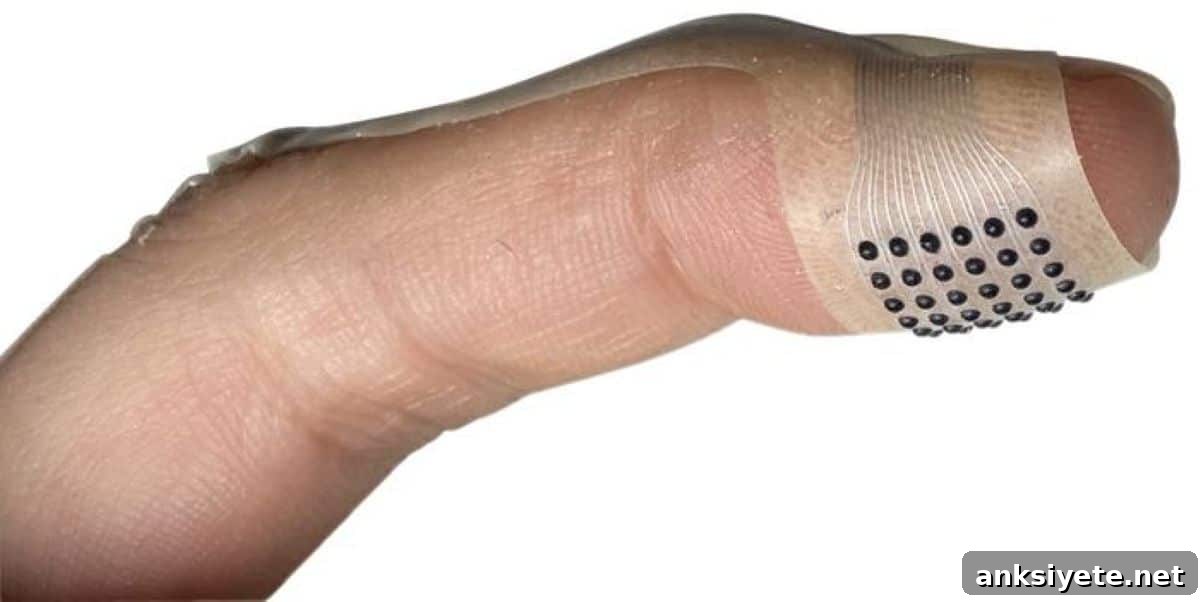
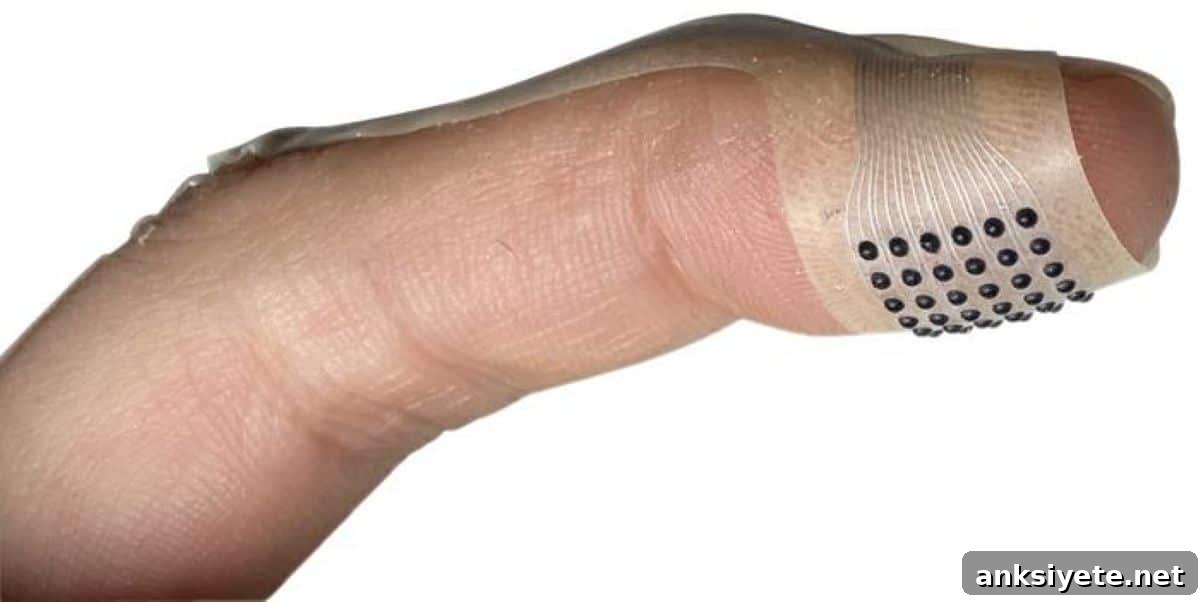
Summary: Engineers have created VoxeLite, the first wearable haptic device that reaches the sensitivity of the human fingertip. Built as a paper-thin, flexible bandage for the finger, it uses dense electroadhesive “pixels of touch” to recreate fine textures and directional cues with lifelike precision.
VoxeLite overcomes two major barriers in haptics—spatial and temporal resolution—so users can feel digital surfaces with a clarity comparable to real ones. This advance promises more convincing virtual reality interactions, improved tactile guidance for accessibility, and new possibilities for touch-enabled digital experiences.
Key Facts
- Human-resolution touch: VoxeLite delivers fingertip-level spatial and temporal precision using tightly packed electroadhesive nodes.
- Ultra-thin and wearable: The device weighs less than one gram and conforms to the skin without blocking natural touch.
- Broad applications: Enhances VR, accessibility tools, advanced interfaces, and human-robot control with realistic tactile cues.
Source: Northwestern University
Northwestern University engineers have developed the first haptic device that achieves “human resolution,” matching the sensing abilities of the human fingertip.
Called VoxeLite, the ultra-thin, lightweight, and flexible wearable recreates touch sensations with the clarity, detail and speed that skin naturally detects. Worn like a small bandage around the fingertip, VoxeLite brings digital touch closer to the realism users expect from today’s visual and audio displays.
By combining high spatial density with a comfortable, wearable form, VoxeLite could change how people interact with digital spaces. Potential uses include immersive virtual reality, assistive technology for people with vision impairments, tactile interfaces for touchscreen devices, and refined human-robot interfaces.
The study describing the device is scheduled for publication in Science Advances.
“Touch is the last major sense without a true digital interface,” said Sylvia Tan of Northwestern, who led the research.
“We already have technologies that render sight and sound convincingly. VoxeLite brings textures and tactile sensations closer to that same level of realism, while remaining comfortable enough for extended wear—like wearing glasses all day without noticing them.”
J. Edward Colgate, a senior author and a pioneer in haptics, called the work a major scientific breakthrough: “For the first time, a technology achieves both the spatial and temporal resolution comparable to the sensory system of the fingertip.”
Colgate and co-senior author Michael Peshkin are faculty at Northwestern’s McCormick School of Engineering and long-time collaborators in haptics. Tan is a Ph.D. student at the university’s Center for Robotics and Biosystems, advised by Colgate and Peshkin.
Challenges in haptics
While video and audio technologies reached high fidelity decades ago, digital touch has lagged. Most current haptic feedback is limited to simple vibrations and cannot convey the rich, high-resolution information that human fingertips naturally sense. This shortfall stems from the difficulty of reproducing both the fine spatial detail and the rapid temporal dynamics of touch.
“Think of early films with low frame rates—movement looked jerky. That’s low temporal resolution,” Colgate explained. “Or early computer displays where images were pixelated—low spatial resolution. For touch, both problems have been hard to solve together.”
Pixels of touch
VoxeLite addresses these limits with an array of tiny, independently controlled actuators—soft rubber domes with a conductive outer layer and a hidden inner electrode—embedded in a thin, stretchable sheet. When a small voltage is applied, each node generates electroadhesion, similar to how a rubbed balloon sticks to a wall. That force allows each node to grip a surface and tilt, producing a localized mechanical indentation on the skin.
Previously, the research team used electroadhesion to modulate friction on touchscreens, creating texture illusions without moving parts. VoxeLite advances that approach by adding fast, localized motion: each node can press into skin, creating distinct tactile “pixels” that vary in intensity and timing. Higher voltages increase friction and produce stronger tactile cues; lower voltages reduce friction for smoother sensations.
“When swiped across a grounded surface, the device controls friction at each node, enabling controlled skin indentation,” Colgate said. “Past systems were bulky and complex. VoxeLite weighs less than a gram.”
Achieving human acuity
To reach fingertip resolution, the team packed nodes tightly. The highest-density prototype had nodes about 1 millimeter apart; user tests used a 1.6-millimeter spacing. “Node density matters,” Tan said. “If nodes are too close, the fingertip perceives them as one; too far apart, and you lose detail. Matching human acuity requires the right spacing.”
VoxeLite operates in two modes. In active mode, nodes tilt and indent at high speed as a user moves across a smooth surface—up to 800 times per second—covering much of the frequency range of human tactile receptors. In passive mode, the device becomes effectively invisible: its thin, soft construction conforms to skin and does not obstruct natural touch, letting users switch easily between real and digital textures.
Perceiving virtual textures
In experiments, participants wearing VoxeLite reliably identified virtual textures, patterns and directional cues. They recognized directional patterns—up, down, left, right—with up to 87% accuracy and identified real fabrics such as leather, corduroy, and terry cloth with about 81% accuracy.
Future versions could pair with smartphones and tablets like wireless earbuds do today, turning flat screens into textured interfaces. Possible applications include more realistic online shopping where shoppers can feel fabrics remotely, tactile maps for people with vision loss, and richer haptic feedback in games and training simulations.
“The most exciting part is combining spatial and temporal resolution with true wearability,” Tan said. “Each of those challenges is hard on its own; solving all three opens up new ways to study how people perceive touch and to build practical tactile devices.”
Funding: The research, “Towards human-resolution haptics: a high bandwidth, high density, wearable tactile display,” was supported by the National Science Foundation (award numbers 2106191 and 2330040).
Key Questions Answered:
A: It delivers “human-resolution” tactile signals that match the fingertip’s natural spatial and temporal sensitivity.
A: By using dense arrays of tiny electroadhesive nodes that independently press into the skin at high speed.
A: Immersive VR, assistive tools for people with vision impairments, human-robot control, and advanced touchscreen interactions.
Editorial Notes:
- This article was edited by a Neuroscience News editor.
- Journal paper reviewed in full.
- Additional context provided by staff.
About this neurotech research news
Author: Amanda Morris
Source: Northwestern University
Contact: Amanda Morris – Northwestern University
Image: The image is credited to Sylvia Tan/Northwestern University
Original Research: Open access.
“Towards human-resolution haptics: A high bandwidth, high density, wearable tactile display” by Sylvia Tan et al., published in Science Advances.
Abstract
Towards human-resolution haptics: A high bandwidth, high density, wearable tactile display
Despite major advances in digitizing vision and hearing, touch still lacks an equivalent digital interface that matches human perceptual fidelity. That gap constrains the realism of virtual experiences and limits the quality of tactile information transmitted digitally.
Here we present a step toward human-resolution haptics: a wearable tactile display engineered to match the spatial and temporal acuity of the human fingertip.
VoxeLite is a 0.1-millimeter-thick, 0.19-gram, skin-conformal array of individually addressable soft electroadhesive actuators (“nodes”). As users touch and move across surfaces, VoxeLite delivers high-resolution, distributed forces through its nodes.
Built with scalable microfabrication methods, the display reaches densities up to 110 nodes per square centimeter, produces stimuli up to 800 hertz, and remains transparent to real-world tactile input.
We demonstrate its ability to render small hapticons and virtual textures and to transmit information about physical surfaces, validated through human psychophysics and biomimetic sensing.
These results position VoxeLite as a practical platform for human-resolution haptics in immersive interfaces, robotics, and digital touch communication.