
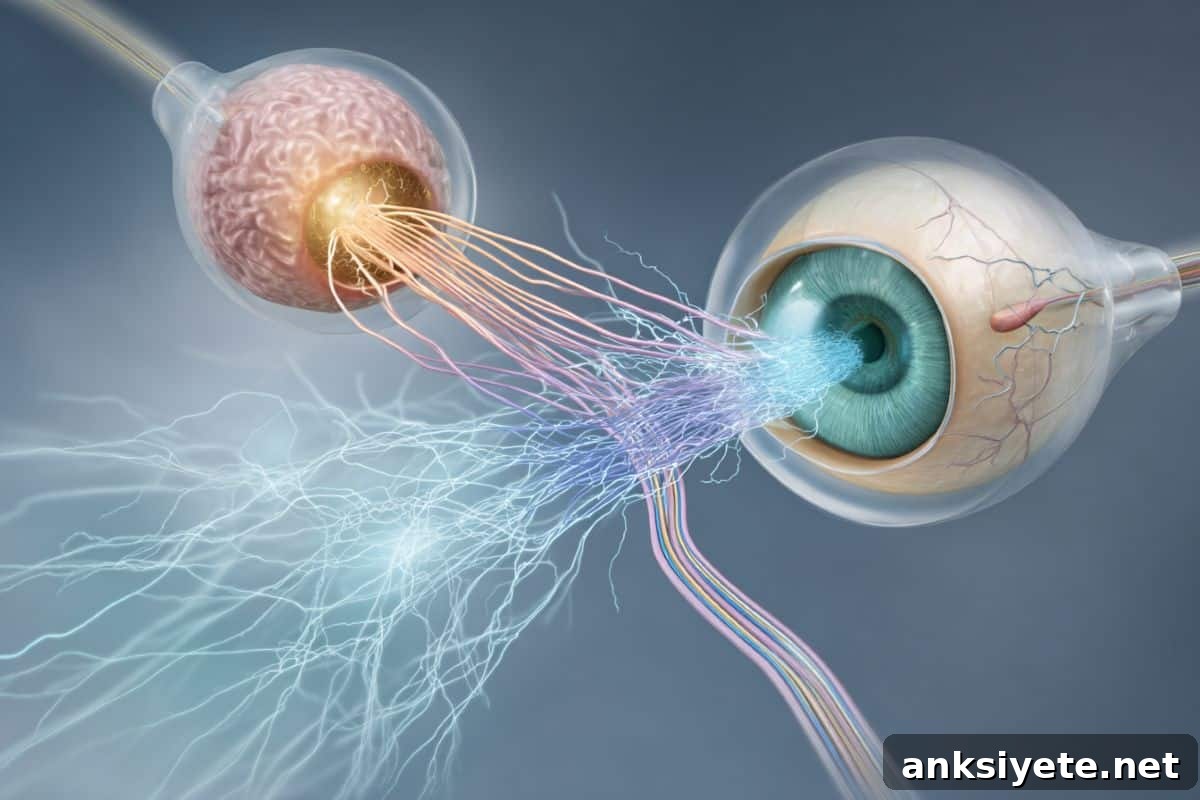
Summary: A new study in mice shows that briefly anesthetizing the retina of the weaker eye can restore its influence on the adult visual cortex. The treatment triggers a specific burst-firing pattern in thalamic relay neurons — a developmental activity mode that reopens plasticity even after the usual critical period has ended.
Crucially, the restorative effect occurs whether the amblyopic eye or the fellow eye is inactivated, indicating that directly treating the weaker eye may revive its cortical connections without interrupting the stronger eye. These results point toward a promising direction for adult amblyopia therapies once validated across species.
Key Facts
- Reversible retinal silencing: Short-term anesthesia of the amblyopic retina reactivates its neural pathways in adult animals.
- Burst firing is required: Recovery depends on T-type calcium channel–mediated bursts in thalamic (dorsal lateral geniculate nucleus, dLGN) neurons.
- Therapeutic potential: The approach may allow amblyopia treatment that restores the weaker eye without patching or suppressing the stronger eye, pending further validation.
Source: Picower Institute at MIT
Background: Amblyopia, a common developmental visual disorder, arises when impaired vision in one eye during a critical early period drives cortical connections to favor the other eye. Even after the original eye problem is corrected, the amblyopic eye often remains functionally weak because cortical circuits were shaped toward the stronger eye during development.
Standard therapies such as patching the better eye are effective mainly in infancy and early childhood while neural circuits remain highly plastic. Restoring vision in adulthood has been challenging because the critical period for visual plasticity is typically closed.
Researchers at the Picower Institute for Learning and Memory at MIT now report that a brief, reversible inactivation of a retina — achieved experimentally with a single injection of tetrodotoxin (TTX) — can restore cortical responsiveness to the previously deprived eye in adult mice. The findings, published in Cell Reports, clarify the neural mechanism behind this recovery and suggest new treatment options for adult amblyopia.
Earlier work from Mark Bear’s lab showed that inactivating the non-amblyopic eye could improve responses from the amblyopic eye, a strategy analogous to patching. Subsequent studies replicated recovery across adult animals of different species. The current study goes further by identifying the thalamic bursting mechanism and demonstrating that inactivating the amblyopic eye itself can also trigger recovery.
“If direct inactivation of the weaker eye works in higher species, it would be an important advance because it would avoid interrupting vision in the better eye during treatment,” said Mark Bear, faculty in MIT’s Department of Brain and Cognitive Sciences. He emphasized the need for validation in animals with visual systems closer to humans before clinical translation.
Mechanism — a beneficial burst
The lab investigated how retinal inactivation produces lasting cortical changes. An older observation in their archive showed that blocking retinal input to the lateral geniculate nucleus (LGN) can induce synchronous burst firing in LGN neurons — a pattern similar to activity present during early development that guides synapse formation.
In the current experiments, transient TTX inactivation of one retina induced high-frequency bursts in dLGN neurons that relay signals to visual cortex. Importantly, bursting appeared not only in neurons driven by the silenced eye but also in neurons driven by the fellow eye. The researchers traced this bursting to low-threshold T-type calcium channels in dLGN neurons (CaV3.1).
To test causality, they genetically removed CaV3.1 channels in dLGN neurons to prevent bursting. In those animals, retinal inactivation no longer produced recovery of cortical responses in amblyopic mice, demonstrating that thalamic bursting is necessary for the therapeutic effect.
Evidence for treating the amblyopic eye directly
Because bursting occurs when either retina is silenced, the team tested whether inactivating the amblyopic retina alone would suffice. In mice modeling long-term monocular deprivation, a two-day retinal block of the amblyopic eye followed by recovery produced a shift in cortical input balance: recordings showed the formerly weak eye’s contribution rose to parity with the stronger eye.
These results indicate that short-term retinal silencing triggers dLGN burst mode firing that restores synaptic strength in primary visual cortex (V1). The authors stress that further tests in additional species and safety studies are needed before considering clinical use in humans.
“We are cautiously optimistic that these findings may lead to a new treatment approach for human amblyopia, particularly given the discovery that silencing the amblyopic eye is effective,” the team wrote.
Lead author Madison Echavarri-Leet conducted this work as part of her doctoral thesis. Co-authors include Tushar Chauhan, Teresa Cramer and Ming-fai Fong. Funding came from the National Institutes of Health, the Swiss National Science Foundation, the Severin Hacker Vision Research Fund and the Freedom Together Foundation.
Key Questions Answered:
A: Temporarily silencing a retina induces restorative burst firing in thalamic relay neurons, which promotes plasticity and strengthens the amblyopic eye’s cortical inputs.
A: Instead of depriving the stronger eye, this method briefly suppresses the weaker eye to trigger thalamic bursting that revives its cortical connections without long-term disruption of the better eye.
A: Induction of burst-mode firing in dLGN neurons via T-type (CaV3.1) calcium channels drives synaptic plasticity in primary visual cortex that rebalances input from both eyes.
Editorial Notes:
- This article was edited by a Neuroscience News editor.
- Journal paper reviewed in full.
- Additional context added by staff.
About this visual neuroscience research news
Author: David Orenstein
Source: Picower Institute at MIT
Contact: David Orenstein – Picower Institute at MIT
Image: The image is credited to Neuroscience News
Original Research: Open access. “Temporary retinal inactivation reverses effects of long-term monocular deprivation in visual cortex by induction of burst mode firing in the thalamus” by Mark Bear et al., Cell Reports.
Abstract
Temporary retinal inactivation reverses effects of long-term monocular deprivation in visual cortex by induction of burst mode firing in the thalamus
Monocular deprivation during an early postnatal critical period causes amblyopia by altering synaptic development in primary visual cortex (V1). Prior work showed these synaptic changes can be reversed after the critical period by transiently inactivating the non-deprived eye with tetrodotoxin (TTX). In mice, inactivation of one eye causes dorsal lateral geniculate nucleus (dLGN) neurons postsynaptic to the other eye to fire high-frequency bursts via recruitment of low-threshold T-type calcium channels. Genetic deletion of CaV3.1 in the dLGN eliminates bursting and prevents the therapeutic effect of retinal inactivation, without disrupting other forms of experience-dependent synaptic modification. Inactivation of the amblyopic eye alone also triggered full recovery, suggesting dLGN bursting is both necessary and sufficient to restore synaptic strength in visual cortex after retinal silencing.