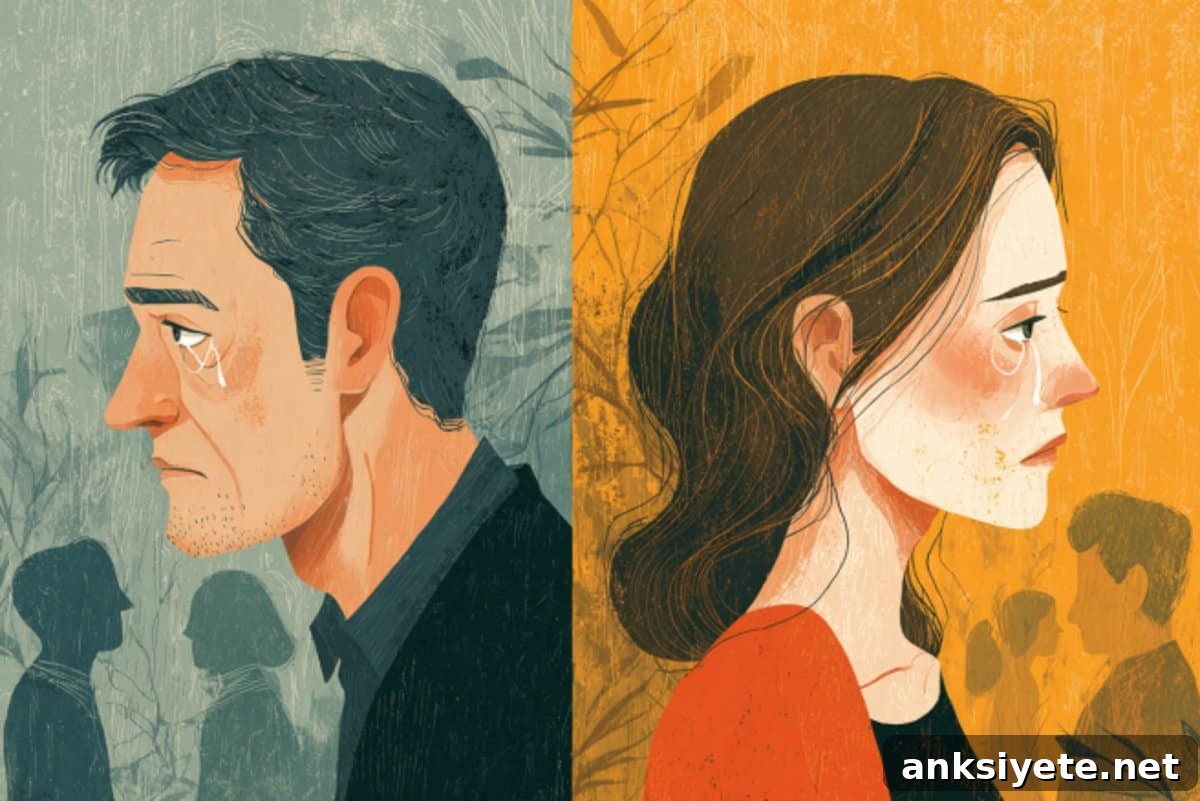
Summary: New research shows that whether observers view someone’s tears as genuine or manipulative depends strongly on context. Tears were judged more sincere when they occurred in non-manipulative situations and when they were shed by people from groups who are less expected to cry—for example, men or individuals judged to be lower in warmth.
These results suggest that unexpected crying may serve as a stronger authenticity cue for observers. In other words, crying is not automatically taken as sincere; perceptions vary according to who cries and the situation in which the tears appear.
Key facts:
- Tears were generally seen as more honest in contexts that did not look manipulative.
- Men and people perceived as lower in warmth gained more credibility when shown crying.
- Contextual and individual factors strongly shape whether tears are read as sincere or strategic.
Source: PLOS
Overview
A new open-access study led by Monika Wróbel of the University of Lodz, Poland, and colleagues examines when emotional tears are perceived as sincere signals and when they are treated as calculated displays—so-called “crocodile tears.” Published in PLOS One on July 16, 2025, the research explores how situational cues, the apparent warmth of a target, target gender, and observer traits combine to shape perceptions of honesty.
People commonly view emotional tears as honest because crying is difficult to produce on demand. At the same time, many recognize that tears can be used strategically to influence others. To understand when observers interpret tears as authentic rather than manipulative, the researchers ran several large-scale experiments in which participants evaluated photographs of faces that either looked tearful (with digitally added tears) or non-tearful.
Photos varied in implied warmth and were paired with short scenarios classified as potentially manipulative or non-manipulative. For example, in a manipulative scenario a person in the photo is trying to cut in line to see a doctor; in a non-manipulative scenario the person is waiting to see the doctor and speaking with a receptionist. Participants also completed questionnaires assessing their own personality traits and dispositions.
Across thousands of responses, the overall effect of tears on perceived honesty was small, but context mattered. Tears increased perceived honesty more for certain targets—notably for men and for individuals rated low in warmth—groups that observers might typically expect to cry less. Tears were also seen as more genuine in non-manipulative scenarios than in scenarios that suggested strategic intent.
The pattern suggests that tears can be especially persuasive when they contradict expectations: when someone whom observers do not expect to cry does so, observers may interpret the display as a reliable signal of genuine emotion. Conversely, when tears occur in contexts that appear designed to influence others, people become more skeptical about sincerity.
Importantly, the authors note that effect sizes were modest and that multiple interacting factors influence perception. Observers’ personality traits—such as higher scores on psychopathy—also affected judgments, with some individuals rating tearful targets as less honest.
The research took place across diverse samples and countries, but it relied on photographs with digitally added tears. The authors acknowledge that crying is a complex multimodal expression involving vocalizations, facial muscle changes, and gestures; future studies should use more ecologically valid stimuli that capture the full range of crying behaviors.
Funding: The work was funded by the National Science Centre, Poland, via a grant awarded to Monika Wróbel (Grant Number: 2021/43/B/HS6/01882). The funders did not influence the study design or reporting.
About this psychology research news
Author: Hanna Abdallah
Source: PLOS
Contact: Hanna Abdallah – PLOS
Image credit: Neuroscience News
Original research (open access): “The honesty behind tears: Situational, individual, and cultural influences on the perception of emotional tears as sincere” by Monika Wróbel et al., PLOS One. DOI and journal reference available in the original publication.
Abstract
The honesty behind tears: Situational, individual, and cultural influences on the perception of emotional tears as sincere
Emotional tears are often treated as honest social signals, perhaps because they are difficult to produce intentionally. Yet people also recognize that tears can be used strategically to manipulate others. This raises the question: under what conditions do observers perceive tears as genuine rather than manipulative?
The authors address this question across three experimental studies with diverse populations. A preliminary study (N = 7,007) provided initial evidence that tears can increase perceptions of honesty, and that this effect may vary with context and target gender. Two main studies (N = 3,488) used a mixture of standardized and non-standardized portraits, varying whether targets appeared tearful or not, whether the accompanying scenarios were potentially manipulative, and whether targets were presented as high or low in warmth. These studies were conducted across five countries: Norway, Poland, South Africa, Canada, and the United Kingdom.
Overall, main effects were small. Perceptions of honesty depended on target characteristics, situational context, and observer traits. Some evidence indicated that tears boost perceived honesty more for targets low in warmth—a pattern that also influenced observers’ intentions to offer support. Manipulative scenarios reduced perceived honesty slightly, and observers higher in psychopathy rated tearful targets as less honest. The authors conclude that whether tears signal honesty depends on multiple interacting factors and that future work should employ more realistic, multimodal stimuli to better capture crying in natural social contexts.