
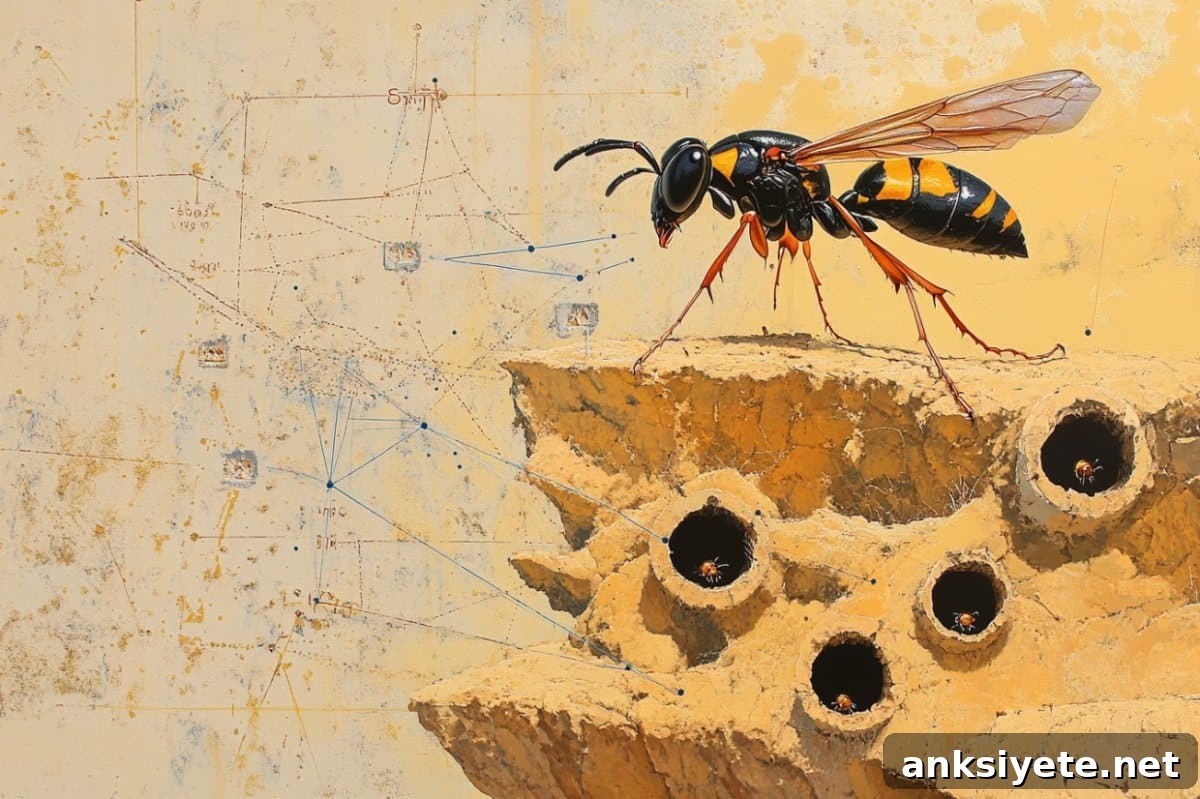
Summary: New research reveals that female digger wasps can track and manage up to nine separate burrows at once, provisioning their larvae in a precise sequence and adjusting that schedule when larvae die or have already received more food. Even when nests are dug in bare sand among hundreds of similar burrows, these mothers misdeliver food in only about 1.5% of observed visits.
These wasps remember which nest contains which offspring, when they last visited each nest, and how much food each larva has received—an unexpectedly sophisticated set of abilities given the small size of their brains. The findings challenge common assumptions about insect cognition and illuminate how memory can evolve to solve ecological problems in the wild.
Key facts
- Impressive memory capacity: Female digger wasps can remember locations and feeding histories for multiple nests simultaneously.
- Adaptive scheduling: Mothers feed larvae in age order, but they flexibly alter the sequence if an offspring dies or if a larva already has more food.
- High natural accuracy: Of 1,293 food deliveries recorded in the study, only 1.5% were delivered to other females’ nests.
Research from the University of Exeter shows wasp mothers combine spatial, temporal and content information to care for their young.
The subject of the study is a progressive provisioning species of digger wasp (Ammophila) that nests on heathland in Surrey, UK. Females dig a small burrow for each egg, place a paralyzed caterpillar inside, lay the egg on the prey, seal the entrance, and then either start a new burrow or return later to add more prey. Mothers typically revisit each nest two to seven days after egg-laying to check whether the larva survives and to bring additional caterpillars—sometimes up to eight in total—before permanently sealing the brood cell.
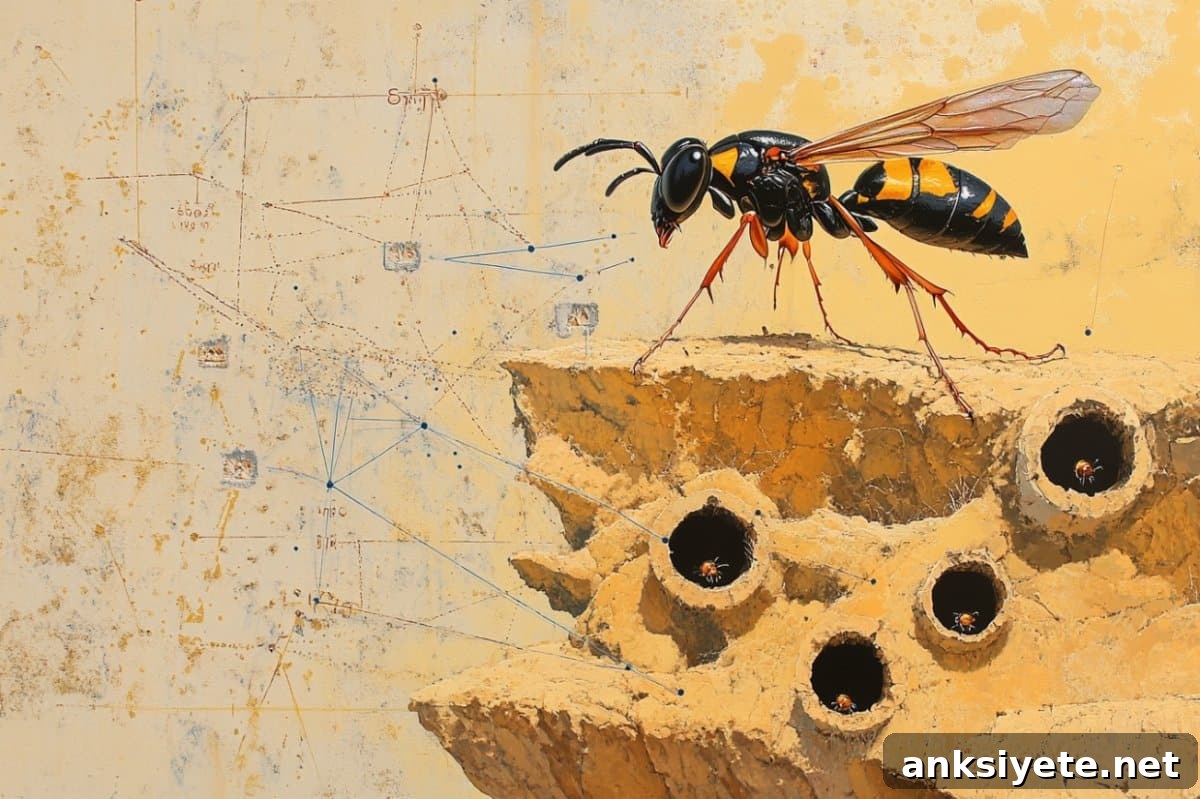
Because nests are often located in featureless sand and sit among many intermingled burrows made by other females, locating the correct nest requires reliable navigation and memory. The study found mothers reliably visit and provision their own nests, feeding offspring in order of age to reduce starvation risk. If a larva is found dead, the mother may lay another egg but moves that nest toward the back of the feeding queue. When researchers experimentally altered the amount of food placed in a nest—by swapping caterpillars—mothers adjusted their schedules, delaying further provisioning for nests that already contained larger prey so they could start provisioning additional offspring sooner.
Professor Jeremy Field, from the Centre for Ecology and Conservation at Exeter’s Penryn Campus, commented that the results indicate “the miniature brain of an insect is capable of remarkably sophisticated scheduling decisions.” The study suggests that rather than relying only on repeated checks, females use memory about what was provided, where, and when—elements comparable to the what-where-when framework used to describe episodic-like memory in animals.
The researchers also found limits to this memory-based strategy. Mothers were more likely to make errors when managing larger numbers of offspring or when the natural feeding order was disrupted by deaths. In some experimental situations, mothers re-sampled offspring needs directly (by inspecting the nest) rather than relying solely on stored information, especially when re-sampling posed little risk of exposing nests to parasites. This pattern indicates that ecological costs and benefits influence whether memory or immediate inspection guides parental decisions.
Overall, the study demonstrates how natural selection can favour memory mechanisms that support complex parental care in the wild, even in animals with very small brains. The authors suggest that skills required for progressive provisioning—coordinating multiple offspring, recognizing maternity, and assessing developmental needs—may have provided preadaptations that supported the evolution of social behaviors in some lineages.
About this memory and evolutionary neuroscience research news
Author: Louise Vennells ([email protected])
Source: University of Exeter
Contact: Louise Vennells – University of Exeter
Image credit: Neuroscience News
Original research: Open access. “Memory and the scheduling of parental care in an insect population in the wild” by Jeremy Field et al., Current Biology. DOI: 10.1016/j.cub.2025.04.045
Abstract
Memory and the scheduling of parental care in an insect population in the wild
Animals are expected to schedule their activities to maximize fitness. Vertebrates are known to use memories of past events—what happened, where, and when—to do this, but many cognitive studies have been laboratory based. This study examines how female digger wasps (Ammophila) schedule parental care in their natural environment, where ecological consequences are visible and behavior can be linked to context.
Despite their small brains, females used information that included all three elements of the what-where-when paradigm. They remembered the locations of up to nine separate nests simultaneously, fed offspring in age order without resampling (thereby reducing starvation risk), and flexibly adjusted sequences when deaths occurred. Memory capacity sometimes constrained performance: feeding order was disrupted when mothers had many offspring to manage or when the age sequence changed following larval death. When nests were experimentally supplied with larger initial food items, mothers delayed further provisioning and initiated additional offspring sooner, but in those cases decisions depended on direct resampling of larval need rather than memory of the original food item. Resampling behavior appears to be sensitive to ecological risks—mothers relied on memory when resampling would increase parasite exposure but inspected nests when risks were lower.
Progressive provisioning requires mothers to coordinate care for multiple offspring and to assess maternity and developmental needs during larval growth. These capabilities may have helped predispose some lineages toward sociality by providing cognitive and behavioral building blocks for more complex family interactions.