
Summary: A visual cortical prosthesis aims to restore sight by bypassing damaged eyes and delivering camera-derived visual information directly to the brain. New research demonstrates a promising approach: dynamically stimulating sequences of electrodes to “trace” shapes on the visual cortex, producing recognizable perceptions of letters and forms.
Source: Cell Press
Most cases of acquired blindness in adults arise from injury to the eyes or the optic nerve while the brain’s visual areas remain intact. For decades, scientists have pursued a device that could restore useful vision by feeding visual data from a camera into the cortex, bypassing the damaged ocular structures. In a study published in Cell, researchers at Baylor College of Medicine describe a method that more closely approximates how the brain naturally interprets shapes. Instead of activating many electrodes simultaneously as if each electrode were a pixel, they stimulated electrodes in rapid temporal sequences to trace outlines on the surface of visual cortex. Participants reported perceiving the intended letter shapes and could reliably identify them.
“When we used electrical stimulation to dynamically trace letters directly on patients’ brains, they were able to ‘see’ the intended letter shapes and could correctly identify different letters,” said senior author Daniel Yoshor. Participants described the percepts as glowing spots or lines that formed letters, similar to skywriting.
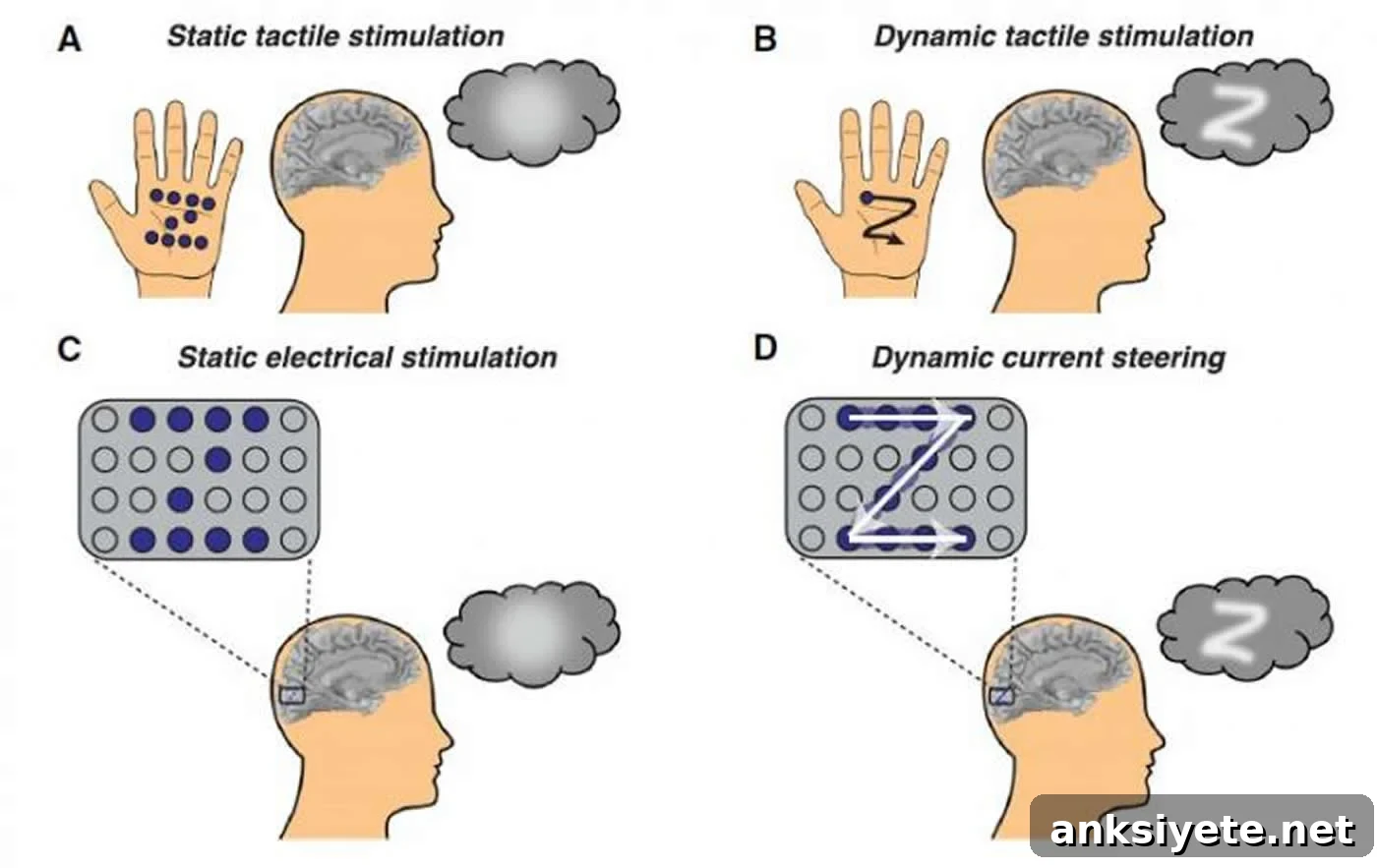
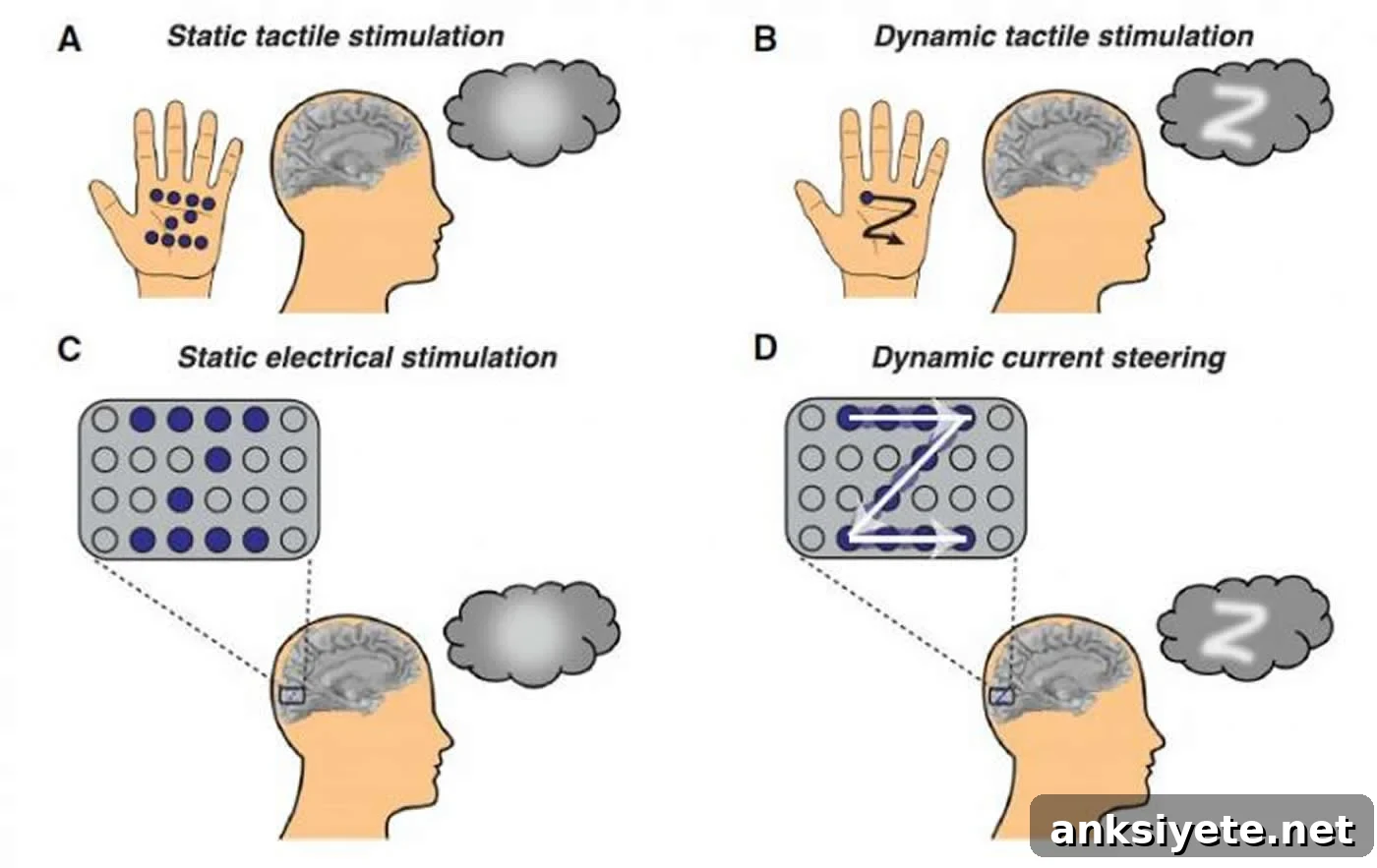
Previous stimulation strategies generally treated each electrode like an individual pixel, delivering concurrent pulses across several electrodes. That approach produced isolated percepts of light—called phosphenes—but failed to combine those spots into coherent objects or letters. The new strategy takes inspiration from tactile letter tracing—like tracing a letter on the palm—which conveys form through motion and sequence rather than static dots. “Rather than trying to build shapes from multiple spots of light, we traced outlines,” explained first author Michael Beauchamp.
The investigators tested the dynamic stimulation paradigm in six human participants: four sighted individuals undergoing clinical monitoring for epilepsy and two blind participants who had electrodes implanted over visual cortex as part of a cortical prosthetic study. Stimulation delivered across multiple electrodes in controlled sequences produced perceptions of shapes that participants could accurately recognize as letters. In blind participants the method yielded rapid identification of forms, with recognition rates reaching up to 86 forms per minute in some conditions.
The results show that the brain’s spatial map of visual space can be engaged by carefully timed stimulation to produce coherent perceptions of form. This finding suggests that a visual cortical prosthesis could restore the ability to detect and recognize objects for people with blindness caused by damage to the eyes or optic nerve, provided the visual cortex is functional and the remaining technical hurdles can be overcome.
There are, however, important challenges before this approach could become a practical clinical device. The primary visual cortex contains roughly half a billion neurons, while the current experiments stimulated only a tiny fraction of those neurons using a limited number of electrodes. Scaling the system will require high-density electrode arrays with many more contacts and hardware capable of safely and precisely delivering dynamic stimulation patterns.
“An important next step will be to work with neuroengineers to develop electrode arrays with thousands of electrodes, allowing us to stimulate more precisely,” Beauchamp said. He also emphasized that improved stimulation algorithms and integration with camera-based vision systems will be needed to translate these percepts into functional vision for daily tasks.
The research received funding from the National Institutes of Health.
About this neuroscience research article
Source: Cell Press
Media contacts: Carly Britton – Cell Press
Image credit: Beauchamp et al./Cell.
Original research: “Dynamic Stimulation of Visual Cortex Produces Form Vision in Sighted and Blind Humans” by Daniel Yoshor et al. Published in Cell. DOI: 10.1016/j.cell.2020.04.033
Abstract (concise summary)
The study tested a visual cortical prosthesis strategy in which shapes are represented by temporally sequenced stimulation of electrodes on the surface of primary visual cortex. Rather than relying on static concurrent stimulation to create pixel-like phosphenes, the dynamic current steering method traces outlines of letters and forms. In both sighted and blind participants, dynamic stimulation evoked coherent percepts of letter shapes predicted by the brain’s retinotopic map. Static stimulation alone failed to produce clear letter percepts. The findings indicate that a brain prosthetic can generate recognizable form vision and that dynamic temporal patterns may be a critical design element for future visual cortical prostheses.
Highlights
- Researchers compared stimulation paradigms for visual cortical prostheses.
- Letters and shapes were traced on cortex using time-sequenced electrical stimulation.
- Static simultaneous stimulation did not reliably produce letter percepts.
- Dynamic current steering produced recognizable letter forms in sighted and blind participants.
The study advances the concept that delivering visual information directly to cortex can produce coherent visual forms when stimulation patterns respect the brain’s spatial and temporal processing. Future work will focus on increasing electrode counts, refining stimulation algorithms, and integrating real-time visual inputs to move toward clinical prosthetic systems for people with blindness.
Feel free to share this neurotechnology news.