
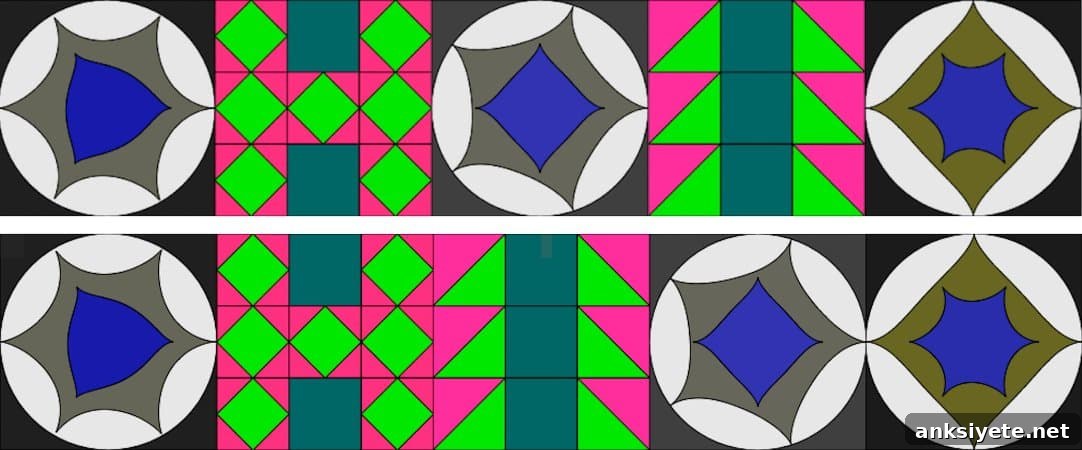
Summary: Seven-month-old infants can rapidly detect whether a mosaic-like pattern is structurally symmetrical, indicating an early, automatic ability to extract organization from complex visual scenes.
Source: University of the Basque Country
A collaborative study led by the UPV/EHU’s Gogo Elebiduna group explored how seven-month-old infants visually respond to abstract mosaic patterns that either possess or lack structural symmetry.
The research shows that infants as young as seven months reliably distinguish symmetrical from asymmetrical mosaic sequences, suggesting they possess a robust, largely automatic sensitivity to structural patterns in multi-featured visual input.
Gogo Elebiduna, the UPV/EHU research group behind the study, specializes in psycholinguistics and investigates how language and cognitive faculties are acquired, organized and processed in the brain. The team examines whether the basic abilities infants use to learn language may also apply to nonlinguistic domains.
The experiment was conducted by Ikerbasque research fellow Irene de la Cruz-Pavía in collaboration with Judit Gervain from the University of Padua and was recently published in the journal PLOS ONE. The study took place at the University of Paris and measured the spontaneous looking behaviour of nearly 100 infants while they viewed abstract, mosaic-like visual sequences.
Stimuli were constructed from two distinct categories of square tiles, labeled A and B. Tiles from each category differed in color scheme and internal shape. Researchers arranged these tiles into sequences that formed either symmetrical structures (for example ABA or ABABA) or asymmetrical sequences (for example AAB or AABBA). The team varied sequence length (three or five tiles) and manipulated abstractness of the symmetry, testing whether infants responded to symmetry at the level of individual tile tokens or at the category level.
Results indicate that the seven-month-old participants discriminated between structurally symmetrical and asymmetrical mosaics, doing so early in the test phase (notably within the first eight trials). Neither the sequence length nor the level of symmetry (token versus category) nor the number of unique tiles per sequence significantly changed infants’ looking patterns. These findings point to a fast, general capacity to detect structure in visual input that is not limited to language-like stimuli.
“Babies as young as seven months have a robust, automatic ability to detect that a structure is symmetrical,” said de la Cruz-Pavía. She noted that similar structural sensitivity has been observed in other studies using diverse stimuli, including sign language and speech, suggesting a broader early competence for recognizing regularities and rules across different kinds of input.
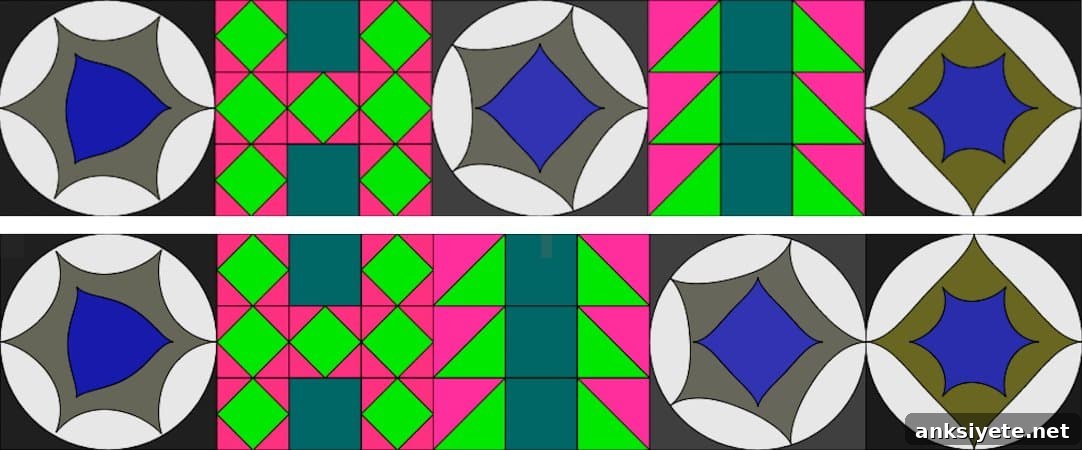
The researchers emphasize that the study used visual information that is not linguistic, allowing them to test whether infants’ structural detection abilities generalize across media. By showing that infants can extract organization from abstract visual patterns, the findings support the idea that some core cognitive skills underlying grammar learning may be domain-general rather than language-specific.
Understanding these early abilities matters because they likely form part of the foundation on which infants build more complex cognitive and linguistic systems. The study helps clarify which perceptual and cognitive skills are available to infants as they begin to learn about structure and regularity in their environment.
The team acknowledges that many questions remain: when this structural-detection ability first emerges, how precisely infants analyze pattern detail, and which visual features (shape, color, or their combination) drive the detection. Future work will seek to chart the developmental timeline, probe the limits of infants’ analysis, and determine the specific cues infants use to recognize symmetry.
About this neurodevelopment and visual neuroscience research news
Author: Press Office
Source: University of the Basque Country
Contact: Press Office – University of the Basque Country
Image: The image is credited to Irene de la Cruz-Pavía / UPV/EHU
Original Research: Open access. “Seven-month-old infants detect symmetrical structures in multi-featured abstract visual patterns” by Irene de la Cruz-Pavía et al., PLOS ONE.
Abstract
Seven-month-old infants detect symmetrical structures in multi-featured abstract visual patterns
This study investigated seven-month-old infants’ sensitivity to structural symmetry in mosaic-like abstract visual patterns. Researchers measured the spontaneous looking behaviour of 98 infants presented with sequences that were either structurally symmetrical or asymmetrical. Sequences used square tiles from two categories that differed in color and internal form, and the experiment manipulated sequence length (three or five tiles) as well as the abstractness of symmetry (token versus category level).
Infants discriminated symmetrical from asymmetrical mosaics during the initial portion of the test phase (the first eight trials). Neither sequence length, level of symmetry, nor the number of unique tiles per sequence significantly affected looking behaviour. These results indicate that very young infants detect differences in structural symmetry within multi-featured visual patterns, revealing an early capacity to extract organization from complex visual input.