Summary: Researchers used advanced neural recording technologies to show human brain organoids transplanted into mice form functional connections with host cortex and respond to visual input.
Source: UCSD
A multidisciplinary team of engineers and neuroscientists has shown that human cortical organoids implanted into the mouse brain form functional connections with the host cortex and respond to external visual stimuli.
Using a novel combination of transparent graphene microelectrode arrays and two-photon imaging, the researchers recorded electrical and optical signals from implanted human organoids and neighboring mouse cortex in real time over several months. They observed that the organoids reacted to visual stimulation in ways that closely matched the surrounding cortical tissue.
The work was led by Duygu Kuzum of the University of California San Diego’s Department of Electrical and Computer Engineering and is reported in Nature Communications. The project involved collaboration with labs at Boston University, UC San Diego, and the Salk Institute, bringing together expertise in neural engineering, stem-cell biology, and systems neuroscience.
Human cortical organoids are three-dimensional neural tissues grown from human induced pluripotent stem cells. These organoids are increasingly used as laboratory models to study human brain development and neurological disorders, but until now it has been difficult to demonstrate functional integration between transplanted human organoids and living animal brain circuits at the temporal resolution required to capture fast neural activity.
Conventional recording technologies often lack either the spatial or temporal resolution to simultaneously image cellular activity and capture millisecond-scale electrical events. Kuzum’s team addressed this limitation by advancing transparent graphene electrode arrays that allow simultaneous optical access and low-noise electrical recording. Paired with two-photon microscopy—which images living tissue up to roughly one millimeter deep—the system enables longitudinal, multimodal monitoring of organoid integration in vivo.
“No other study has been able to record optically and electrically at the same time,” said Madison Wilson, the paper’s first author and a Ph.D. student in Kuzum’s lab. “Our experiments show that visual stimuli evoke electrophysiological responses within the organoids that match responses from the surrounding cortex.”
The transparent graphene electrodes were first introduced by Kuzum’s group in 2014 and have since been optimized. In this study the team used platinum nanoparticles to reduce electrode impedance by about 100-fold while retaining transparency. The resulting low-impedance graphene electrodes support recordings that span network-level dynamics and single-cell spiking while allowing concurrent optical imaging.
In experiments, the researchers placed electrode arrays directly over human cortical organoids transplanted into the retrosplenial cortex of adult mice. Two-photon imaging revealed host blood vessels penetrating the grafts, indicating vascularization that supplies oxygen and nutrients to the implanted tissue. Electrically, the electrodes recorded responses from both organoid and surrounding mouse cortex in real time.
When the animals were presented with visual stimuli—brief flashes of white LED light under two-photon imaging—the team detected stimulus-evoked electrical activity above the organoids consistent with responses in adjacent cortex. Activity propagated through functional pathways from regions nearest the mouse visual cortex across the implanted tissue. The recordings captured increases in gamma-band power and showed phase locking between organoid spiking and slow oscillations in the host visual cortex, evidence of coordinated, functional interactions.
These multimodal observations indicate that within roughly three weeks after implantation the human organoids established synaptic-level contacts with host cortex and began receiving functional input from the mouse brain. The team conducted chronic monitoring for up to eleven weeks, documenting both morphological and functional integration between the implanted human tissue and the host mouse cortex.
Future directions include longer-term studies, experiments using disease-model organoids, and incorporating calcium imaging to visualize neuronal spiking at cellular resolution. Additional anatomical tracing methods could further map axonal projections and delineate the routes of host-organoid connectivity.
Kuzum emphasized the broader potential of the approach: combining human stem-cell–derived organoids with advanced neurorecording platforms could enable physiologically relevant models of human neural development and disease, facilitate testing of candidate therapies on patient-specific organoids, and help evaluate whether engineered organoids might one day restore function to damaged or degenerated brain regions.
Funding: This research was supported by the National Institutes of Health, the Research Council of Norway, and the National Science Foundation.
About this neuroscience research news
Author: Katherine Connor
Source: UCSD
Contact: Katherine Connor – UCSD
Image: The image is credited to Madison Wilson/UC San Diego
Original Research: Open access. “Multimodal monitoring of human cortical organoids implanted in mice reveal functional connection with visual cortex” by Duygu Kuzum et al., published in Nature Communications.
Abstract
Multimodal monitoring of human cortical organoids implanted in mice reveal functional connection with visual cortex
Human cortical organoids—three-dimensional neuronal cultures derived from human induced pluripotent stem cells—are emerging as powerful tools to study brain development and dysfunction. However, demonstrating functional connections between organoids and a sensory network in vivo has remained a challenge.
In this study, transparent microelectrode arrays were combined with two-photon imaging for longitudinal, multimodal monitoring of human cortical organoids transplanted into the retrosplenial cortex of adult mice. Two-photon imaging confirmed vascularization of the transplanted organoids.
Visual stimulation evoked electrophysiological responses in the organoids that matched responses from surrounding cortex. Observed increases in multi-unit activity and gamma power, together with phase locking between stimulus-evoked multi-unit activity and slow oscillations, indicate functional integration between the implanted human tissue and the host brain.
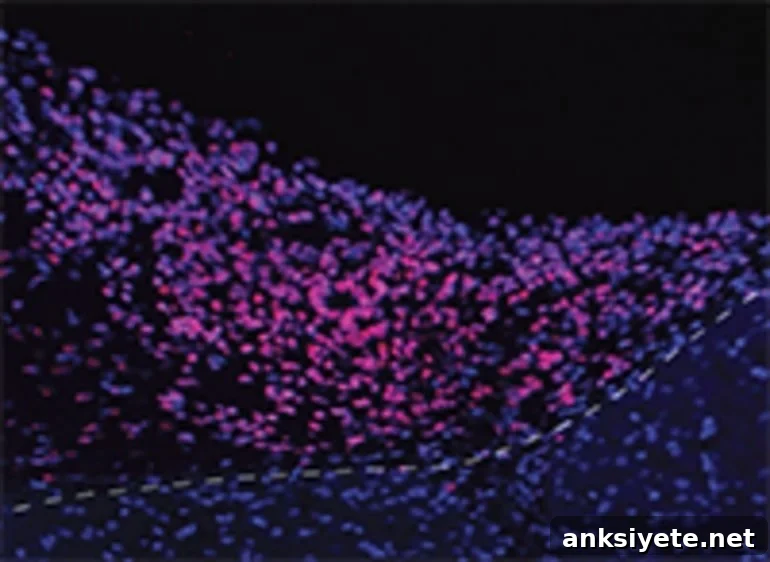
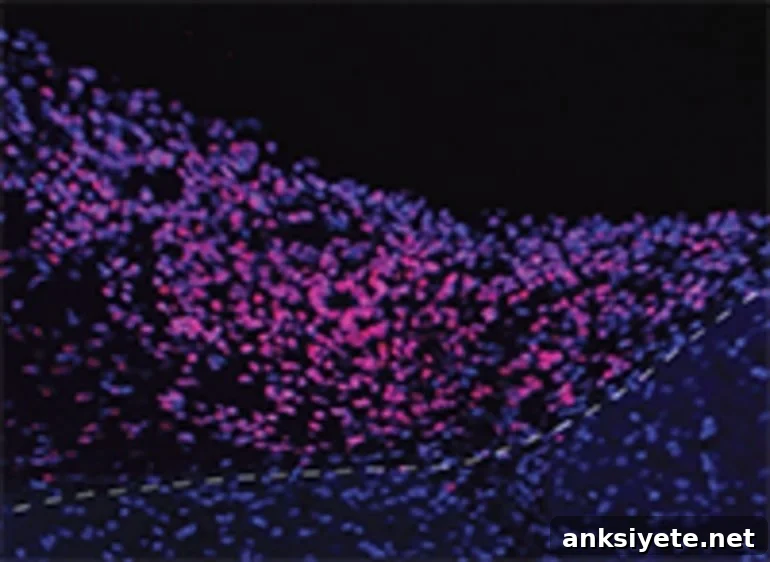
Immunostaining validated the presence of human–mouse synapses. Implantation of transparent microelectrodes alongside organoids provides a versatile in vivo platform for evaluating the development, maturation, and functional integration of human neuronal networks within the mouse brain.