
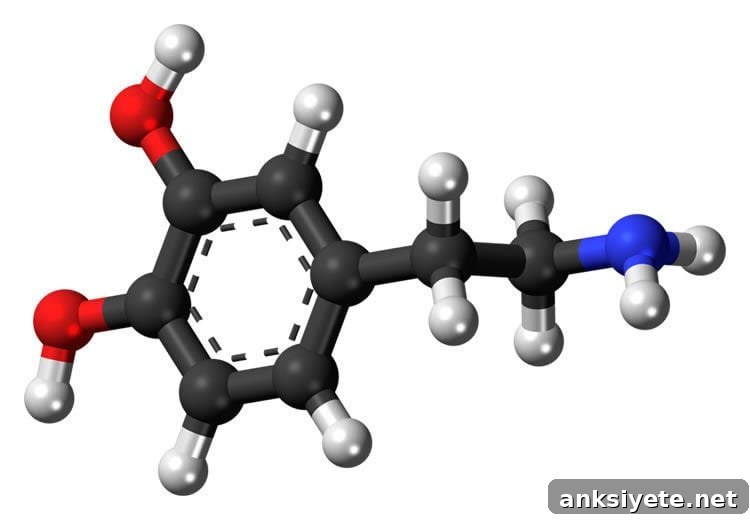
Summary: A new study clarifies how dopamine contributes to decision making by encoding the passage of time between rewards.
Source: UT San Antonio.
How do we judge whether waiting in line for a meal at a new restaurant was worth it? To make that judgment, the brain must register how rewarding the meal was and link that feeling to the restaurant. A small group of cells deep in the brain releases the chemical dopamine to signal reward value. The amount of dopamine released can shape future decisions by indicating how valuable a forthcoming reward is likely to be. For example, the smell of a freshly baked cake triggers more dopamine than the scent of reheated leftovers. But does the length of the wait itself change dopamine release?
New research published in Cell Reports and led by Matthew Wanat, assistant professor of biology at The University of Texas at San Antonio (UTSA), examines how dopamine neurons represent the passage of time and how that representation affects choice. Using fast-scan cyclic voltammetry to measure real-time dopamine release, Wanat and colleagues recorded neurotransmitter signals in rodents trained with Pavlovian conditioning. In this task, two distinct auditory cues each predicted the delivery of a food reward, but one cue always followed a short wait after the previous reward while the other always followed a longer wait. The researchers found that the cue associated with the shorter wait produced a larger dopamine response than the cue tied to the longer wait. In other words, when dopamine neurons respond to predictive cues, faster expected reward delivery elicits stronger dopamine signaling.
“Our main goal is to identify the brain signals that guide the decisions people and animals make,” Wanat explained. “Many choices depend on comparing the values associated with different cues. Evidence suggests that dopamine signals tied to external cues provide important value-related information that can influence whether an animal engages in a behavior.”
The experiment demonstrates that cue-evoked dopamine release carries temporal information about recent reward history—how much time has passed since the last reward—and that this retrospective timing influences the magnitude of the dopamine response. Notably, the difference in dopamine release for short-wait versus long-wait cues persisted even when those cues were learned in separate contexts and never experienced together. This indicates that dopamine encodes temporal information in a context-independent way, offering a subjective estimate of relative reward rate rather than simply reflecting contextual associations.
Beyond basic neuroscience, these findings have implications for understanding pathological conditions in which dopamine signaling is disrupted, such as drug addiction. Addiction can “hijack” brain systems where dopamine operates, distorting how cues and timing influence behavior. “By defining how the dopamine system functions under normal conditions and how it changes in abnormal states, we may be better able to identify interventions that correct maladaptive signaling and reduce the harmful consequences of addictive behaviors,” Wanat said.
Charles Wilson, Ewing Halsell Distinguished Chair in Biology, emphasized the significance of directly measuring dopamine during choice processes: “Much has been said about dopamine and reward, but reward matters primarily in the context of the choices we make. Dr. Wanat’s experiments offer direct measurements of dopamine signals during decision making and reveal how the brain assigns value to different options.”
Wanat’s broader research explores how memory, stress and addiction interact with neural circuits and neurotransmitter systems. He is a member of the UTSA Neurosciences Institute, a multidisciplinary center focused on integrating diverse approaches to study the biological foundations of behavior and brain disorders. The institute fosters collaboration across laboratories to advance understanding of how the nervous system functions and how it fails in disease.
Wanat is one of forty brain health researchers at UTSA whose expertise spans neurodegenerative disease, circuit function and neural signaling, traumatic brain injury, regenerative medicine and stem cell therapies, medicinal chemistry, neuroinflammation, drug design and psychology. Together these investigators pursue large-scale, collaborative projects aimed at mapping complex brain processes and identifying factors that cause cognitive decline and neurological disease.
Source: Joanna Carver – UT San Antonio
Image Source: NeuroscienceNews.com image is in the public domain.
Original Research: Full open-access research: “Dopamine Encodes Retrospective Temporal Information in a Context-Independent Manner” by Kaitlyn M. Fonzi, Merridee J. Lefner, Paul E.M. Phillips, and Matthew J. Wanat, published in Cell Reports. Published online August 22, 2017. DOI: 10.1016/j.celrep.2017.07.076
Abstract
Dopamine Encodes Retrospective Temporal Information in a Context-Independent Manner
Highlights
- Cue-evoked dopamine release encodes retrospective temporal information.
- Dopamine signals differences between cues in a context-independent manner.
- Conditioned responding is not directly determined by differences in dopamine release between cues.
- Conditioned responding corresponds with changes in dopamine release to a given cue.
Summary
The dopamine system clearly responds to reward-predictive cues to represent an expected value of future rewards. However, its role in encoding retrospective reward-related information—specifically information about time elapsed since the last reward—was less well understood. This study shows that cues preceding shorter waits since the prior reward evoke larger dopamine responses in the nucleus accumbens core than cues that follow longer waits. These differences persist even when cues are learned separately in different contexts, indicating that cue-evoked dopamine conveys a subjective estimate of relative reward rate that is not bound to a specific environmental context. While conditioned behavior updates when dopamine release to a cue changes, the level of conditioned responding is not simply proportional to the difference in dopamine responses between two cues. Together, the findings reveal that dopamine signals carry retrospective temporal information that can influence how the brain values and chooses among options.
“Dopamine Encodes Retrospective Temporal Information in a Context-Independent Manner” by Kaitlyn M. Fonzi, Merridee J. Lefner, Paul E.M. Phillips, and Matthew J. Wanat. Cell Reports, published online August 22, 2017. DOI: 10.1016/j.celrep.2017.07.076