
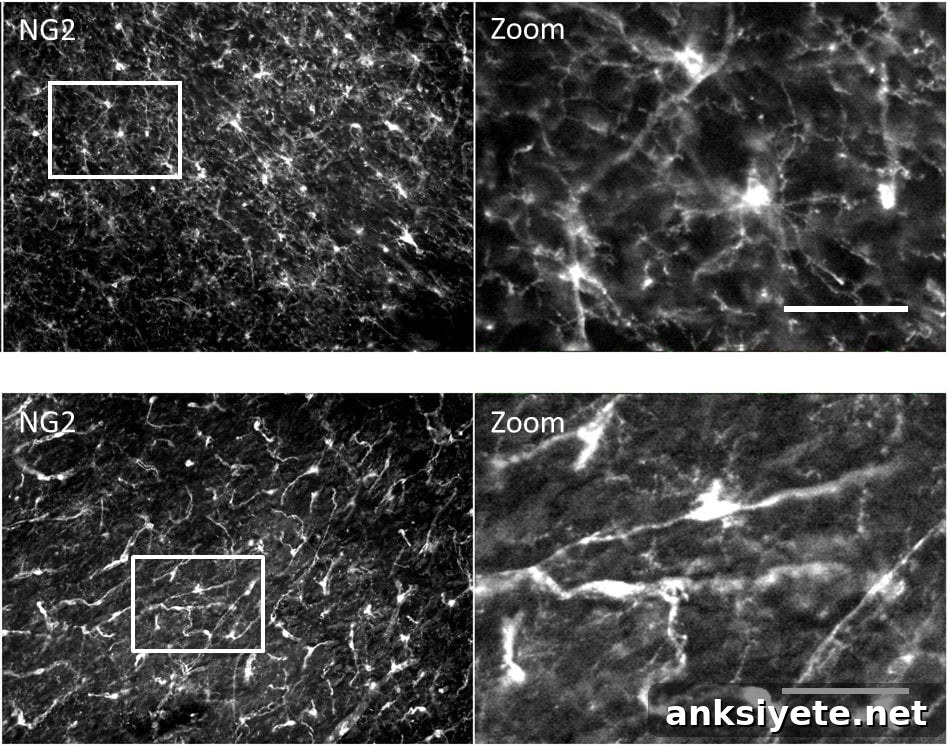
Transmembrane protein NG2 directs oligodendrocyte precursor cells to wound sites — Publication in the Journal of Neuroscience
When the central nervous system (CNS) is injured, oligodendrocyte precursor cells (OPCs) migrate toward lesions and help rebuild myelin sheaths around demyelinated axons. Researchers at the Institute of Molecular Cell Biology, Johannes Gutenberg University Mainz (JGU), have identified a specific transmembrane protein that guides the orientation and directed movement of OPCs during this repair response. The protein, NG2, is present on the surface of OPCs and is downregulated as these precursor cells mature into myelinating oligodendrocytes. These new findings, which clarify how OPCs sense and move toward injury, were published in the Journal of Neuroscience.
The myelin sheath electrically insulates axons and is essential for fast and reliable nerve signal transmission. In the event of injury, various neural cells release signaling molecules that attract OPCs to damaged areas. The JGU team demonstrated that NG2 enables OPCs to respond to some of these signals and to migrate in a directed, polarized manner toward the lesion. “We were able to show in cell biological experiments that NG2 orients OPCs toward the lesion and ensures targeted migration by regulating cell polarity,” said Dr. Fabien Binamé, lead author of the study. Dr. Binamé conducted this research at the Institute of Molecular Cell Biology under the supervision of Professor Jacqueline Trotter, with support from the German Research Foundation (DFG).
Co-author Dominik Sakry emphasized that the precise mechanisms by which NG2 functions are still being worked out. “The NG2-associated regulatory mechanism becomes particularly apparent in cases of nervous system injury,” he said, noting that NG2’s role seems to be most relevant when tissue is damaged and OPCs must migrate accurately to repair sites.
The study links NG2 activity to known regulators of cell movement and polarity. The original research describes involvement of Rho family GTPases and polarity complex proteins in NG2-mediated directional migration of OPCs, suggesting a molecular pathway that connects extracellular signals to the cell’s internal orientation machinery. By influencing cell polarity, NG2 helps OPCs align their leading edge and cytoskeletal dynamics toward the source of injury signals, enabling efficient and focused migration.
Understanding how NG2 controls OPC behavior has clinical relevance. Diseases such as multiple sclerosis (MS), traumatic brain injury, and certain brain tumors involve damage to myelin and impaired tissue repair. Professor Jacqueline Trotter, head of the JGU Institute of Molecular Cell Biology, noted that the team’s insights into NG2-regulated orientation and migration could improve understanding of remyelination processes and might be important for addressing aggressive brain tumors that show high NG2 expression. Better knowledge of these mechanisms could inform strategies to promote repair in demyelinating conditions or to limit harmful migration in invasive tumors.
The study combines cell biological assays and molecular analysis to reveal how a surface protein can steer OPCs toward wounds. While more work is needed to translate these findings into therapies, identifying NG2’s role in directional migration builds a clearer picture of cellular repair processes in the CNS and highlights potential targets for future research into remyelination and tumor biology.
Notes about this neurobiology research
Contact: Dr. Jacqueline Trotter — Johannes Gutenberg University Mainz
Source: Johannes Gutenberg University Mainz press release
Image credit: Dominik Sakry (adapted from the Johannes Gutenberg University Mainz press release)
Original research: Binamé F., Sakry D., Dimou L., Jolivel V., Trotter J., “NG2 Regulates Directional Migration of Oligodendrocyte Precursor Cells via Rho GTPases and Polarity Complex Proteins,” Journal of Neuroscience, published online June 26, 2013. doi: 10.1523/JNEUROSCI.5010-12.2013