Summary: In animals made deaf early in life, connections between a specific sensory cortex region and the superior colliculus are reduced, while other auditory and limbic inputs to the superior colliculus increase.
Cats deaf from an early age show altered cortical outputs to a midbrain center that orients the animal in space. A new study in the Journal of Neuroscience is the first to map how auditory cortical outputs reorganize after early hearing loss.
Early sensory experience shapes the developing brain. Although mammals are capable of seeing and hearing soon after birth, the neural circuits that support those senses continue to refine over weeks and months in response to incoming signals. This experience-dependent plasticity helps tune perception to the animal’s environment. When a sensory modality is lost, the cortical regions normally devoted to that sense can be recruited to support other modalities — a process known as crossmodal plasticity.
Researchers led by Blake Butler examined how early-onset deafness changes not only which cortical areas receive inputs, but how the cortex sends outputs to subcortical structures. They focused on projections from auditory cortex to the superior colliculus (SC), a midbrain structure that integrates multisensory information and directs orienting movements toward stimuli.
Using a retrograde tracer placed in the superior colliculus of mature cats that had been deafened during the first weeks of life (perinatal-onset deafness), the team traced labeled neurons throughout the cerebral cortex. They quantified the origin and distribution of cortical neurons projecting to the SC and compared those patterns with prior data from hearing animals.
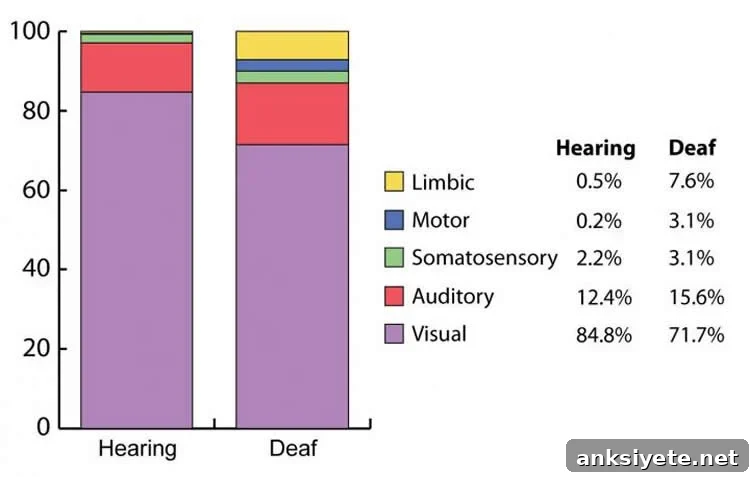
The key findings were twofold. First, projections from the anterior ectosylvian sulcus (a key region of the auditory cortex) to the superior colliculus were reduced in deaf animals relative to hearing controls. Second, however, other auditory cortical areas and limbic regions showed increased projections to the SC. In aggregate, the overall proportion of cortical inputs to the superior colliculus originating from auditory cortex was larger in deaf animals, and these projections were dispersed more widely across auditory fields rather than concentrated in a single subregion.
These results reveal a surprising dissociation: cortical afferent patterns (the inputs that cortex receives) have been shown previously to remain remarkably robust after sensory deprivation, but cortical efferent patterns (the outputs from cortex to subcortical targets) appear highly flexible. The expansion and dispersion of auditory cortical outputs to the superior colliculus in deaf animals suggest a reorganization that could support enhanced processing of remaining senses, such as vision and touch, by routing additional cortical resources into subcortical multisensory centers.
Connections from limbic regions to the superior colliculus were also elevated in deaf cats. Increased limbic input may reflect compensatory mechanisms that enhance attention, salience detection, or other modulatory influences on orienting behavior when auditory input is absent.
Significance: This study provides the first detailed description of how cortical outputs change following early sensory deprivation. By showing that auditory cortical efferents expand and disperse to a multisensory midbrain target, the work supports models in which abnormal early sensory experience leads to altered multisensory integration and to compensatory enhancements of intact senses. The findings have implications for understanding how developing neural circuits reorganize after sensory loss and how those changes affect perception and behavior.
Funding: Supported by the Natural Sciences and Engineering Research Council of Canada, the Canadian Institutes of Health Research, and the Canada Foundation for Innovation.
Source: SfN (Society for Neuroscience).
Publisher: NeuroscienceNews.com reports on the study.
Image credit: Butler, Sunstrum & Lomber, Journal of Neuroscience (2018).
Original research: Butler, B. E., Sunstrum, J. K., & Lomber, S. G., “Modified origins of cortical projections to the superior colliculus in the deaf: Dispersion of auditory efferents,” Journal of Neuroscience. Published April 2, 2018. doi: 10.1523/JNEUROSCI.2858-17.2018
Following the loss of a sensory modality such as deafness, crossmodal plasticity is commonly identified in cerebral regions that normally process the deprived sense. It has been hypothesized that major changes in cortical afferent and efferent projections may underlie these functional crossmodal changes. Studies of thalamocortical and cortico-cortical connections, however, have shown a resilience of cortical afferent projections after deafness and blindness. This study is the first to examine cortical outputs after sensory deprivation by characterizing cortical projections to the superior colliculus in mature cats (N = 5, 3 female) with perinatal-onset deafness. The superior colliculus was exposed to a retrograde tracer, labeled cells throughout the cerebrum were identified and quantified, and results indicated that the percentage of cortical projections arising from auditory cortex was substantially increased and more diffusely distributed across auditory fields in early-deaf cats compared to intact animals. These findings demonstrate that while cortical afferent patterns are relatively stable after perinatal deafness, cortical efferents to the superior colliculus are highly mutable.
This research highlights a notable form of neural reorganization after early deafness: instead of simply losing auditory influence on downstream structures, the auditory cortex changes how it routes information to subcortical multisensory centers. Increased and dispersed auditory cortical projections to the superior colliculus, together with enhanced limbic inputs, likely contribute to altered orienting responses and the compensatory enhancement of other senses observed in deaf animals.