A new, ultra-sensitive light-based test for measuring the toxic protein that causes Huntington’s disease (HD) reveals the protein accumulates progressively in blood cells. Published 17 September in the Journal of Clinical Investigation, the study clarifies how mutant huntingtin may drive brain damage in HD and offers a promising blood-based biomarker for tracking disease progression and evaluating therapies designed to lower the harmful protein.
Huntington’s disease is an inherited, fatal neurodegenerative disorder that typically appears in adulthood. It causes involuntary movements, psychiatric changes and cognitive decline. The condition results from a genetic mutation that produces a defective form of the huntingtin protein—commonly called mutant huntingtin—which is believed to drive neuronal injury and the clinical features of HD.
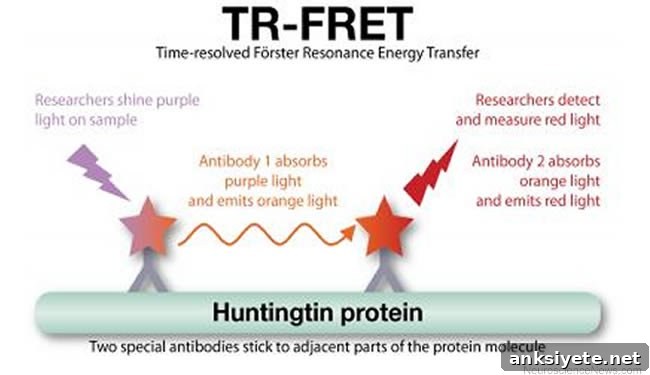
A research team led by Professor Sarah Tabrizi at the UCL Institute of Neurology, with collaborators from the Novartis Institutes for Biomedical Research and King’s College London, applied a highly sensitive immunoassay to measure both mutant and normal huntingtin in blood cells from people at different stages of HD. The assay, known as TR-FRET (time-resolved fluorescence resonance energy transfer), uses pairs of antibodies that bind to huntingtin molecules and produce distinct light signals. These paired antibody probes enable the reliable detection of extremely low concentrations of huntingtin with strong specificity.
The investigators found that mutant huntingtin accumulates gradually in white blood cells beginning before clinical symptoms appear and continuing as the disease progresses. Using MRI measures of brain volume, the study showed that blood levels of mutant huntingtin correlated with the rate of brain atrophy—an important and measurable indicator of neurodegeneration in HD. To the authors’ knowledge, this is the first time a blood-based measure has been shown to predict brain shrinkage in a human neurodegenerative condition. In contrast, the normal form of huntingtin remained steady across disease stages.
Further analysis revealed that small fragments of the most toxic portion of mutant huntingtin were accumulating in immune cells. Detecting these truncated fragments in white blood cells from people with HD is novel and suggests a possible mechanism for the slow, progressive injury seen in patients: if similar fragment accumulation happens in neurons, it could help explain the gradual buildup of cellular damage that eventually leads to clinical symptoms.
The accumulation of mutant huntingtin in immune cells may also help account for earlier observations by Professor Tabrizi’s group that the immune system is hyperactive in HD. The presence of toxic huntingtin fragments in white blood cells could influence immune signaling and inflammation, linking protein toxicity to peripheral immune changes observed in the disease.
Professor Tabrizi commented that TR-FRET provides a valuable new tool for HD research and drug development: “This assay enables accurate measurement of the most toxic forms of huntingtin in easily obtained blood samples from real patients. The correlation between mutant huntingtin in blood and brain atrophy indicates that these peripheral measures are relevant to the process of neurodegeneration in HD.”
Practical applications include using TR-FRET to monitor the effects of experimental gene-silencing therapies that aim to reduce production of mutant huntingtin in the brain. Because gene-silencing drugs can have off-target effects or safety concerns, reliable biomarkers that demonstrate target engagement—showing that huntingtin levels are actually falling—are essential to advancing safer and more effective treatments.
Notes about this Huntington’s disease research
Contact: David Weston – University College London
Source: University College London press release
Image Source: TR-FRET image adapted from image credited to UCL Press Office
Original Research: Open access research report for “Mutant huntingtin fragmentation in immune cells tracks Huntington’s disease progression” by Andreas Weiss, Ulrike Träger, Edward J. Wild, Stephan Grueninger, Ruth Farmer, Christian Landles, Rachael I. Scahill, Nayana Lahiri, Salman Haider, Douglas Macdonald, Chris Frost, Gillian P. Bates, Graeme Bilbe, Rainer Kuhn, Ralph Andre and Sarah J. Tabrizi in Journal of Clinical Investigation 17 September 2012 doi:10.1172/JCI64565