
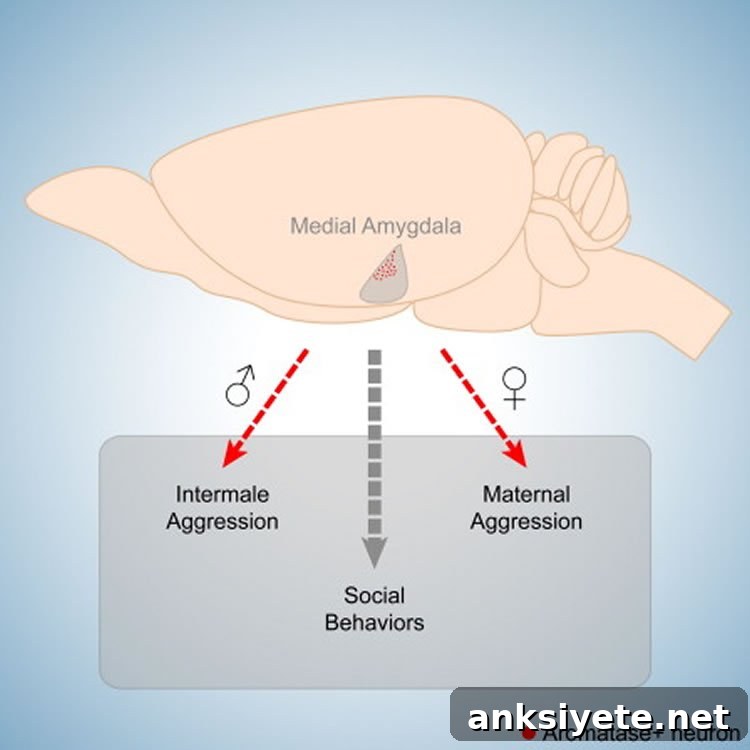
When a tiny group of cells is missing, both males and females become slower to engage in fights.
A very small cluster of estrogen-producing neurons in the mouse brain has specific and measurable effects on aggressive behavior in both males and females, according to new research from scientists at the University of California, San Francisco. These findings highlight how a discrete population of aromatase-expressing neurons in the medial amygdala influences the timing and initiation of aggression without broadly disrupting other social behaviors.
The neurons under study—called aromatase-expressing (aromatase+) cells—make up less than 0.05% of the total neurons in the mouse brain but are concentrated within a brain region called the posterodorsal medial amygdala (MeApd). Aromatase, the enzyme these cells express, converts testosterone into estrogen in the brain. Although estrogen is often associated with females, it is also synthesized in the male brain through this conversion and plays important roles in social and reproductive behaviors.
In males, estrogen produced locally by aromatase+ neurons is known to support a range of behaviors, including the ultrasonic vocalizations males produce when courting females, mating behaviors, territorial marking, and intermale aggression. Aromatase+ neurons are present in females as well, in smaller numbers, but their function in females has been less clear because circulating estrogen levels in females are already high.
To isolate the role of aromatase+ neurons in a specific circuit, the UCSF team led by senior author Nirao Shah, MD, PhD, used targeted genetic methods to selectively eliminate these cells within the MeApd of adult mice. Within this region, aromatase+ neurons account for roughly 40% of neurons, and the MeApd receives pheromonal input from the olfactory system—information that mice use to identify others and trigger appropriate social responses.
Following selective depletion of MeApd aromatase+ neurons, male mice displayed largely normal social behaviors in many contexts: they continued territorial scent marking, they recognized and courted females, and they could mate successfully. But their responses to unfamiliar males changed in a specific way. Normally, a male encountering an intruder will rapidly display threat behaviors, including tail-rattling, and quickly escalate to attack. Males lacking MeApd aromatase+ neurons showed significantly reduced tail-rattling and took much longer to launch an attack. The delay in initiating aggression correlated with the number of aromatase+ neurons removed.
Importantly, once an attack began, the intensity and pattern of aggression resembled that of control males. In other words, the loss of these neurons affected the decision to initiate aggression rather than the execution of aggressive actions once initiated.
Female mice showed a parallel, narrowly focused effect. Females without MeApd aromatase+ neurons behaved normally in interactions with males and in mating. However, maternal aggression—aggressive defense of pups by nursing mothers—was diminished in the onset of attack. Nursing females typically attack unfamiliar males because males can pose a threat to offspring; dams lacking aromatase+ cells were much slower to begin attacking intruders. As in males, once they began to attack, the structure and intensity of the attack were comparable to normal nursing females.
Lead author Elizabeth K. Unger, a graduate student in the Shah laboratory, emphasized the selectivity of this neural population. “These estrogen-producing neurons did not control all aspects of social behavior,” she said. “Instead, they specifically modulated a small component of aggression—the speed and likelihood of initiating an attack—across both sexes.”
For Shah, a professor of anatomy, the study illustrates modularity in the neural control of complex social behaviors. Behaviors that appear seamless—territory marking, mate recognition, mating, and fighting—are in fact organized by distinct neural circuits that govern specific elements. This work shows how a tiny, anatomically localized population of aromatase+ neurons in the medial amygdala can regulate the timing of aggressive responses without disrupting other social or reproductive behaviors.
Contact: Pete Farley – UCSF
Source: UCSF press release
Image Source: The image is credited to the researchers/Cell Reports and is licensed under Creative Commons Attribution Non Commercial No Derivs 3.0 Unported
Original Research: Full open-access research: “Medial Amygdalar Aromatase Neurons Regulate Aggression in Both Sexes” by Elizabeth K. Unger et al., published in Cell Reports (January 22, 2015), doi:10.1016/j.celrep.2014.12.040