Summary: Resveratrol analogues can reactivate splicing factors, causing aged cells to regain youthful characteristics, begin to divide and show signs of rejuvenation within hours of exposure, according to a new study.
Source: University of Exeter.
Researchers led by Professor Lorna Harries, Professor of Molecular Genetics at the University of Exeter, report a novel approach to reawaken inactive, senescent cells. Within hours of treatment, these older cells began dividing and showed lengthening of telomeres — the protective chromosome end caps that shorten with age.
The study, supported by the Dunhill Medical Trust, builds on previous work from the Exeter team demonstrating that a group of genes called splicing factors are progressively downregulated during ageing. Working with Professor Richard Faragher and Dr Elizabeth Ostler from the University of Brighton, the team identified chemical compounds that restore splicing factor activity, making senescent cells not only appear younger but also behave more like young cells and re-enter the cell cycle.
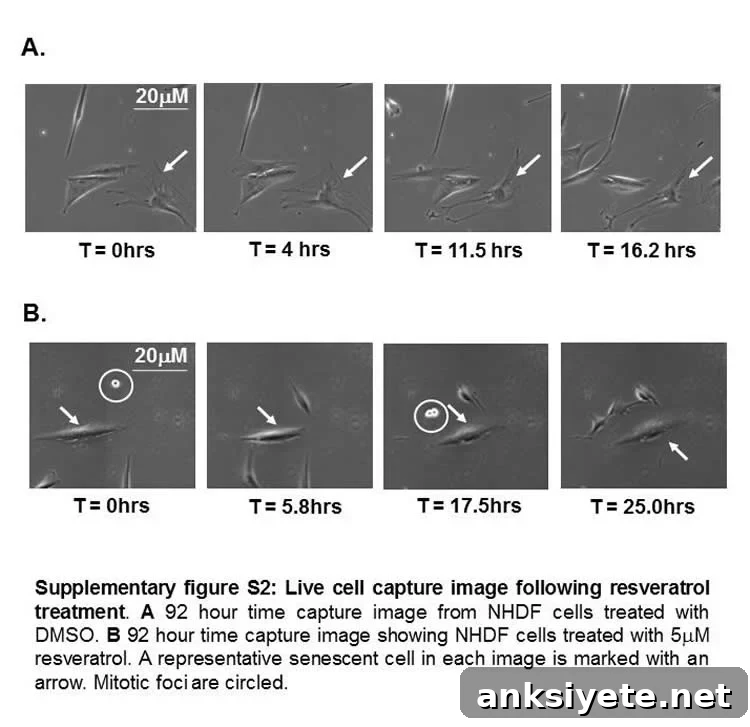
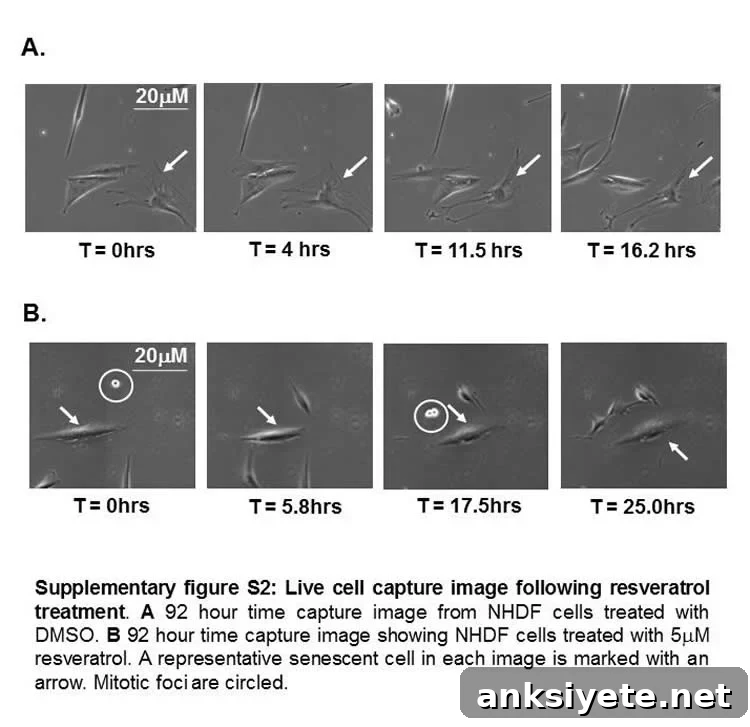
In laboratory cultures, the researchers treated human cells with resveratrol analogues — small molecules modelled on resveratrol, a compound naturally present in red wine, dark chocolate, red grapes and blueberries. These resveralogues triggered the reactivation of splicing factors that typically decline with age. Within hours, treated cells displayed a more youthful morphology and began rejuvenating and dividing.
The peer-reviewed paper, titled “Small molecule modulation of splicing factor expression is associated with rescue from cellular senescence,” is published in BMC Cell Biology.
This discovery may open paths to therapies aimed at improving healthspan — the period of life spent in good health — by reducing some degenerative consequences of ageing. Chronic diseases become far more common with age: by 85 many people have experienced long-term illnesses and face greater risks of stroke, heart disease and cancer.
Professor Harries commented: “This is a first step in trying to make people live normal lifespans, but with health for their entire life. Our data suggests that using chemicals to switch back on the major class of genes that are switched off as we age might provide a means to restore function to old cells.”
Dr Eva Latorre, a Research Associate at the University of Exeter who led the laboratory experiments, described her reaction to the rapid cellular changes: “When I saw some of the cells in the culture dish rejuvenating I couldn’t believe it. These old cells were looking like young cells. It was like magic. I repeated the experiments several times and in each case the cells rejuvenated. I am very excited by the implications and potential for this research.”
As organisms age, tissues accumulate senescent cells: viable cells that no longer divide or perform their normal functions. One reason these cells become dysfunctional is their reduced ability to regulate gene expression correctly. Genes produce messages (mRNA) that direct cell behavior, and many genes are capable of generating multiple different messages. Splicing factors are proteins that determine which of these messages are produced, shaping how a cell responds to its environment.
Splicing factors are essential for the full functional repertoire of many genes. For example, a single gene can provide different instructions related to processes such as blood vessel growth, and splicing factors guide which instruction is produced. During ageing, splicing factor expression and activity decline, limiting cellular adaptability. Senescent cells isolated from older tissues also display reduced levels of these factors.
Professor Harries added: “This demonstrates that when you treat old cells with molecules that restore the levels of the splicing factors, the cells regain some features of youth. They are able to grow, and their telomeres — the caps on the ends of the chromosomes that shorten as we age — are now longer, as they are in young cells. Far more research is needed now to establish the true potential for these sort of approaches to address the degenerative effects of ageing.”
Professor Richard Faragher (University of Brighton) emphasized the need for increased investment in ageing research: “At a time when our capacity to translate new knowledge about the mechanisms of ageing into medicines and lifestyle advice is limited only by a chronic shortage of funds, older people are ill-served by self-indulgent science fiction. They need practical action to restore their health and they need it yesterday. Our discovery of cell rejuvenation using these simple compounds shows the enormous potential of ageing research to improve the lives of older people.”
Funding: Research funded by Dunhill Medical Trust, University of Brighton, Glenn Foundation for Medical Research and BBSRC.
Source: Marie Woolf – University of Exeter
Publisher: NeuroscienceNews.com
Image Source: University of Exeter
Original Research: Latorre E., Birar V.C., Sheerin A.N., Jeynes J.C.C., Hooper A., Dawe H.R., Melzer D., Cox L.S., Faragher R.G.A., Ostler E.L., and Harries L.W., “Small molecule modulation of splicing factor expression is associated with rescue from cellular senescence,” BMC Cell Biology. Published October 17, 2017. doi:10.1186/s12860-017-0147-7
University of Exeter, “Old Human Cells Rejuvenated in Breakthrough Discovery on Aging,” NeuroscienceNews, November 7, 2017.
Abstract
Small molecule modulation of splicing factor expression is associated with rescue from cellular senescence
Background
Changes in mRNA splicing factor expression occur with ageing and are thought to contribute to the ageing process. Senescent cell accumulation also increases with age and contributes to degenerative pathology. The connection between altered splicing factor levels and cellular senescence is not well understood. The authors developed a panel of small molecules based on resveratrol, previously implicated in mRNA splicing modulation, to test whether adjusting splicing factor expression can influence features of replicative senescence.
Results
Treatment with resveratrol analogues altered splicing factor expression and was associated with reversal of multiple senescent features. This rescue occurred independently of simple cell cycle effects, SIRT1 activity, changes in the senescence-associated secretory phenotype (SASP), or senolysis. Under conditions allowing cell growth, cells with restored splicing factor expression showed increased telomere length, re-entered the cell cycle and resumed proliferation. ERK pathway modulators also influenced these outcomes.
Conclusions
This study provides the first evidence that modulation of splicing factor levels can be associated with reversal of cellular senescence in human primary fibroblasts. Small molecules targeting splicing factor regulation may represent a promising avenue for developing anti-degenerative therapies.
Article: “Small molecule modulation of splicing factor expression is associated with rescue from cellular senescence” — Eva Latorre et al., BMC Cell Biology, published online October 17, 2017. doi:10.1186/s12860-017-0147-7