
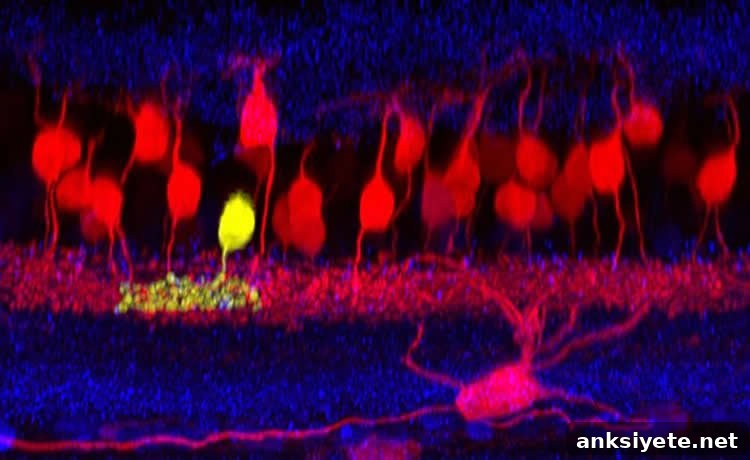
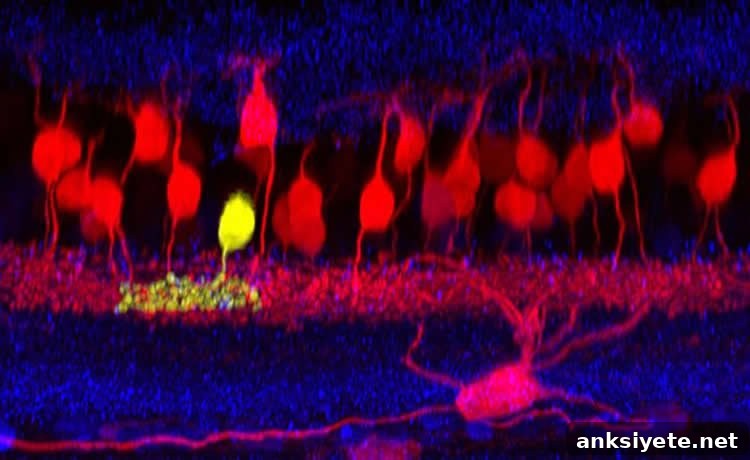
Summary: Researchers have identified a previously unrecognized neuron in the mouse retina that does not fit traditional categories of retinal interneurons.
Source: UW Medicine.
A newly described GluMI cell combines the anatomy of a monopolar interneuron with the excitatory behavior of bipolar cells, revealing an unexpected pathway for retinal signaling.
Scientists studying the mouse retina have uncovered a neuron that challenges the century-old classification of interneurons in this well-characterized tissue.
Neurons transmit information by receiving and sending electrical and chemical signals. The newly identified cell, named the glutamatergic monopolar interneuron or GluMI (pronounced “gloomy”) by researchers at UW Medicine, has the morphology of a monopolar interneuron yet functions like an excitatory bipolar cell.
Luca Della Santina, a co-lead author on the study and former postdoctoral researcher in the University of Washington Department of Biological Structure, said the discovery opens up a new perspective on how visual information is routed within the retina.
The team reported their findings in the paper “Glutamatergic monopolar interneurons provide a novel pathway of excitation in the mouse retina,” published in Current Biology on Aug. 8, 2016.
For more than a century, retinal interneurons have been sorted into two broad groups. Bipolar cells typically receive direct input from photoreceptors, the light-sensitive cells that capture visual information, and relay excitatory signals to retinal ganglion cells, which send visual output to the brain. Monopolar interneurons—commonly referred to as amacrine cells—have been classified as mostly inhibitory and are not thought to receive direct photoreceptor input.
GluMIs break that dichotomy. They are structurally monopolar, resembling amacrine cells, but they are glutamatergic and provide excitatory input to ganglion cells, a role normally associated with bipolar neurons.
Della Santina first noticed these unusual cells in 2010 while examining the retinas of transgenic mice that express fluorescent markers to label different cell types. He observed cells with a monopolar shape that did not carry the usual markers of inhibitory interneurons.
After initial observations, a team of researchers from UW Medicine—Rachel Wong, Sidney Kuo, Takeshi Yoshimatsu, Fred Rieke—and collaborators including a researcher from the University of Tokyo, undertook a detailed analysis to resolve the apparent contradiction between structure and function.
They began by characterizing GluMI anatomy. Under conventional microscopy, GluMIs appeared to contain synaptic ribbons, specialized presynaptic structures typically associated with bipolar cells. To confirm this, the researchers used serial block-face electron microscopy, an advanced technique that produces high-resolution three-dimensional images of neuronal ultrastructure at nanometer scale. These 3-D reconstructions verified the presence of ribbon synapses in GluMI terminals.
Next, the team tested GluMI function. Postdoctoral researcher Sidney Kuo, working with Fred Rieke, demonstrated that GluMIs respond to light and can drive excitatory signals to retinal ganglion cells. However, unlike bipolar cells, GluMIs do not receive direct synaptic input from photoreceptors. Instead, their light responses are shaped by inhibitory inputs originating from both ON and OFF retinal pathways, leaving the precise source and circuit mechanism that generates their light-driven signals an open question.
Because GluMIs combine anatomical features of monopolar interneurons with glutamatergic transmission and ribbon synapses, the researchers chose the descriptive name glutamatergic monopolar interneuron (GluMI). Rachel Wong noted that the name “gloomy” was a lighthearted reference and not intended to describe Seattle weather.
The team found that GluMIs make substantial synaptic contacts onto a particular class of retinal ganglion cell known as OFF-sustained A-type (AOFF-S) RGCs. In fact, GluMIs make nearly as many synapses onto these ganglion cells as do type 2 OFF bipolar cells. Nevertheless, GluMIs and type 2 OFF bipolar cells produce different light-response profiles, suggesting they supply distinct components of excitation to the same ganglion cell targets.
These findings reveal an unexpected excitatory circuit element in the vertebrate retina and highlight the complexity of neuronal identity even in regions of the central nervous system that have been intensively studied. The existence of GluMIs suggests that classical distinctions based on morphology, transmitter type, and synaptic architecture may not always align and that the retina uses more diverse strategies to encode visual information than previously appreciated.
Funding: This research received support in part from National Institutes of Health R01 grants EY017101, EY11850, and EY01730.
Source: Anne Trafton, UW Medicine. Image credit: UW Medicine. Original research: “Glutamatergic Monopolar Interneurons Provide a Novel Pathway of Excitation in the Mouse Retina” by Luca Della Santina et al., Current Biology. Published online July 14, 2016. DOI: 10.1016/j.cub.2016.06.016.
GluMIs represent a novel class of retinal interneuron that are morphologically monopolar but biochemically and functionally glutamatergic, and they form ribbon synapses usually associated with bipolar cells. They do not receive direct input from photoreceptors and their light responses are strongly modulated by inhibitory inputs from both ON and OFF pathways. GluMIs make substantial excitatory contacts onto AOFF-S retinal ganglion cells, providing a distinct route of light-driven excitation that complements input from OFF bipolar cells. This discovery expands our understanding of excitatory circuitry in the vertebrate retina and underscores the diversity of neuronal types and pathways even in well-studied neural tissues.
The researchers plan further experiments to clarify how GluMIs integrate network inputs and contribute to visual processing, and to determine whether similar cells exist in other species.