
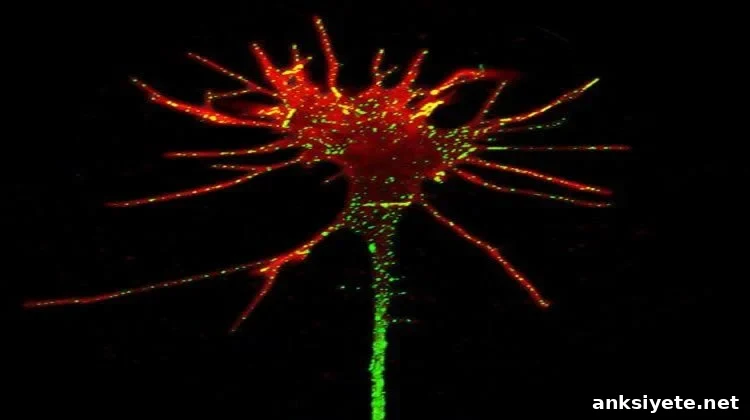
A detailed analysis of how nerve fiber tips form crucial connections during brain development could improve our understanding of the origins of some cognitive disorders.
Researchers at the University of Queensland—working across the Queensland Brain Institute, the School of Mathematics and Physics, and the School of Biomedical Sciences—have identified six fundamental shape dimensions that characterize the appearance of nerve fiber tips as they navigate the developing nervous system to form synaptic connections.
The team, led by Professor Geoff Goodhill of QBI, set out to clarify a relationship that had remained largely unexplored: how the complex shapes of growing nerve endings relate to the way axons find their targets during development.
“We want to understand how nerve fibers are guided to their targets,” Professor Goodhill explained. The study focuses on the morphology of growth cones, the dynamic structures at the tips of extending axons that interpret guidance cues and steer growth. Although growth cones display intricate and highly variable shapes, previous research had not systematically quantified those shapes or linked them to the process of directed growth.
The researchers collected and analyzed more than 50,000 images of nerve fibers from different preparations. Using a mathematical approach, they reduced each observed growth cone to a set of 500 parameter points that together described its outline and structure. From that large dataset, they extracted six principal dimensions that summarize the majority of the meaningful variation in growth cone morphology.
One of the central findings is that growth cone shapes are not static: they oscillate. The study found a direct connection between these oscillations and growth speed — growth cones that showed stronger and faster shape oscillations tended to advance more rapidly. This observation suggests that particular dynamic features of growth cone morphology are closely tied to the mechanics of axon extension and the ability of a fiber to relocate itself toward appropriate targets.
Importantly, the same six morphological dimensions and dynamic patterns appeared across preparations and species. The researchers observed that rat nerve fibers growing in an in vitro culture system and zebrafish nerve fibers growing within the intact, living brain displayed similar growth cone shapes and behaviors. That cross-species consistency supports the idea that the identified shape dimensions reflect basic, conserved biological properties of growth cones rather than artifacts of a single experimental system.
Understanding these conserved morphological rules offers a framework for examining how accurate wiring of the nervous system is achieved during development. The brain’s connectivity is staggeringly complex—there are thought to be an enormous number of synaptic connections—and even small errors in the initial wiring process can have outsized consequences for circuit function. Recent work in the field has pointed to faulty axon guidance and miswiring as potentially contributing factors in a range of neurodevelopmental and neurological conditions, including autism spectrum disorder, dyslexia, Down syndrome, Tourette’s syndrome and Parkinson’s disease. By defining the normal rules and dynamics that govern growth cone behavior, scientists gain a clearer basis for investigating how and why wiring errors arise.
Professor Goodhill and colleagues emphasized that the next steps will be to probe the causal role of these morphological dynamics in navigation. They plan to investigate how specific shape features influence decision-making during pathfinding and whether the behaviors of growth cones can be modulated experimentally. Such work could reveal mechanisms by which guidance cues and internal cytoskeletal processes produce particular oscillatory patterns and, ultimately, effective guidance to targets.
The research team applied rigorous image analysis and mathematical modeling techniques to transform raw microscopy images into quantitative shape descriptors. By working across different experimental models and applying the same analytical pipeline, they were able to identify generalizable features of growth cone morphology and dynamics rather than system-specific quirks.
Funding for the project came from grants awarded by the Australian Research Council and the National Health and Medical Research Council. The peer-reviewed results of the analysis are reported in the journal BMC Biology.
Contact: Darius Koreis – University of Queensland
Source: University of Queensland press release
Image source: Zac Pujic, adapted from University of Queensland materials
Original research: Geoffrey J. Goodhill and colleagues, “The dynamics of growth cone morphology” (BMC Biology). Published online February 11, 2015. DOI: 10.1186/s12915-015-0115-7