
Summary: Researchers mapped the inputs to two rare types of striatal interneurons linked to psychiatric and movement disorders. The findings help clarify how distinct neural pathways contribute to conditions ranging from depression to Parkinson’s disease and may point to new treatment targets.
Source: Salk Institute.
When most of your neighbors are outgoing, you naturally learn more about them than the few who keep to themselves. The same is true in the brain: neuroscientists understand a great deal about the 95 percent of striatal neurons that send signals outside the striatum, but far less about the roughly 5 percent that communicate only within the striatum.
Scientists at the Salk Institute have now charted where those local signals originate for two rare interneuron types in the striatum, clarifying their distinct input pathways and strengthening links between each cell type and different kinds of brain disorders. The study, published in eLife, focused on cholinergic (ChAT) and parvalbumin-expressing (PV) interneurons and reveals separate cortical and subcortical sources of information that help explain their likely roles in cognitive versus sensorimotor function.
“Studying striatal interneurons is challenging because they are so few in number,” says Xin Jin, associate professor in the Molecular Neurobiology Laboratory at the Salk Institute and senior author of the paper. “Targeting a small population—sometimes only a dozen cells—makes it difficult to determine cause and effect with standard recording methods.”
ChAT and PV interneurons together make up less than 2 percent of the striatal neuron population. Postmortem studies in humans have linked decreased ChAT interneurons to psychiatric conditions such as depression and schizophrenia, while reductions in PV interneurons have been observed in movement disorders including Huntington’s disease, Tourette syndrome and dystonia. Because these interneurons are sparse, conventional electrophysiological recordings and other standard techniques yielded limited insight into their whole-brain input organization.
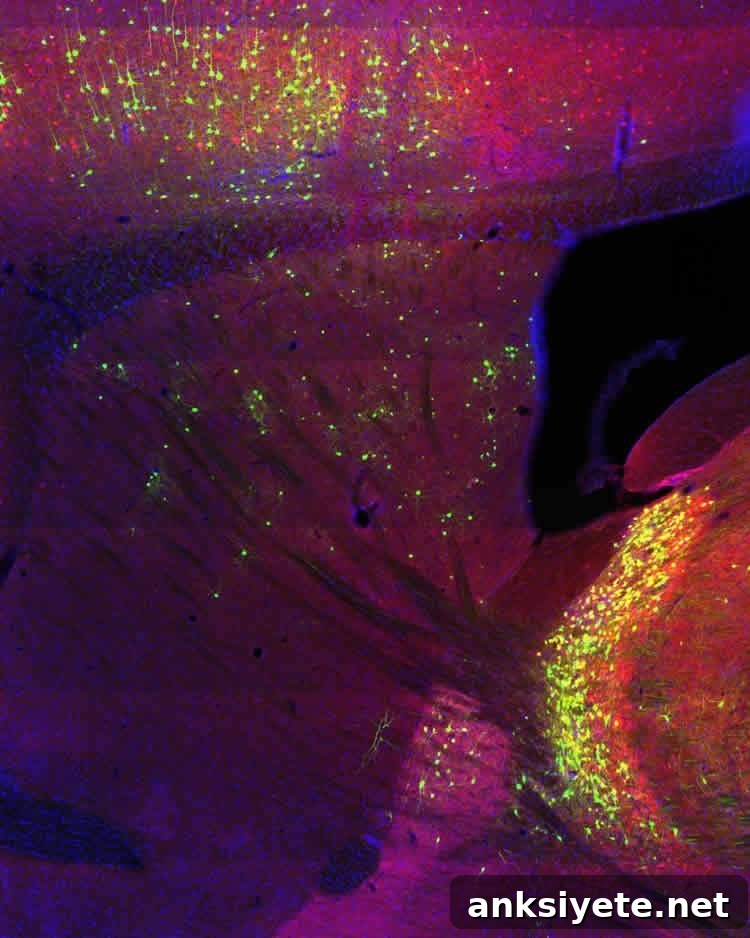
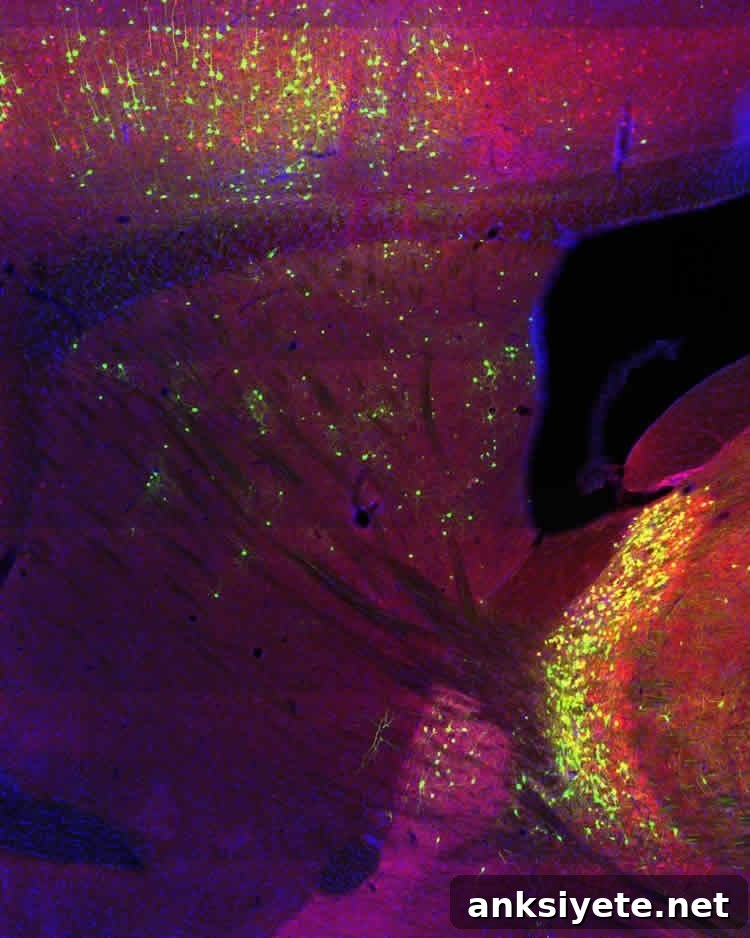
To overcome that limitation, the Salk team used a viral tracing approach developed by colleague Edward Callaway: a modified rabies virus labeled with a fluorescent marker that marks which neurons connect to a genetically targeted cell population. This whole-brain rabies tracing in mice allowed the researchers to map the origins of inputs to ChAT and PV interneurons across the brain.
The tracing revealed a clear dissociation in input sources. ChAT interneurons received substantial input from associative cortical regions implicated in higher cognitive processing, including orbitofrontal and other prefrontal areas. In contrast, PV interneurons were principally targeted by sensorimotor cortical regions. These divergent input patterns match clinical associations of ChAT interneurons with psychiatric disorders and PV interneurons with sensorimotor and movement disorders, suggesting distinct roles for these interneurons in regulating striatal circuits.
In addition to confirming expected cortical sources, the study identified a previously unrecognized subcortical projection: neurons in the thalamic reticular nucleus (TRN) that project directly to striatal PV interneurons. The TRN has been most commonly described as a thalamic structure that gates attention, and its projection to the striatum had not been characterized before. This finding suggests a new anatomical route by which attentional mechanisms could influence striatal processing of sensorimotor information.
Because the TRN-striatum connection was unexpected, the team validated the rabies tracing results with two independent functional techniques. First, they used optogenetics to activate TRN neurons with light. Second, they performed electrophysiological recordings from striatal PV interneurons to determine whether TRN activation produced synaptic responses. The recordings confirmed that stimulating TRN neurons evoked responses in PV interneurons, establishing functional connectivity in addition to the anatomical tracing evidence.
“Combining anatomical screening with rabies tracing and functional verification by optogenetics and electrophysiology was essential,” says Jason Klug, first author and research associate at the Salk Institute. “This multi-method approach allowed us to uncover inputs that were overlooked or underappreciated by earlier studies.”
Xin Jin adds, “The TRN has long been proposed to act as an attentional spotlight. Our discovery of a TRN projection to the striatum points to a mechanism for coordinating attention with action selection through direct TRN–striatal communication. That has important implications for understanding both normal brain function and disorders that affect attention, motor control, and their interaction.”
The research team plans to continue exploring how ChAT and PV interneurons influence behavior, how their distinct inputs shape striatal processing, and whether these interneurons can serve as therapeutic targets in psychiatric and neurological disorders.
Funding: This work was supported by the National Institutes of Health (R01NS083815 and R01AG047669), the Dana Foundation, the Ellison Medical Foundation, and the Whitehall Foundation.
Source: Salk Institute.
Publisher: Organized by NeuroscienceNews.com.
Image Source: Image credit: Salk Institute.
Original Research: Open access research titled “Differential inputs to striatal cholinergic and parvalbumin interneurons imply functional distinctions” by Jason R. Klug, Max D. Engelhardt, Cara N. Cadman, Hao Li, Jared B. Smith, Sarah Ayala, Elora W. Williams, Hilary Hoffman, and Xin Jin, published in eLife on May 1, 2018. DOI: 10.7554/eLife.35657.
Salk Institute. “Where Brain Cells Get Their Information May Determine Their Roles in Diseases.” NeuroscienceNews. May 2, 2018. (Adapted summary)
Abstract
Differential inputs to striatal cholinergic and parvalbumin interneurons imply functional distinctions
Striatal cholinergic (ChAT) and parvalbumin (PV) interneurons exert powerful influences on striatal circuitry in health and disease, but the organization of their inputs has been unclear. Using rabies virus tracing, electrophysiology, and genetic tools in mice, this study compares whole‑brain inputs to ChAT and PV interneurons and dissects their functional connectivity. ChAT interneurons receive substantial cortical input from associative regions such as orbitofrontal cortex. Among subcortical inputs, an inhibitory projection from the thalamic reticular nucleus (TRN) to striatal PV interneurons is identified. The external segment of the globus pallidus targets striatal ChAT interneurons and can inhibit their tonic firing. A novel excitatory pathway from the pedunculopontine nucleus to ChAT interneurons is also described. These results map direct brain‑wide inputs to two major striatal interneuron types and suggest distinct roles for each in regulating striatal activity and behavior.