
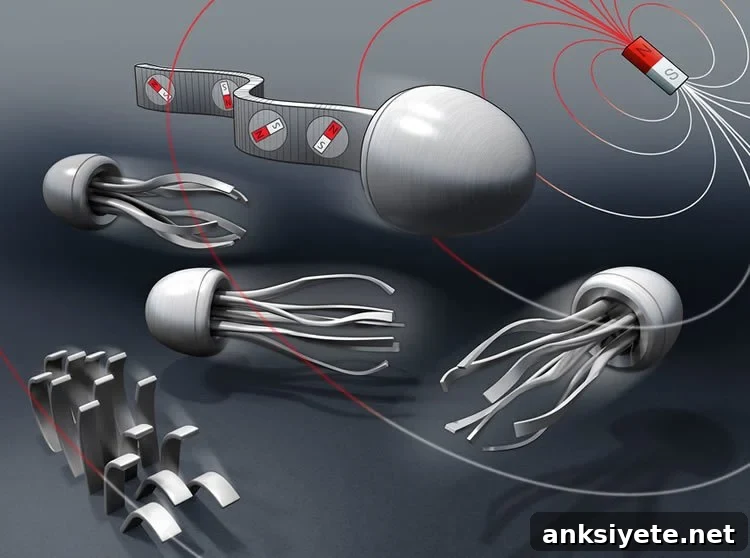
Summary: Researchers have developed magnetically programmable microbots made from soft elastomers that can produce controlled, time-varying shapes.
Source: Max Planck Institute.
Soft magnetic materials that generate time-varying shapes could power microswimmers
Microrobots that swim like sperm, paramecia, or jellyfish could one day navigate tiny environments inside the body or operate in confined microfluidic systems. Researchers at the Max Planck Institute for Intelligent Systems in Stuttgart have designed soft, magnetically responsive elastomers that reproduce the beating patterns of biological flagella, cilia, and jellyfish limbs. Coupled with a purpose-built computational algorithm, the team can now automatically compute the magnetic programming and external fields needed to produce specific dynamic gaits. Beyond locomotion, this shape-programming approach may enable a host of microscale engineering functions such as pumping, mixing, and targeted actuation in lab-on-a-chip and biomedical settings.
Replicating biological strokes with magnetized elastomers
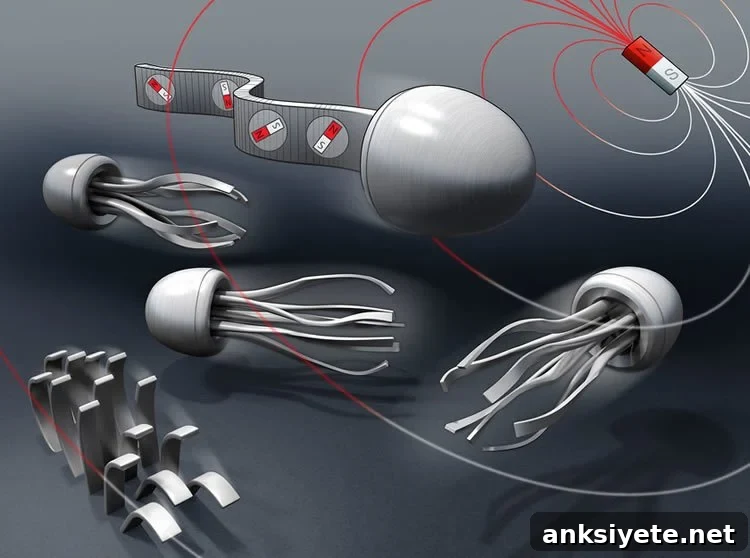
The researchers created thin silicone strips just a few millimeters long by embedding magnetizable neodymium-iron-boron particles into the elastic matrix. By controlling how the elastomer is magnetized and then applying external magnetic fields, the soft strips can be made to bend and wave in coordinated patterns. Using this fabrication and actuation strategy, the team reproduced undulatory flagellar motion similar to sperm, the asymmetric rowing stroke of cilia that propels paramecia, and the rhythmic tentacle movements of a simple jellyfish-like construct.
Key to these behaviors is the ability for different regions of the elastomer to respond differently to the same applied field. Some zones must be attracted while others are effectively repelled; without spatially varying magnetic response, the material could not deform into traveling waves, fold at the ends, or execute asymmetric strokes.
Special magnetization technique enables spatially varying response
To generate distinct magnetic responses along a single soft strip, the team combined two techniques. First, they varied the local concentration of magnetic particles during fabrication so that, after initial magnetization, different regions hold different magnetic strengths. Second, they controlled the magnetization orientation of those particles by deforming the elastomer into a temporary shape while applying a strong magnetizing field. Although the particles are magnetized in a uniform field, the temporary deformation reorients them so that when the strip is returned to its original flat shape each region carries a deliberately chosen magnetization direction.
After that initial programming, the researchers operated the devices under weaker, time-varying magnetic fields that do not remagnetize the material but cause the preprogrammed regions to attract or repel in concert. By adjusting the external field’s strength and direction over time, the soft strips trace the desired dynamic shapes and beating patterns.
Automated design: computing optimal magnetization and fields
One major advance reported by the team is the development of a mathematical and computational framework that automatically calculates the magnetization profile and the time-varying magnetic fields required to obtain a desired motion. Previously, researchers relied largely on intuition and trial-and-error to approximate magnetization patterns for a given task. The new algorithm models the physics of shape-programmable magnetic soft matter and produces practical magnetization and actuation strategies for both two-dimensional and three-dimensional dynamic behaviors.
This capability shortens design cycles and opens the door to systematically creating a wide variety of miniature soft devices capable of complex, coordinated motion.
Potential applications in microrobotics and micro-scale engineering
The ability to program and remotely actuate soft materials in milliseconds offers many possible applications. In biomedical contexts, shape-programmable micro-swimmers could act as drug carriers or micro-tools that are guided magnetically to specific sites within the body. In engineering and lab-on-a-chip systems, magnetically driven soft structures could serve as micro-pumps, mixers, valves, or moving surfaces that manipulate fluids and particles without onboard power or complex control electronics.
Because the underlying computational approach is universal for designing time-varying shapes, the technology could inspire new classes of miniature soft devices across robotics, materials science, and biomedical engineering. The fabrication method demonstrated in the study is currently optimized for planar beam geometries, but the theory and computational methods extend to broader 2D and 3D shape-programmable systems.
About this research
Source: Annette Stumpf, Max Planck Institute for Intelligent Systems. Image credit to Phil Loubere.
Original research (open access): “Shape-programmable magnetic soft matter” by Guo Zhan Lum, Zhou Ye, Xiaoguang Dong, Hamid Marvi, Onder Erin, Wenqi Hu, and Metin Sitti. Published online September 26, 2016. The study develops theoretical formulations, computational strategies, and fabrication procedures for programming magnetic soft matter, and demonstrates a jellyfish-like robot, a spermatozoid-like undulating swimmer, and an artificial cilium that mimics biological beating patterns.
Abstract
Shape-programmable matter is a class of active materials whose geometry can be controlled to achieve mechanical functionalities beyond those of traditional machines. Magnetically actuated matter is particularly promising for producing complex time-varying shapes at sub-centimeter scales. Prior work relied on human intuition to approximate the required magnetization profile and external fields. Here, researchers propose a universal programming methodology that automatically generates the magnetization profile and actuation fields needed for soft matter to realize specified time-varying shapes. The method integrates theory, computation, and fabrication. The theoretical and computational components are applicable to programming both 2D and 3D shapes, while the fabrication technique presented is suited to creating planar beams. Using this approach, the authors demonstrate a set of miniature soft devices including a jellyfish-like robot, an undulating swimmer, and a biomimetic cilium.