
Summary: New guidance from Penn State researchers outlines practical steps—such as removing digital devices from bedrooms and adopting calming pre-bed routines—to support healthy sleep for children and adolescents.
Source: Penn State.
Penn State researchers recommend removing electronic media from bedrooms and promoting calming bedtime routines to improve sleep among children and teens.
These recommendations are drawn from a manuscript published in a special supplement of Pediatrics that reviews evidence showing how screen-based media use before bed is linked to shorter and later sleep in young people.
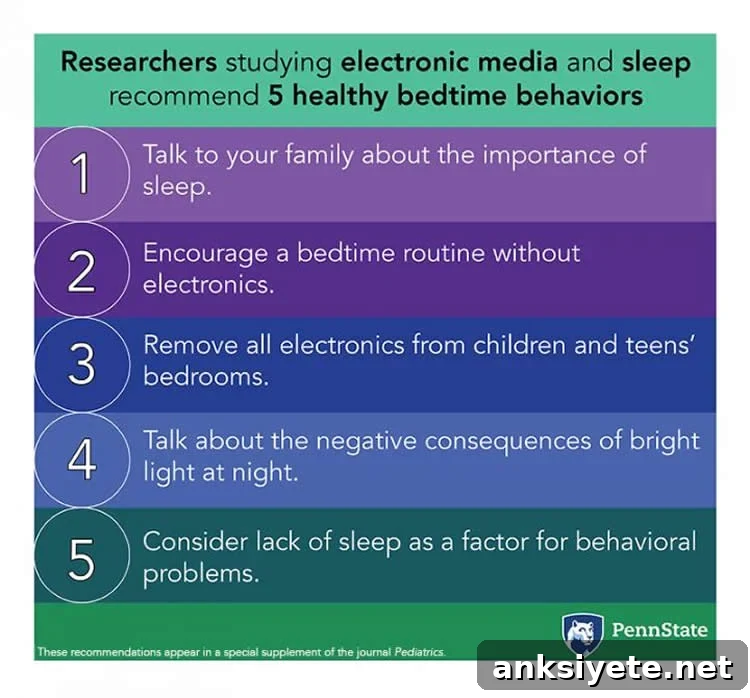
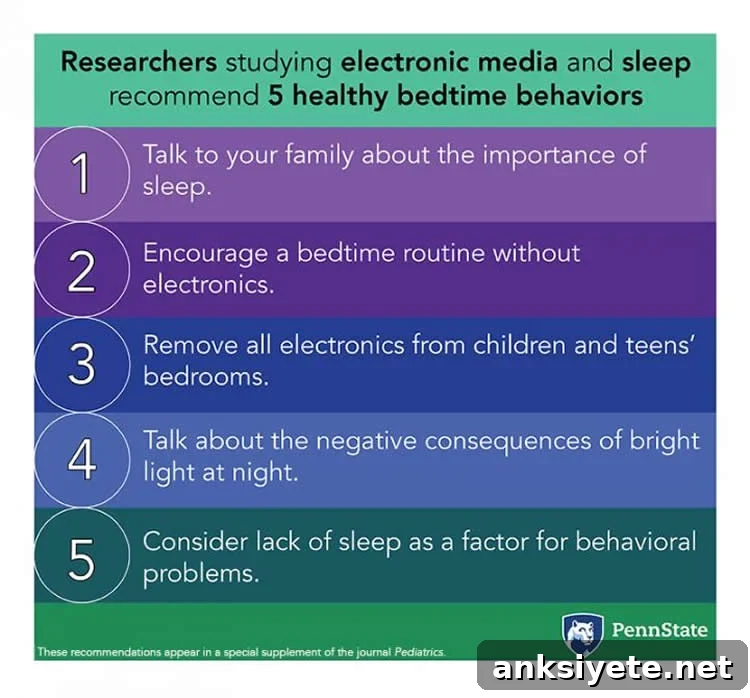
The practical recommendations for parents, caregivers, and clinicians are:
1. Make sleep a family priority by discussing the importance of adequate sleep and establishing realistic, developmentally appropriate sleep expectations;
2. Establish a consistent bedtime routine that emphasizes quiet, calming activities and avoids the use of electronic media in the hour before sleep;
3. Remove all electronic devices from children’s and adolescents’ bedrooms—this includes televisions, video game consoles, desktop and laptop computers, tablets, and mobile phones;
4. Educate family members about how bright light in the evening—especially light from screens—can shift circadian timing and make it harder to fall asleep; and
5. Consider insufficient sleep as a potential contributing factor when a child or adolescent presents with mood, attention, or behavioral problems.
“Recent reviews of the scientific literature show that most studies report an adverse relationship between screen-based media use and sleep health, with delayed bedtimes and shorter total sleep time being the most consistent findings,” said Orfeu Buxton, associate professor of biobehavioral health at Penn State and a coauthor of the manuscript.
The mechanisms that likely link screen time to poorer sleep include several overlapping factors: time displacement, where time spent on devices replaces opportunities for sleep; psychological and physiological stimulation from engaging media content; and the effects of light from screens that can delay the body’s internal clock and increase alertness at a time when sleep is desired.
Buxton and his colleagues are continuing to investigate these issues. Current research efforts aim to clarify how media use influences sleep timing and duration across childhood and adolescence; how family routines and parenting practices shape media habits and sleep; the relationship between screen exposure and perceived sleep quality and daytime tiredness; and how evening light exposure interacts with developing circadian systems to affect sleep health.
The manuscript’s coauthors include Anne-Marie Chang (Penn State), Lauren Hale (Stony Brook Medicine), Monique LeBourgeois and Lameese Akacem (University of Colorado Boulder), Hayley Montgomery-Downs (West Virginia University), and Orfeu Buxton (Penn State). The paper, titled “Digital Media and Sleep in Childhood and Adolescence,” summarizes existing research and offers recommendations for both practice and future studies.
Source: Marjorie S. Miller, Penn State.
Publisher: NeuroscienceNews.com.
Image credit: Joslyn Neiderer, Penn State.
Original research: “Digital Media and Sleep in Childhood and Adolescence” by Monique K. LeBourgeois, Lauren Hale, Anne-Marie Chang, Lameese D. Akacem, Hawley E. Montgomery-Downs, and Orfeu M. Buxton, published in Pediatrics (special supplement, November 2017).
Digital Media and Sleep in Childhood and Adolescence
With widespread use of screen-based media and a high prevalence of insufficient sleep among children and teenagers, this concise review summarizes evidence linking electronic media use to poorer sleep outcomes and outlines priorities for future research. Systematic reviews show a consistent pattern: greater screen exposure is associated with later bedtimes and reduced overall sleep duration among youth. Three main mechanisms are proposed: (1) time displacement—screen use displaces time that could be used for sleep and other restorative activities; (2) psychological stimulation from content that increases arousal and delays sleep onset; and (3) exposure to artificial light from screens, which can shift circadian rhythms, alter sleep physiology, and increase evening alertness. Much of the current evidence relies on cross-sectional designs and self-reported measures; therefore, additional experimental and longitudinal research is needed to determine how changes in media use and evening light exposure affect sleep and circadian development across infancy, childhood, and adolescence, and how disrupted sleep contributes to health, learning, and safety outcomes such as obesity, depression, and risk-taking behaviors.
Authors: Monique K. LeBourgeois, Lauren Hale, Anne-Marie Chang, Lameese D. Akacem, Hawley E. Montgomery-Downs, and Orfeu M. Buxton. Pediatrics, November 2017.