
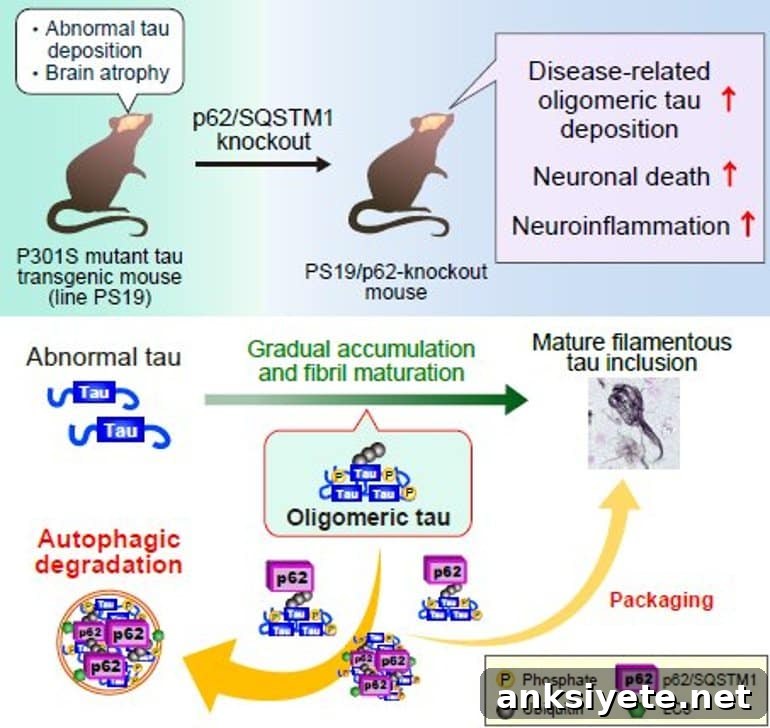
Summary: Researchers identify a central role for the p62 gene in the selective autophagy and clearance of toxic tau oligomers.
Source: National Institutes for Quantum Science and Technology
Cells preserve internal balance through selective autophagy, a process that identifies and degrades unwanted or toxic proteins. This selection is directed by autophagy receptor proteins that bind damaged or aggregated proteins and target them for removal.
Tau proteins normally stabilize the internal structure of neurons, but when abnormally modified—particularly by hyperphosphorylation—they can form oligomers and larger aggregates. These toxic tau species contribute to neurofibrillary tangles (NFTs), neuronal loss, and the progressive cognitive decline seen in dementia and Alzheimer’s disease.
Although selective autophagy has been implicated in tau clearance, the precise molecular mechanisms that recognize and remove pathogenic tau species in living brains remained unclear. A recent study from the National Institutes for Quantum Science and Technology (Japan) sheds light on this question by demonstrating a protective function for the p62 (SQSTM1) gene in removing toxic tau oligomers in a mouse model of tauopathy.
Led by Maiko Ono and Naruhiko Sahara from the Department of Functional Brain Imaging, the research team published their results in Aging Cell on 5 June 2022. Their experiments used P301S mutant tau transgenic mice (PS19), a well-established model of tauopathy, and compared animals with intact p62 to those in which the p62 gene was knocked out (p62-KO).
Previous work had suggested that p62, a ubiquitin-binding selective autophagy receptor, can recognize ubiquitinated protein aggregates. In this study, the authors tested whether p62 is required in vivo to control accumulation of toxic tau oligomers and to protect neurons from tau-induced damage. Their findings reveal that p62 helps identify and eliminate disease-related tau species, thereby preventing inflammation, neuronal loss, and brain atrophy.
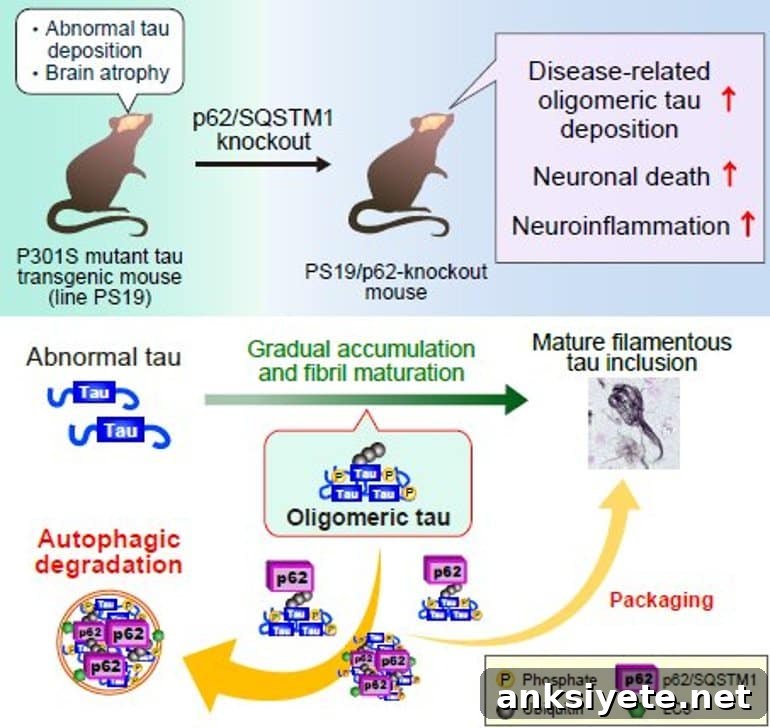
The investigators mapped tau accumulation across brain regions and found important regional differences. In PS19 mice with intact p62, neurofibrillary tangles and p62 co-localization were prominent in the brainstem, whereas the hippocampus—critical for memory—showed fewer tangles and lower p62 levels. In PS19 mice lacking p62, both the hippocampus and brainstem accumulated increased amounts of phosphorylated and oligomeric tau.
MRI and histological analyses revealed that p62-KO mice developed hippocampal atrophy, heightened inflammation, and greater neuronal loss compared with PS19 mice that expressed p62. Immunofluorescence and dot-blot assays using antibodies selective for tau dimers and higher-order oligomers confirmed that oligomeric tau species were significantly enriched in PS19/p62-KO brains.
These results indicate that p62 is necessary to eliminate oligomeric tau species that are thought to be especially neurotoxic. In the absence of p62, oligomeric tau accumulates, triggering cytotoxic pathways, neuroinflammation, and accelerated neuronal degeneration. Thus, p62 acts in a neuroprotective capacity by facilitating selective autophagic removal of disease-related tau species.
Understanding how p62 and selective autophagy target tau oligomers is important for therapeutic strategies aimed at slowing or preventing tau-driven neurodegenerative diseases. By showing that manipulation of p62 levels affects tau clearance and pathology in vivo, this study supports the idea that enhancing selective autophagy or modulating p62 function could be a viable approach to treat tauopathies such as Alzheimer’s disease and other forms of dementia.
As populations age globally and the burden of neurodegenerative disease grows, identifying intrinsic cellular systems that limit toxic protein accumulation remains a high priority. This work provides clear experimental evidence that p62-mediated selective autophagy contributes to neuronal resilience against tau pathology and offers a direction for future research into therapies that target tau oligomers.
About this genetics and neuroscience research news
Author: Press Office
Source: National Institutes for Quantum Science and Technology
Contact: Press Office – National Institutes for Quantum Science and Technology
Image: The image is credited to National Institutes for Quantum Science and Technology
Original Research: Open access. “Central role for p62/SQSTM1 in the elimination of toxic tau species in a mouse model of tauopathy” by Maiko Ono et al., Aging Cell
Abstract
Central role for p62/SQSTM1 in the elimination of toxic tau species in a mouse model of tauopathy
Intracellular accumulation of filamentous tau aggregates with progressive neuronal loss is a hallmark of tauopathies. While the mechanisms driving tau-induced neurodegeneration remain incompletely understood, molecular systems capable of degrading or sequestering neurotoxic tau species could slow disease progression.
We provide evidence that p62/SQSTM1, a ubiquitin-binding cargo receptor for selective autophagy, protects neurons from death and neuroinflammation triggered by abnormal tau accumulation. P301S mutant tau transgenic mice (line PS19) show neurofibrillary tangle accumulation with p62 localization primarily in the brainstem, but the hippocampus exhibits neuronal loss with fewer tangles and lower p62 levels.
In PS19 mice lacking p62 (PS19/p62-KO), phosphorylated tau accumulation increased, neuronal loss accelerated, and neuroinflammation worsened in the hippocampus compared with PS19 mice. Abnormal tau and inflammation were also elevated in the brainstem of PS19/p62-KO animals. Immunostaining and dot-blot analyses using an antibody selective for tau dimers and higher-order oligomers demonstrated significantly greater accumulation of oligomeric tau species in PS19/p62-KO mice than in PS19 controls, indicating that p62 is required to eliminate disease-related oligomeric tau.
These findings suggest that p62 exerts neuroprotection against tau pathology by removing neurotoxic tau species and that targeting p62-mediated selective autophagy may offer an intrinsic therapeutic approach for treating tauopathy.