
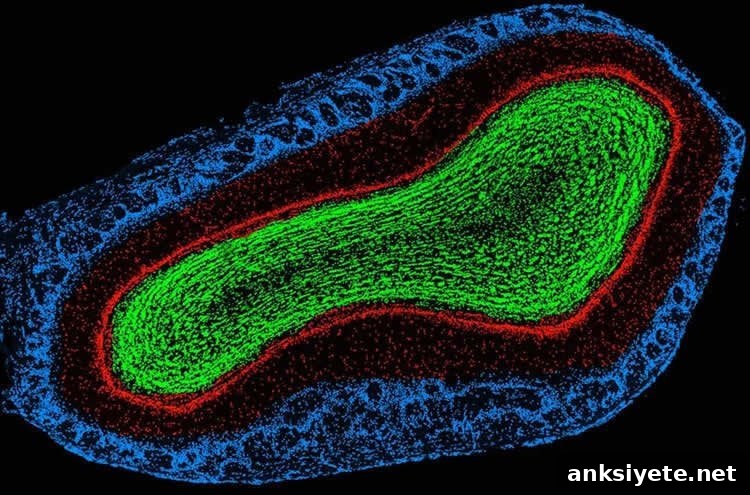
Researchers at the University of Pittsburgh School of Medicine have identified the mechanism behind a long-standing mystery of how the sense of smell organizes receptor expression. In a paper published online in the Proceedings of the National Academy of Sciences, the team reports that a simple physical principle—cooperativity—underlies this surprisingly elegant biological solution.
When we inhale, a complex mixture of odor molecules travels to the back of the nose and binds to specialized olfactory receptors that sit on millions of sensory neurons. Activation of those receptors produces neuronal signals that travel to the brain, where the identity and quality of a scent are interpreted.
Each olfactory sensory neuron expresses a single type of receptor and therefore responds to a subset of odor molecules. Yet across the entire population of sensory neurons, hundreds to thousands of different olfactory receptor types are represented roughly evenly. This dual outcome—monoallelic, single-receptor expression in each neuron combined with broad receptor diversity across the population—has puzzled scientists for decades, explained senior investigator Jianhua Xing, Ph.D., associate professor of computational and systems biology at the University of Pittsburgh School of Medicine. The discovery of olfactory receptors and these observations by Richard Axel and Linda Buck earned them the 2004 Nobel Prize in Physiology or Medicine.
“The central question has been how biology reliably chooses one, and only one, receptor gene for each neuron while simultaneously ensuring that all receptor types are represented across the population,” said Dr. Xing.
To address that question, Dr. Xing and colleagues built a computational model grounded in existing experimental data about olfactory receptor expression. The model integrates known molecular interactions and regulatory features to explain how individual neurons settle on a single receptor allele yet the organism as a whole maintains maximal receptor-type diversity. The model reproduced known experimental findings and correctly predicted several additional observations verified by other groups, supporting its validity.
Unexpectedly, the model revealed that receptor selection is governed by a three-layer regulatory design that leverages cooperativity—a phenomenon in which elements in a system influence one another rather than acting independently. Cooperativity is a familiar physical principle that explains diverse phenomena, from phase transitions in materials to cooperative folding in proteins.
The three regulatory layers identified by the model are: zonal segregation, which restricts which receptor genes are available in different regions of the olfactory epithelium; an epigenetic barrier-crossing mechanism coupled to a negative feedback loop, which ensures stable monoallelic activation and differs mechanistically from some previous theoretical proposals; and a competitive interaction among enhancers that biases the choice toward a single active receptor gene. Combined, these cooperative and synergistic mechanisms achieve two objectives at once: each neuron stably expresses a single receptor allele, and the overall population preserves broad receptor diversity.
Dr. Xing commented, “It’s remarkable that what appears to be a daunting engineering challenge for the nervous system can be achieved through such a compact, physically grounded design. The cooperative interactions in this regulatory network turn out to be a natural solution to the dual objectives of monoallelic expression and global diversity.”
The model offers a platform for generating new, testable predictions about olfactory receptor regulation. Future experiments inspired by these predictions will help refine the model and deepen understanding of how genetic, epigenetic, and regulatory elements work together to shape sensory coding for smell.
The research team included Xiao-Jun Tian, Ph.D., of the University of Pittsburgh; Jens Sannerud, a former Pitt undergraduate summer research fellow now at Brown University; and Hang Zhang, Ph.D., of Virginia Polytechnic Institute and State University.
Funding: This research was supported by National Science Foundation awards DMS-1545771 and DMS-1462049.
Source: Gloria Kreps – University of Pittsburgh
Image Source: The image is in the public domain.
Original Research: Abstract for “Achieving diverse and monoallelic olfactory receptor selection through dual-objective optimization design” by Xiao-Jun Tian, Hang Zhang, Jens Sannerud, and Jianhua Xing in PNAS. Published online May 9, 2016 doi:10.1073/pnas.1601722113
Abstract
Achieving diverse and monoallelic olfactory receptor selection through dual-objective optimization design
Biological systems frequently solve multiple objectives at once. In the mammalian olfactory system, each sensory neuron typically expresses only one olfactory receptor (OR) allele, while at the organism level the expressed OR repertoire must be as diverse as possible. Prior models emphasized only monoallelic activation and failed to account for several mutant phenotypes, such as the reduced global OR diversity observed in G9a/GLP knockouts. Integrating current knowledge about OR regulation, the authors constructed a physically based model that captures available data and uncovers an evolutionarily optimized three-layer regulatory mechanism: zonal segregation, epigenetic barrier-crossing coupled with a negative feedback loop, and enhancer competition. This framework explains both monoallelic choice and the maximization and maintenance of OR diversity, and its predictions align with existing experimental results. By drawing analogies to thermally activated barrier crossing and applying comparative reverse engineering, the study highlights cooperativity and synergy as general design principles for multiobjective optimization in biology.
“Achieving diverse and monoallelic olfactory receptor selection through dual-objective optimization design” by Xiao-Jun Tian, Hang Zhang, Jens Sannerud, and Jianhua Xing in PNAS. Published online May 9, 2016 doi:10.1073/pnas.1601722113