
Amidst the astounding complexity of the billions of nerve cells and trillions of synaptic connections in the brain, how do nerve cells decide how far to grow or how many connections to build? How do they coordinate these events within the developing brain?
Researchers at the Florida campus of The Scripps Research Institute (TSRI) have provided new insight into these fundamental questions. Their latest study uncovers a more nuanced role for a large intracellular signaling protein, RPM-1, showing that it uses multiple molecular mechanisms to coordinate axon growth and synapse formation during neuronal development.
The work, reported in PLOS Genetics, focuses on RPM-1, a conserved protein expressed in the nervous system. Led by TSRI Assistant Professor Brock Grill, the team reveals how RPM-1 controls axon extension and synaptic construction by directly regulating a signaling protein called DLK-1. DLK-1 is known to influence neuron development and axon regeneration, and its activity must be tightly controlled for normal wiring and repair of the nervous system.
Putting Together the Pieces
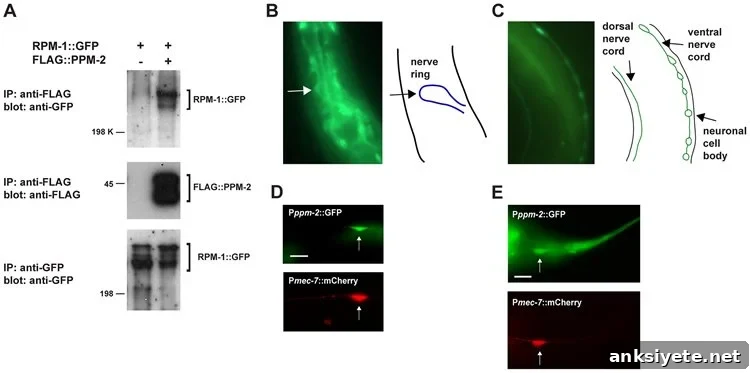
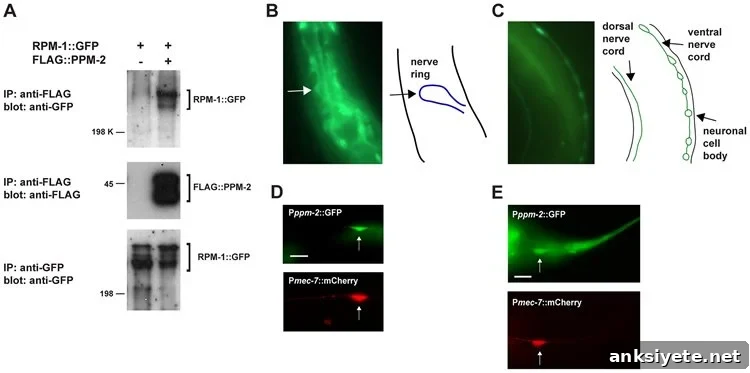
The team discovered that RPM-1 restricts DLK-1 activity through two complementary molecular strategies. First, RPM-1 recruits PPM-2, a phosphatase that removes phosphate groups and thereby modulates target protein activity. Second, RPM-1 engages ubiquitin ligase activity, a process that can mark proteins for degradation or alter their function. By combining phosphatase-based regulation with ubiquitin-dependent control, RPM-1 exerts precise inhibition of DLK-1 to shape axon growth and synapse formation.
According to Scott T. Baker, the study’s first author, RPM-1’s many roles during neuron development make direct manipulation risky, but the discovery that PPM-2 helps control DLK-1 suggests a new, potentially more selective route to influence axon regeneration. Identifying mechanisms that temper DLK-1 activity could have implications for understanding and treating neurodegenerative conditions and enhancing neural repair.
Beyond these molecular interactions, the Grill laboratory has broadened our view of how RPM-1 functions within larger signaling networks. Related research demonstrates RPM-1’s involvement in a pathway that regulates β-catenin, linking RPM-1 to extracellular signaling inputs such as Wnt family growth factors. This connection provides the first evidence that RPM-1 participates in wider developmental signaling cascades rather than acting in isolation.
Additional work has mapped RPM-1’s subcellular localization. RPM-1 is present at both synapses and the mature axon tip, positioning it to coordinate construction of synaptic contacts with the mechanisms that control axon extension and termination. This spatial distribution supports a model in which RPM-1 integrates local signals at the synapse with distal cues at the axon tip to balance growth and connectivity.
The study titled “RPM-1 Uses Both Ubiquitin Ligase and Phosphatase-Based Mechanisms to Regulate DLK-1 during Neuronal Development” includes contributions from Scott T. Baker, Karla J. Opperman, Erik D. Tulgren, Shane M. Turgeon, Willy Bienvenut, and Brock Grill. Related publications from the lab include “The Nesprin Family Member ANC-1 Regulates Synapse Formation and Axon Termination by Functioning in a Pathway with RPM-1 and β-Catenin” (first author Erik D. Tulgren) and “RPM-1 Is Localized to Distinct Subcellular Compartments and Regulates Axon Length in GABAergic Motor Neurons” (first author Karla J. Opperman).
This body of work was supported by grants from the National Institutes of Health and the National Science Foundation, reflecting sustained funding for basic research into molecular mechanisms that regulate neuronal development, axon growth, and synapse formation.
The new findings refine our understanding of how neurons coordinate two essential developmental tasks—growing axons to precise lengths and assembling appropriate synaptic connections—by revealing an intricate regulatory role for RPM-1 that combines enzymatic and proteostatic controls. These insights deepen knowledge of neural circuit assembly and suggest molecular targets that could be explored in efforts to promote repair after injury or to mitigate neurodegenerative processes.