
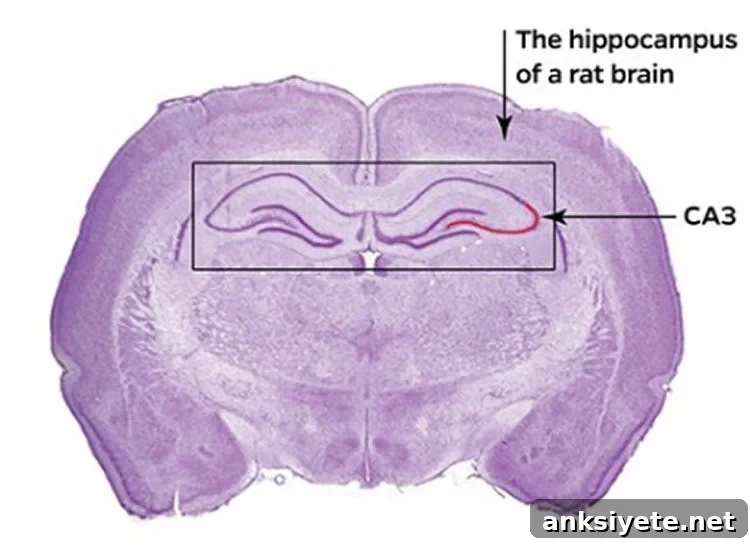
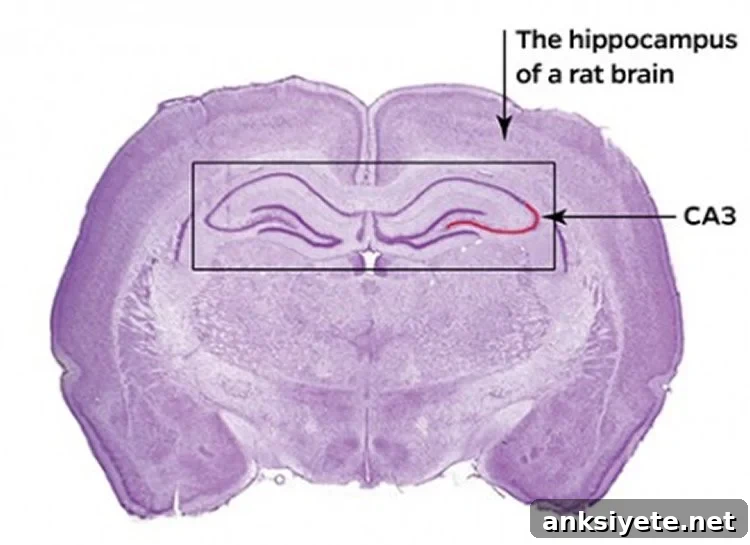
Two parts of the hippocampus work together to decide whether a stimulus is entirely new or a variant of something familiar.
You spot a man in the grocery store and pause: is that the college friend you haven’t seen in years, or merely someone who looks like him?
Neuroscientists at Johns Hopkins University have pinpointed how a small region of the hippocampus helps solve that question. Their results, published in the journal Neuron, clarify how the brain distinguishes genuinely new experiences from altered versions of past ones and shed light on what may go wrong in memory disorders.
“You see a familiar face and think, ‘I believe I’ve seen that face before,’” said James J. Knierim, professor of neuroscience at the Zanvyl Krieger Mind/Brain Institute and lead author of the study. “But is this the same person you met years ago—perhaps with thinner hair or different glasses—or someone else entirely? That is one of the core problems our memory system must solve.”
The hippocampus supports many everyday memory tasks: remembering where you parked, finding your home after a paint job, or recognizing a familiar song. Classic theories proposed that two hippocampal subregions—the dentate gyrus and CA3—have opposing roles. The dentate gyrus was thought to perform pattern separation, generating distinct memory representations for small changes. CA3, with its recurrent circuitry, was thought to drive pattern completion, filling in partial cues to retrieve an existing memory.
Previous work supported that model, but the new research reveals greater nuance inside CA3 itself. Rather than acting as a single homogeneous unit, different parts of CA3 can make divergent decisions and send those differing signals to other brain regions.
“The decisive work of CA3 is to determine whether an input should be treated as the same memory or as a new one,” Knierim explained. “Most of the time you correctly judge that a slightly altered person is the same familiar person. But when you’re wrong—when you embarrassingly discover the person is a complete stranger—you need a clear, separate memory for that new person so you don’t repeat the mistake.”
To study how these computations unfold, Knierim and colleagues Heekyung Lee, Cheng Wang and Sachin S. Deshmukh monitored neural activity in rats as the animals learned and then experienced controlled changes to an environment. The researchers implanted electrodes across the transverse axis of CA3 and recorded neural population activity while rats ran a textured circular track for food rewards. The track surface included distinct textures—sandpaper, carpet padding, duct tape and rubber—while a surrounding curtain displayed visual cues. Over multiple days the rats formed stable spatial maps of this environment.
The critical manipulation introduced a mismatch: the track was rotated counter-clockwise while the curtain cues were rotated clockwise, creating a conflict between local (track) and global (curtain) reference frames. Knierim likened the feeling to opening your house door to find pictures and furniture moved to different walls—a disorienting experience that forces the brain to decide whether the place is the same or different.
Their recordings showed a functional split along the CA3 transverse axis. Proximal CA3—closer to the dentate gyrus and with weaker recurrent collaterals—tended to alter its population activity dramatically when cues conflicted, effectively creating a new representation of the environment (pattern separation). Distal CA3—closer to CA2 and equipped with stronger recurrent connections—more often preserved a coherent activity pattern and treated the altered scene as the same stored representation (pattern completion). CA2 activity resembled distal CA3 under these cue-mismatch conditions.
In practical terms, this means that when sensory inputs are subtly changed, some CA3 circuits favor forming a distinct memory while others favor retrieving an existing one. The brain can therefore weigh both interpretations: maintaining stability when the change is minor, yet creating a new memory when the discrepancy becomes significant enough.
These findings validate computational models of associative memory and clarify how heterogeneous circuitry within CA3 supports both pattern completion and pattern separation functions. Better understanding of these mechanisms may help explain memory failures in conditions such as Alzheimer’s disease and inform strategies to preserve memory accuracy during aging.
Funding: This research was supported by National Institutes of Health grants R01 NS039456 and R01 MH094146 and by the Johns Hopkins University Brain Sciences Institute.
Source: Jill Rosen – Johns Hopkins University
Image Source: Johns Hopkins University
Original Research: “Neural Population Evidence of Functional Heterogeneity along the CA3 Transverse Axis: Pattern Completion versus Pattern Separation” by Heekyung Lee, Cheng Wang, Sachin S. Deshmukh, and James J. Knierim in Neuron. Published online August 19, 2015. doi:10.1016/j.neuron.2015.07.012
Abstract
Neural Population Evidence of Functional Heterogeneity along the CA3 Transverse Axis: Pattern Completion versus Pattern Separation
Highlights
• Neural population analyses reveal a functional dissociation along the CA3 transverse axis
• Proximal CA3 population activity demonstrates computational pattern separation
• Distal CA3 population activity demonstrates computational pattern completion
• CA2 population activity is similar to distal CA3 in environments with cue conflicts
Summary
Traditional associative memory models treated CA3 as a homogeneous attractor network because of its recurrent circuitry. Anatomical and physiological gradients, however, suggest functional diversity along the transverse axis. When local and global spatial frames were put into conflict, proximal CA3—near the dentate gyrus and with weaker recurrent collaterals—showed degraded, flexible representations similar to pattern separation. Distal CA3—near CA2 and with strong recurrent collaterals—maintained coherent representations resembling attractor network behavior. CA2 also maintained coherent representations. This dissociation supports the idea that recurrent collateral strength underlies associative, pattern-completing functions in distal CA3, while proximal CA3 contributes to pattern separation.
“Neural Population Evidence of Functional Heterogeneity along the CA3 Transverse Axis: Pattern Completion versus Pattern Separation” by Heekyung Lee, Cheng Wang, Sachin S. Deshmukh, and James J. Knierim in Neuron. Published online August 19, 2015. doi:10.1016/j.neuron.2015.07.012