
Summary: Researchers analyzed decades of data to estimate how many people in the United States have Down syndrome and examined differences across racial and ethnic groups.
Source: Mass General.
First study to trace changes across decades and detail racial and ethnic groups
A new national study provides the first comprehensive estimates of the number of people with Down syndrome in the United States from 1950 through 2010, and for the first time breaks those estimates down by race and ethnicity. The research finds that previous widely cited counts substantially overestimated the population size. The results, published in Genetics in Medicine, offer a clearer baseline for policy makers, health providers, and advocacy organizations concerned with Down syndrome prevalence, care, and services.
Lead author Gert de Graaf, PhD, along with Frank Buckley and senior author Brian Skotko, MD, MPP, used updated data sources and modeling to account for births, prenatal testing and elective termination, migration, and improvements in survival. Their approach combined historical birth estimates for babies with Down syndrome with condition-specific mortality rates to project how the population aged and grew over six decades.
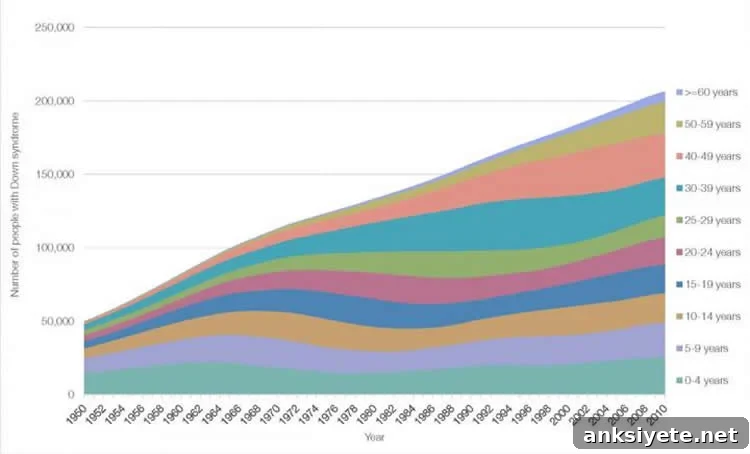
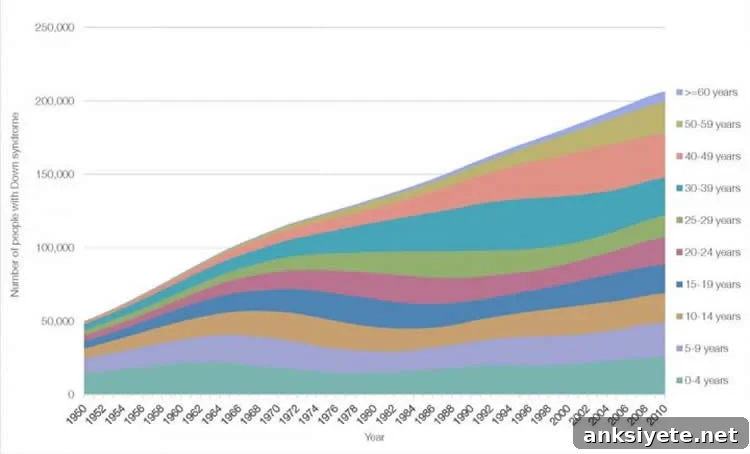
The investigators estimate that the number of people with Down syndrome in the U.S. rose from about 49,923 in 1950 to 206,366 in 2010. That 2010 total includes both people born in the U.S. and those who immigrated. The population prevalence for 2010 was estimated at 6.7 per 10,000 people (about 1 in 1,499).
Estimates by race and ethnicity
Breaking the 2010 estimates down by racial and ethnic groups, the study reports:
- Non-Hispanic white: 138,019
- Non-Hispanic black: 27,151
- Hispanic: 32,933
- Asian/Pacific Islander: 6,747
- American Indian/Alaskan Native: 1,527
Across all groups, the largest numbers occur in younger age brackets, but the researchers also documented substantial growth in the number of adults with Down syndrome. The condition, which in the 1950s affected mainly children due to high mortality in infancy and early childhood, now includes a growing population of adults in their 40s, 50s, and 60s.
Drivers of change: survival, medical care, and prenatal testing
Skotko and colleagues highlight two major forces that shaped the population trends. First, improvements in medical care have dramatically increased survival. Cardiac surgeries that were uncommon before the 1980s are now routine, and better treatment of thyroid disease, obstructive sleep apnea, and certain forms of leukemia has increased longevity for many people with Down syndrome. Second, the introduction and expansion of prenatal screening and diagnostic testing — and the availability of elective termination — have affected birth rates for some groups, particularly contributing to a leveling among non-Hispanic whites in recent decades.
These combined factors mean policymakers, health systems, and social-service organizations must adapt planning and resources to support an aging and increasingly diverse Down syndrome population.
Implications for advocacy, health care, and research
The new, detailed estimates give nonprofit organizations and advocacy groups better tools to evaluate how representative their membership is and where outreach and services may need to expand. For example, support organizations can now compare the racial and ethnic composition of their clients with the estimated national distribution and consider whether programs and materials are culturally and linguistically appropriate.
For policymakers and health-care planners, the updated counts and age distributions help anticipate demand for pediatric and adult services, long-term care planning, and disability supports. The study also sets a baseline to monitor the potential future effects of newer noninvasive prenatal testing technologies on population size and composition.
Authors: Gert de Graaf, PhD; Frank Buckley; Brian G. Skotko, MD, MPP.
Journal: Genetics in Medicine (published online September 8, 2016).
Study focus: Estimation of the number of people with Down syndrome in the United States by year, age, race, and ethnicity, using historical birth estimates and Down syndrome–specific mortality rates.
Abstract (summary)
Purpose: Reliable counts of people with Down syndrome in the United States have been difficult to obtain because no nationwide population registries exist. This study aimed to estimate population size by age, race, and ethnicity.
Methods: The authors modeled expected numbers of people with Down syndrome in different age groups and calendar years by estimating live births of infants with Down syndrome from 1900 onward and constructing condition-specific mortality rates from prior research.
Results: Estimated growth from 49,923 people with Down syndrome in 1950 to 206,366 in 2010. The 2010 racial and ethnic breakdown is listed above. Population prevalence in 2010 was estimated at 6.7 per 10,000 inhabitants.
Conclusion: Until the early 2000s Down syndrome met the criteria for a rare disease, but demographic shifts, increased survival into adulthood, and prenatal testing have changed the population’s size and age distribution. Growth has leveled in some groups due to elective termination, while improved survival has led to more adults living into mid- and later-life decades.
The estimates in this report are intended to inform planning, service delivery, and future research while providing a clearer picture of the evolving demographic landscape of Down syndrome in the United States.