
Summary: Study identifies the neurons that direct adaptive behavior.
Source: University of Zurich
Researchers at the Brain Research Institute of the University of Zurich used a mouse model to identify specific neurons that guide adaptive behavior. Their findings clarify how higher-order brain regions influence sensory areas during decision-making and may help explain changes in flexible behavior seen in certain brain disorders.
The COVID-19 pandemic highlighted how quickly people must abandon routines—no handshakes, mask mandates, new hygiene habits—to cope with changing circumstances. Animals likewise depend on the brain’s ability to reshape behavior when environments change. The underlying biological mechanisms that enable such flexibility, however, remain only partially understood.
“Brain plasticity is the basis of adaptive behavior,” says Fritjof Helmchen, co-director of the Brain Research Institute at the University of Zurich and head of the Neuroscience Center Zurich. “But the cellular and circuit-level processes that permit rapid relearning have been elusive.” The team’s new experiments take an important step toward revealing those processes.
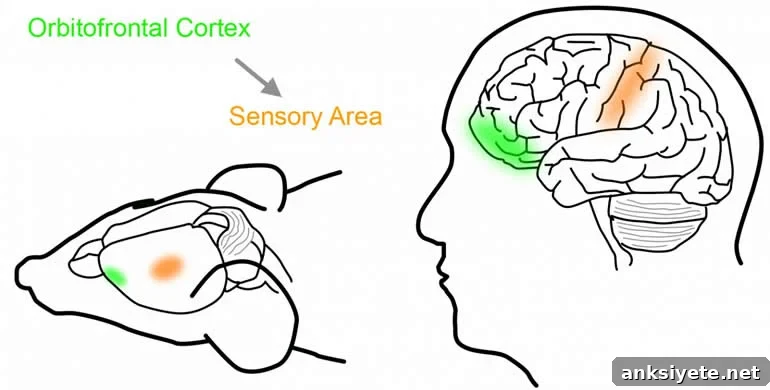
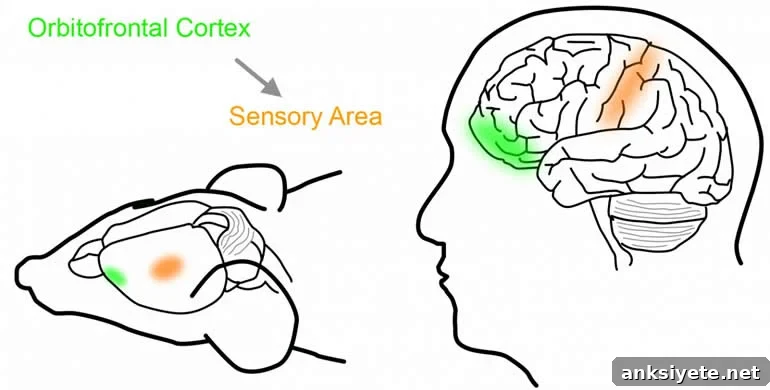
Published in Nature, the study shows that the orbitofrontal cortex (OFC)—a frontal brain region situated above the orbits of the eyes—can reprogram neurons in sensory cortex to support new behavioral rules.
Watching neurons relearn in real time
To study relearning, the researchers trained head-fixed mice in a sensory discrimination task and recorded activity at single-neuron resolution. Initially, mice were taught to lick when their whiskers contacted a coarse-grit sandpaper strip; correct licks were rewarded with sucrose water. Contact with fine-grain sandpaper required withholding licking; an incorrect lick produced a mild aversive sound.
After the animals had learned this contingency, the reward contingency was reversed: licking became rewarded for fine-grain contact and punished for coarse-grit contact. The mice adapted quickly and learned the new rule after only a small number of trials, allowing the team to observe how neural circuits changed during reversal learning.
A top-down signal remaps sensory cortex
Using molecular tools and two-photon calcium imaging, the researchers tracked the function of individual neurons in both the lateral OFC and primary somatosensory cortex (S1). They discovered that a population of lateral OFC neurons became strongly active at the moment of the rule switch. These OFC neurons send long-range axonal projections to S1, and their transient activity correlated with changes in sensory-cortex responses.
Some neurons in S1 initially maintained the old activity pattern but were subsequently remapped to reflect the new reward contingency. When the team selectively inactivated the OFC neurons, the mice struggled to relearn the reversed rule and the plastic changes in S1 were abolished. This provides direct evidence that the lateral OFC communicates value-related signals to sensory cortex and drives experience-dependent remapping.
“We demonstrated a direct pathway from the orbitofrontal cortex to sensory areas, and showed that top-down signals can functionally reconfigure a subpopulation of sensory neurons,” explains Helmchen. “This plasticity—and the instructions delivered from higher-order cortex—appear essential for flexible behavior and adapting to new contexts.”
“It has long been known that the orbitofrontal cortex contributes to decision-making,” notes Abhishek Banerjee, lead author of the study and now an Associate Professor at Newcastle University. “What was unclear until now is how OFC circuits instruct sensory areas to update representations when values change. This mode of long-range communication and control across distant cortical areas is remarkable.”
“This mode of communication and control across distant areas of the brain is truly remarkable.”
Implications for understanding disorders
The authors believe these cellular mechanisms are conserved across mammals, including humans. Gaining a clearer picture of how value signals from frontal cortex reshape sensory representations deepens our understanding of flexible decision-making. Such insight may prove important for conditions where behavioral flexibility is impaired, including some forms of autism spectrum disorder and schizophrenia, where patients can struggle to change behavior in response to new information.
About this neuroscience research article
Source:
University of Zurich
Contacts:
Fritjof Helmchen – University of Zurich
Image Source:
Image credited to UZH.
Original Research:
“Value-guided remapping of sensory cortex by lateral orbitofrontal cortex” by Abhishek Banerjee, Giuseppe Parente, Jasper Teutsch, Christopher Lewis, Fabian F. Voigt & Fritjof Helmchen. Nature. DOI: 10.1038/s41586-020-2704-z. (Closed access)
Abstract
Value-guided remapping of sensory cortex by lateral orbitofrontal cortex
Flexible, adaptive behavior depends on frontal cortical computations that represent value and guide sensory processing. To explore how the orbitofrontal cortex (OFC) encodes decision variables and instructs sensory areas, the authors developed a tactile reversal learning task for head-fixed mice and used longitudinal two-photon calcium imaging to monitor lateral OFC and primary somatosensory cortex (S1) neurons across learning phases. Mice learned to discriminate ‘go’ versus ‘no-go’ tactile stimuli and adapted their behavior after the stimulus–reward contingency was reversed. S1 neurons reflected initial task learning, while lateral OFC neurons showed a rapid, salient response to the rule switch. Anatomical and functional evidence revealed direct long-range projections from lateral OFC to S1 that convey a value prediction error signal. This top-down input updated sensory representations by functionally remapping a subset of S1 neurons sensitive to reward history. Chemogenetic silencing of lateral OFC disrupted reversal learning and abolished plasticity in S1, demonstrating that top-down feedback is required for value-dependent sensory remapping. The dynamic OFC–sensory cortex interaction thus implements history-dependent, error-based computations that enable flexible decision-making.