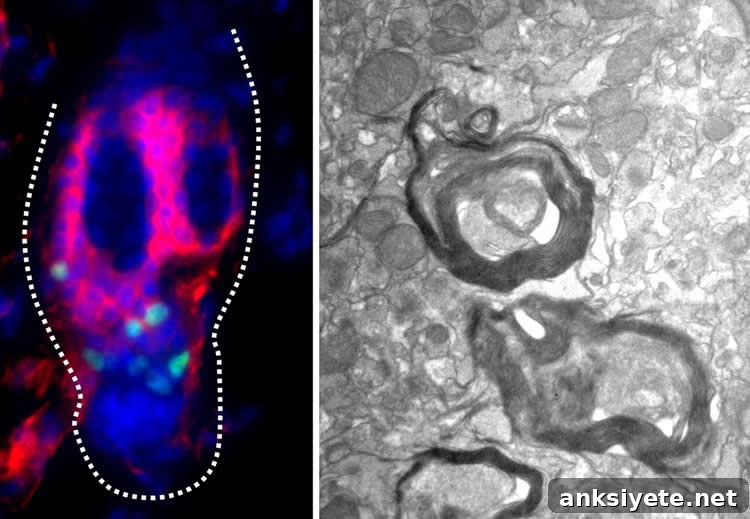
Summary: Melanocyte stem cells in human hair follicles that express CD34 can be directed to form glial cells and generate myelin. CD34-positive melanocyte stem cells (McSCs) restored myelin on neurons in cell culture and improved myelination when introduced into mice with a genetic defect that prevents normal myelin formation. These results suggest a promising new avenue for therapies targeting demyelinating disorders such as multiple sclerosis.
Source: PLOS
Overview
Researchers led by Dr. Thomas Hornyak at the VA Maryland Health Care System and the University of Maryland School of Medicine report that a specific subgroup of melanocyte stem cells (McSCs) located in hair follicles has the capacity to regenerate myelin, the insulating layer that surrounds neurons. Published in PLOS Genetics on 24 April, this study identifies functional differences between two McSC subpopulations and highlights the therapeutic potential of CD34-positive McSCs for nerve repair and demyelinating diseases.
Background
Melanocytes are pigment-producing cells responsible for hair and skin color and originate from embryonic neural crest cells—multipotent progenitors that also give rise to neurons and glial cells. Hair follicles house melanocyte stem cells that replenish differentiated melanocytes during each hair cycle. Previous work from Hornyak’s group mapped two distinct niches of McSCs within mature hair follicles. In this study, the team separated these McSC populations by the presence or absence of the surface glycoprotein CD34, a marker known from other stem cell types, including hematopoietic stem cells.
Key findings
- Using hair follicles from mice, the researchers isolated CD34-positive and CD34-negative McSCs and grew them in culture. The two populations showed clear functional differences.
- CD34-negative McSCs were more efficient at regenerating pigmentation, matching their role in producing differentiated melanocytes during the hair cycle.
- Unexpectedly, CD34-positive McSCs displayed a neural crest–like gene expression profile and a remarkable capacity to differentiate into glial cells that form myelin.
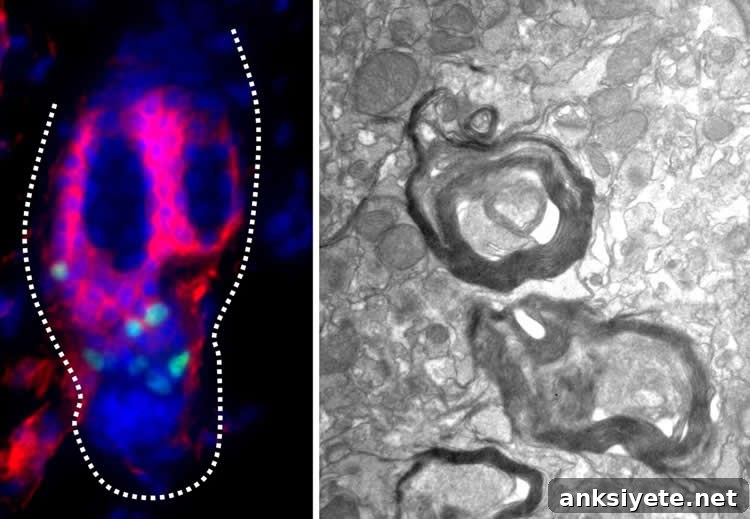
- CD34-positive McSCs were able to myelinate neurons in vitro and to form myelin sheaths in vivo when transplanted into mice with a genetic inability to form normal myelin.
Implications for demyelinating disease and nerve repair
The discovery that CD34-positive McSCs retain neural crest–like properties and can generate myelin suggests a previously unrecognized source of cells with therapeutic relevance for demyelinating conditions. If analogous CD34-positive McSCs are present in human hair follicles, they could become an accessible, autologous cell source for developing treatments for diseases such as multiple sclerosis and for promoting recovery after traumatic nerve injury. The authors plan to expand this work to determine whether these cells can improve functional recovery after neuronal injury and to use genome-wide data from this study to identify similar cell populations in human skin.
Funding and disclosures
This research received support from NIH/NIAMS R01 grant 1R01AR064810, the U.S. Department of Health & Human Services; a VA Merit Award BX002582 from the Office of Research & Development, United States Department of Veterans Affairs; funds from the Dean’s Office at the University of Maryland School of Medicine; and the Baltimore Research and Education Foundation, VA Maryland Health Care System. The funders did not influence study design, data collection and analysis, the decision to publish, or manuscript preparation. The authors report no competing financial interests.
About the research
The study, titled “CD34 defines melanocyte stem cell subpopulations with distinct regenerative properties,” used Dct-H2BGFP mice and fluorescence-activated cell sorting (FACS) to separate bulge/lower permanent portion (LPP) CD34-positive McSCs from CD34-negative McSCs in the secondary hair germ (SHG) region during telogen. Genome-wide expression profiling revealed that CD34-negative McSCs express higher levels of melanocyte differentiation genes, while CD34-positive McSCs exhibit a transcriptional program more consistent with neural crest stem cells. Functionally, CD34-negative McSCs favored pigmentation regeneration, whereas CD34-positive McSCs selectively demonstrated the ability to myelinate neurons both in culture and in animal models. These findings identify CD34-positive McSCs as a promising cellular resource for in vivo myelination strategies and potential therapeutic development for demyelinating diseases and nerve injuries.