
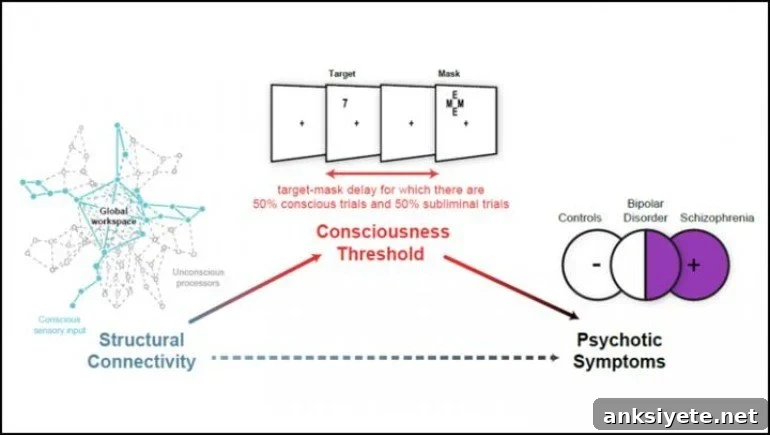
Summary: White matter connectivity does not directly produce psychosis, but it appears to influence psychotic symptoms by altering the brain’s threshold for conscious access to sensory information.
Source: SfN
Altered long-range white matter connections can limit the brain’s ability to bring sensory information into conscious awareness, a process that may contribute to delusions and other psychotic symptoms in disorders such as schizophrenia and bipolar disorder, new research published in Journal of Neuroscience suggests.
Although the brain is continuously active, much of that activity remains non-conscious. According to the global neuronal workspace (GNW) theory, a stimulus becomes consciously perceived only when early, non-conscious activity in sensory regions is amplified and broadcast across widespread cortical networks through long-distance white matter tracts. If those tracts are impaired, the broadcasting process can be disrupted, raising the threshold for conscious perception and potentially altering how the world is experienced.
To investigate how structural connectivity relates to conscious access and psychosis, Berkovitch and colleagues used diffusion MRI tractography alongside a visual masking paradigm. They compared structural white matter measures and consciousness thresholds across groups of participants with varying degrees of psychosis: healthy control subjects, people with schizophrenia, and people with bipolar disorder with or without a history of psychotic features.
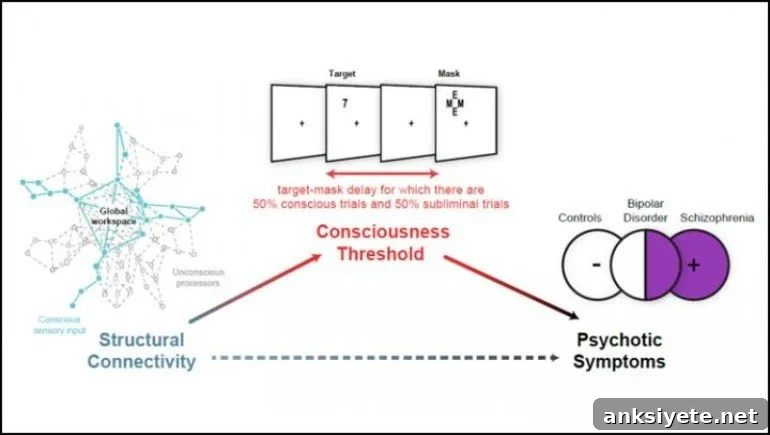
The visual masking task measured the consciousness threshold: how long a visual stimulus must be presented before it is successfully broadcast across brain networks and reported as consciously seen. A lower threshold indicates better conscious access. The study found that participants with psychotic symptoms—both individuals with schizophrenia and bipolar disorder with psychotic features—required longer stimulus durations to reach conscious perception compared with healthy controls and bipolar participants without psychosis.
Across the entire sample, better conscious access (shorter thresholds) was associated with stronger structural connectivity in long-range white matter tracts. Specifically, the correlation was apparent in tracts implicated in the GNW, including the inferior fronto-occipital fasciculus, the cingulum, and the corpus callosum. Mediation analyses indicated that altered long-distance connectivity was linked to an increased consciousness threshold, and this elevated threshold in turn was associated with psychotic symptoms.
Taken together, these results suggest that deficits in long-range white matter connectivity do not directly cause psychosis, but they may contribute to its development by impairing the brain’s ability to bring sensory information into conscious awareness. In other words, disrupted structural connectivity may raise the barrier for conscious access, and this impairment in conscious processing could help explain some core symptoms of psychosis such as delusions.
Abstract
Disruption of Conscious Access in Psychosis Is Associated With Altered Structural Brain Connectivity
Global neuronal workspace theory proposes that conscious access depends on long-distance cerebral connectivity that enables a global neuronal ignition representing conscious content. Prior studies have reported both altered cerebral connectivity and an elevated threshold for conscious perception in schizophrenia and bipolar disorder. However, how structural connectivity relates to disrupted conscious access and how these alterations connect to psychopathology had remained unclear.
This study aimed to quantify the relationship between structural connectivity and consciousness threshold, with special attention to psychosis. Using a visual masking paradigm to measure consciousness threshold and diffusion MRI tractography to assess white matter structure, the authors studied 97 participants of either sex across a spectrum of psychotic expression: healthy controls (n = 46), schizophrenia patients (n = 25), bipolar disorder patients with psychotic history (n = 17), and bipolar disorder patients without psychotic history (n = 9).
Results showed that patients with psychosis (schizophrenia and bipolar disorder with psychotic features) exhibited an elevated masking threshold compared to controls and bipolar patients without psychotic features. Across participants, masking threshold correlated negatively with average fractional anisotropy within white matter tracts that compose the GNW—namely the inferior frontal-occipital fasciculus, the cingulum, and the corpus callosum. Mediation analysis supported the interpretation that altered long-distance connectivity was associated with an increased consciousness threshold, which in turn related to psychotic symptoms.
These findings support the notion that long-range structural connectivity within networks proposed by GNW theory plays a critical role in conscious access, and that impairments in conscious access may mediate the relationship between impaired structural connectivity and psychosis.
SIGNIFICANCE STATEMENT
People with schizophrenia and some people with bipolar disorder show both cerebral dysconnectivity and deficits in conscious access. By measuring diffusion MRI-based structural connectivity and behavioral consciousness thresholds across controls and patients with and without psychotic features, this study demonstrates that deficits in conscious access are linked to psychosis. Connectivity within a defined GNW network correlates with conscious access as predicted by theory, and impairments in conscious access appear to mediate the relationship between dysconnectivity and psychotic symptoms.
Source: SfN
Contact: Calli McMurray – SfN
Image: The image is credited to Berkovitch et al., JNeurosci 2020
Original Research: Closed access. “Disruption of Conscious Access in Psychosis Is Associated With Altered Structural Brain Connectivity” by Berkovitch et al., Journal of Neuroscience