Patients with traumatic brain injuries are not benefiting from recent advances in cognitive neuroscience — and they should be, researchers argue in a special issue of Current Opinion in Behavioral Sciences.
Clinicians who care for people with brain injury still rely largely on longstanding, coarse tools and diagnostic categories instead of applying contemporary discoveries about how the brain organizes cognition. In typical practice, responders use the Glasgow Coma Scale to classify injuries as mild, moderate, or severe. Imaging is sometimes used to locate focal damage, and patients commonly receive one or more broad clinical diagnoses: coma (loss of responsiveness to sensory stimulation), delirium (difficulty sustaining attention), amnesia (memory impairment), and dysexecutive syndrome (problems with planning and goal-directed thought).
Those categories, while useful for triage and general prognosis, reveal little about the specific neural systems that have been disrupted by injury, says Aron Barbey, a professor of neuroscience, psychology, and speech and hearing science at the University of Illinois. He and his colleagues recommend that clinicians adopt a network-based perspective, assessing how trauma affects the large-scale brain networks that support attention, memory, and executive control. Barbey holds appointments in the Beckman Institute for Advanced Science and Technology and the Carl R. Woese Institute for Genomic Biology.
“Traumatic brain injury is a global public health concern with rising incidence,” Barbey notes. “By 2020, the World Health Organization projected that TBI would become a leading cause of neurological disability worldwide across age groups.”
Modern cognitive neuroscience shows that cognition is organized by multiple, interacting networks of brain regions. Each network comprises nodes — specific brain structures — connected by axonal pathways bundled as white-matter tracts. These intrinsic connectivity networks (ICNs) coordinate activity to support distinct cognitive functions and are particularly vulnerable to the mechanical forces and diffuse axonal injury common in TBI.
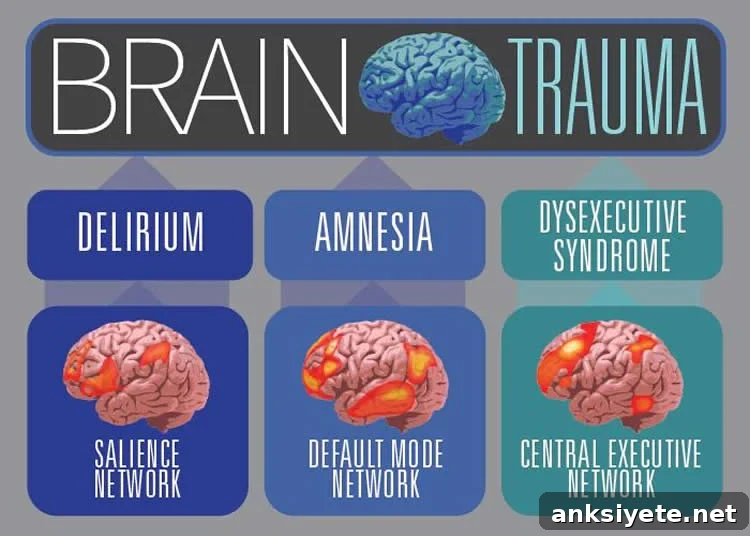
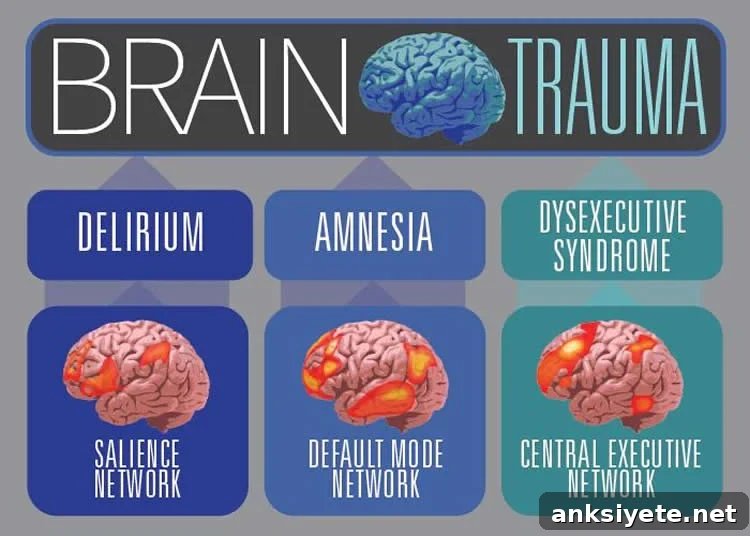
Barbey and colleagues emphasize three core networks that underlie cognitive control and are frequently affected by traumatic brain injury. The salience network helps detect and orient attention to important events and supports coordinated behavioral responses. The default mode network (DMN) underlies internally directed processes such as autobiographical memory and imagining the future. The central executive network supports externally directed attention and higher-order goal-directed activities like planning and problem solving.
Damage to these networks maps onto familiar clinical syndromes. Disruption of the salience network can produce symptoms resembling delirium — fluctuating attention and disorientation. Alteration of the default mode network often corresponds with amnesia and impaired autobiographical memory. Injury to the central executive network is associated with dysexecutive syndrome, with difficulties in organizing thought and carrying out complex tasks. A coma typically reflects widespread, system-level failure.
Identifying which networks are affected in an individual patient has practical value: it can improve prediction of specific cognitive and behavioral impairments and guide more precise treatment and rehabilitation strategies. To translate these insights into clinical care, the authors call for targeted assessment methods that map functional network integrity and for intervention trials that test network-specific therapies.
Several therapeutic approaches from cognitive neuroscience, currently underused in routine clinical settings, deserve rigorous testing in TBI populations. These include targeted neuromodulation techniques such as transcranial direct-current stimulation (tDCS), which can be applied to modulate the responsiveness of particular networks and potentially enhance outcomes from cognitive rehabilitation. In addition, systemic interventions that promote overall brain health — notably physical fitness and aerobic training — may increase resilience and support recovery after injury.
Evidence suggests that combining targeted stimulation with behavioral rehabilitation can produce greater benefits than rehabilitation alone, by priming network function and facilitating plasticity. Likewise, improving cardiovascular fitness is associated with widespread benefits to brain structure and function, which may help patients regain cognitive capacity and adapt to injury-related changes.
“The objective is to move beyond crude labels and develop more precise assessment standards for traumatic brain injury,” Barbey explains. “Translating discoveries from cognitive neuroscience into practical clinical therapies could improve recovery and quality of life for people with brain injury.”
Source: Diana Yates — University of Illinois
Image Source: Image credited to Julie McMahon
Original Research: Abstract for “Network topology and dynamics in traumatic brain injury” by Aron K. Barbey, Antonio Belli, Ann Logan, Rachael Rubin, Marta Zamroziewicz, and Joachim T. Operskalski, published in Current Opinion in Behavioral Sciences (published online April 24, 2015).
Abstract
Network topology and dynamics in traumatic brain injury
The authors propose a network-based approach to clinical translation that links core behavioral phenotypes of traumatic brain injury to damage within specific intrinsic connectivity networks (ICNs). The review surveys recent methods from cognitive neuroscience that aim to enhance network function and support recovery through both targeted (network-specific) and global (systemic) interventions. A network framework provides insight into mechanisms of injury, connects ICN characteristics to distinct profiles of cognitive impairment, identifies neurobiological targets for therapeutic development, and reframes perspectives on cognitive recovery and rehabilitation after TBI.
“Network topology and dynamics in traumatic brain injury” by Aron K. Barbey, Antonio Belli, Ann Logan, Rachael Rubin, Marta Zamroziewicz, and Joachim T. Operskalski in Current Opinion in Behavioral Sciences. Published online April 24, 2015.