
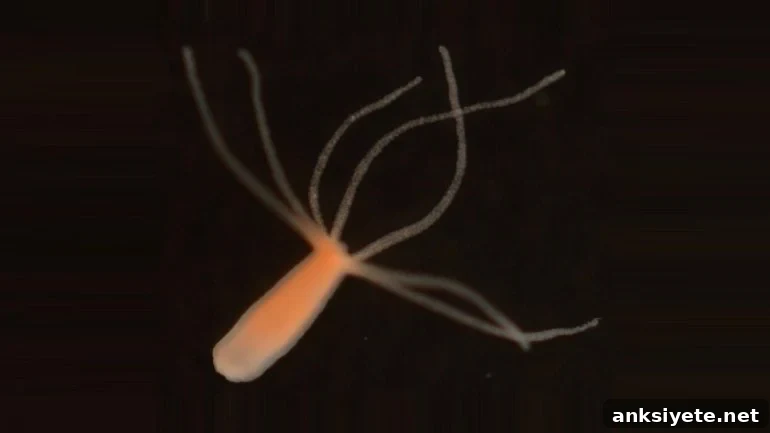
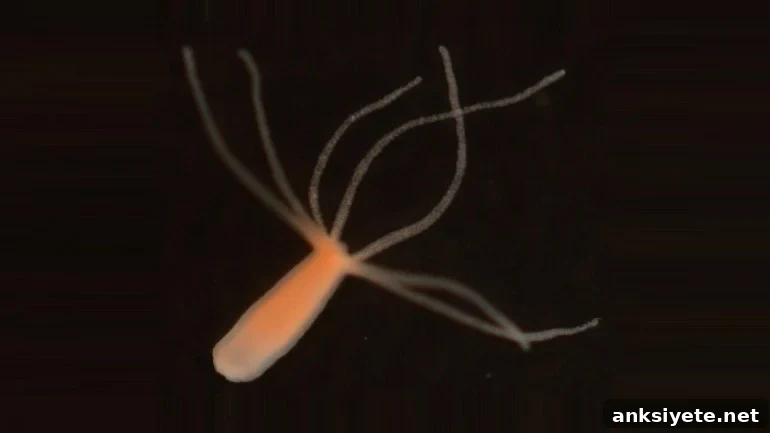
Summary: Using tiny water-dwelling hydras, researchers present new evidence that the need for sleep arose before the evolution of a centralized brain.
Source: Kyushu University
Staying awake for too long impairs cognition, but brief sleep restores mental performance. When and why animals began to need sleep remains an open evolutionary question — and whether a brain is required for sleep has been unclear.
An international research team reports that Hydra vulgaris, a tiny freshwater cnidarian lacking a central nervous system, exhibits a sleep-like state and responds to molecules known to regulate sleep in more complex animals. The study, led by Taichi Q. Itoh at Kyushu University and published in Science Advances, provides strong evidence that sleep-related mechanisms emerged before the evolution of brains.
Hydras are a few centimeters long and possess a diffuse nerve net rather than a centralized brain. Because conventional sleep measures such as electroencephalography cannot be applied to brainless animals, the researchers used continuous video monitoring to track movement and identify sleep-like episodes defined by reduced activity and responsiveness. These quiescent periods could be interrupted by brief flashes of light, indicating a reversible, sleep-like state.
Unlike the typical 24-hour circadian rhythm seen in many animals, hydras did not display a daily cycle. Instead, the team detected ultradian rhythms: repeated cycles of activity and quiescence roughly every four hours. This suggests sleep-like regulation in hydras is driven by different timing mechanisms than those in organisms with established circadian patterns.
On a molecular level, hydras showed responses to several well-known sleep regulators. Application of melatonin modestly increased sleep duration and frequency, while gamma-aminobutyric acid (GABA), an inhibitory neurotransmitter linked to sleep across many species, strongly promoted sleep-like behavior. Surprisingly, dopamine — which typically promotes wakefulness in animals with brains — increased sleep in hydras, indicating that some neurotransmitter functions may have been repurposed during brain evolution.
The researchers also simulated sleep deprivation with mechanical vibrations and temperature shifts. Deprived hydras showed compensatory increases in sleep the following day — a hallmark of homeostatic sleep regulation — and sleep loss suppressed cell proliferation, demonstrating that quiescent periods are physiologically important for these animals.
Genetic analysis of sleep-deprived hydras revealed altered expression of 212 genes. Among these were genes linked to PRKG1 (cGMP-dependent protein kinase 1), a protein implicated in sleep regulation in diverse animals including mice, flies, and nematodes. The study found that melatonin, GABA, and PRKG1 promoted sleep in hydras, supporting the idea that key sleep-related pathways were already present in early-diverging animal lineages.
Additional comparative experiments used fruit flies to probe gene function. Disrupting fly genes that appear to share evolutionary origins with hydra sleep-related genes changed sleep duration in flies, suggesting conserved molecular components influence sleep across distant animal groups and offering a path to identify previously unknown sleep genes in animals with brains.
The authors note that while several sleep mechanisms are conserved, some processes may have switched roles during the evolution of centralized nervous systems. For example, the opposing effects of ornithine metabolism on sleep between Hydra and Drosophila indicate that certain metabolic pathways were reprogrammed as brains evolved.
Taken together, these findings indicate that fundamental sleep-regulatory physiology and molecular components existed in brainless metazoans and were carried forward — and in some cases repurposed — during the evolution of centralized nervous systems. Hydra provides a tractable, simple model to further explore how sleep originated and how conserved molecular mechanisms support quiescence across the animal kingdom.
About this evolutionary neuroscience research news
Source: Kyushu University
Contact: William J. Potscavage Jr. – Kyushu University
Image: The image is credited to Taichi Q. Itoh, Kyushu University
Original Research: Open access. “A sleep-like state in Hydra unravels conserved sleep mechanisms during the evolutionary development of the central nervous system” by Taichi Q. Itoh et al., Science Advances
Abstract
A sleep-like state in Hydra unravels conserved sleep mechanisms during the evolutionary development of the central nervous system
Sleep behaviors are observed across diverse animal groups, yet the evolutionary origins of sleep regulation remain unclear. This study reports a sleep-like state in the cnidarian Hydra vulgaris, which has a simple, diffuse nervous organization. Hydra sleep displays homeostatic regulation and supports cell proliferation but lacks free-running circadian rhythms; instead, hydras show 4-hour ultradian rhythms that may govern their rest–activity cycles. Microarray analysis following sleep deprivation revealed sleep-dependent changes in expression of 212 genes, including PRKG1 and ornithine aminotransferase. Sleep-promoting effects of melatonin, GABA, and PRKG1 were conserved in Hydra, whereas dopamine unexpectedly induced sleep. Differences in the role of ornithine metabolism between Hydra and Drosophila suggest evolutionary reprogramming of sleep-regulatory functions. These results indicate that sleep-relevant physiology and many molecular components predate the emergence of centralized nervous systems and were subsequently refined during nervous system evolution.