
Summary: New research shows that selective serotonin reuptake inhibitors (SSRIs), commonly prescribed for depression and anxiety, can improve the quality of aging female gametes in model organisms. Treatment with SSRIs reduced embryonic death and chromosomal abnormalities in surviving offspring and produced visibly healthier egg cells in both roundworms and fruit flies.
These findings point to a conserved role for serotonin signaling in preserving oocyte quality and suggest potential pharmacological strategies to delay reproductive aging and address some causes of infertility, though much more research is required before applying these results to humans.
Key Facts:
- Northwestern University researchers found that certain SSRIs improved the quality of aging female egg cells in Caenorhabditis elegans (roundworms) and Drosophila melanogaster (fruit flies).
- Exposure to SSRIs reduced embryonic death rates by more than twofold and lowered chromosomal abnormalities among surviving offspring by a similar margin; treated oocytes also appeared rounder and healthier under the microscope.
- The results reveal a conserved serotonergic mechanism that supports germline quality and suggest pharmacological avenues to slow reproductive aging, but translation to human fertility treatment will require extensive additional study.
Source: Northwestern University
Antidepressants and egg health in animal models
Researchers at Northwestern University exposed aging female roundworms to low doses of selective serotonin reuptake inhibitors (SSRIs), a drug class used in clinical practice for mood and anxiety disorders. To their surprise, the treatment improved multiple measures of egg quality. Embryonic lethality declined substantially, chromosomal errors were less frequent among surviving progeny, and oocytes appeared visually younger and more robust—round and plump rather than shrunken or misshapen, which commonly occurs with age.
To test whether the effect was specific to worms, the team repeated the experiments in fruit flies. The SSRIs produced comparable improvements in oocyte quality in that species as well, supporting the idea that serotonergic signaling plays a conserved role in maintaining germline health across diverse animals.
The study appears in the journal Developmental Biology. Lead investigator Ilya Ruvinsky emphasized that while these results are encouraging, there remains a considerable gap between findings in model organisms and safe, effective clinical applications for humans. Still, the research opens new avenues for investigating how modulating neuronal serotonin signaling might extend reproductive capacity or counteract age-related declines in egg health.
Cutting out the middleman
Previous work from the same lab showed that male pheromones can delay oocyte aging by shifting a female’s physiological priorities toward reproductive maintenance. Those pheromones trigger neuronal circuits that use serotonin to direct resources to the germline. In the new experiments, the researchers chose to bypass pheromone signaling entirely and stimulate the serotonergic system pharmacologically to see whether they could reproduce the beneficial effects directly.
“The neurons that signal the body to shift its resources rely on serotonin as the messenger,” the team explained. By activating that signaling pathway with SSRIs, they observed improved oocyte quality across multiple measures without relying on male-derived cues.
Delaying decline
For the worm experiments, the researchers supplemented the animals’ food with low doses of SSRIs—primarily fluoxetine (commonly known as Prozac), and also testing citalopram and zimelidine. Concentrations were chosen to be comparable to those used therapeutically in humans. In untreated worms, oocyte quality typically deteriorates quickly with age, but consistent SSRI exposure maintained higher-quality eggs and reduced the usual drop in reproductive success.
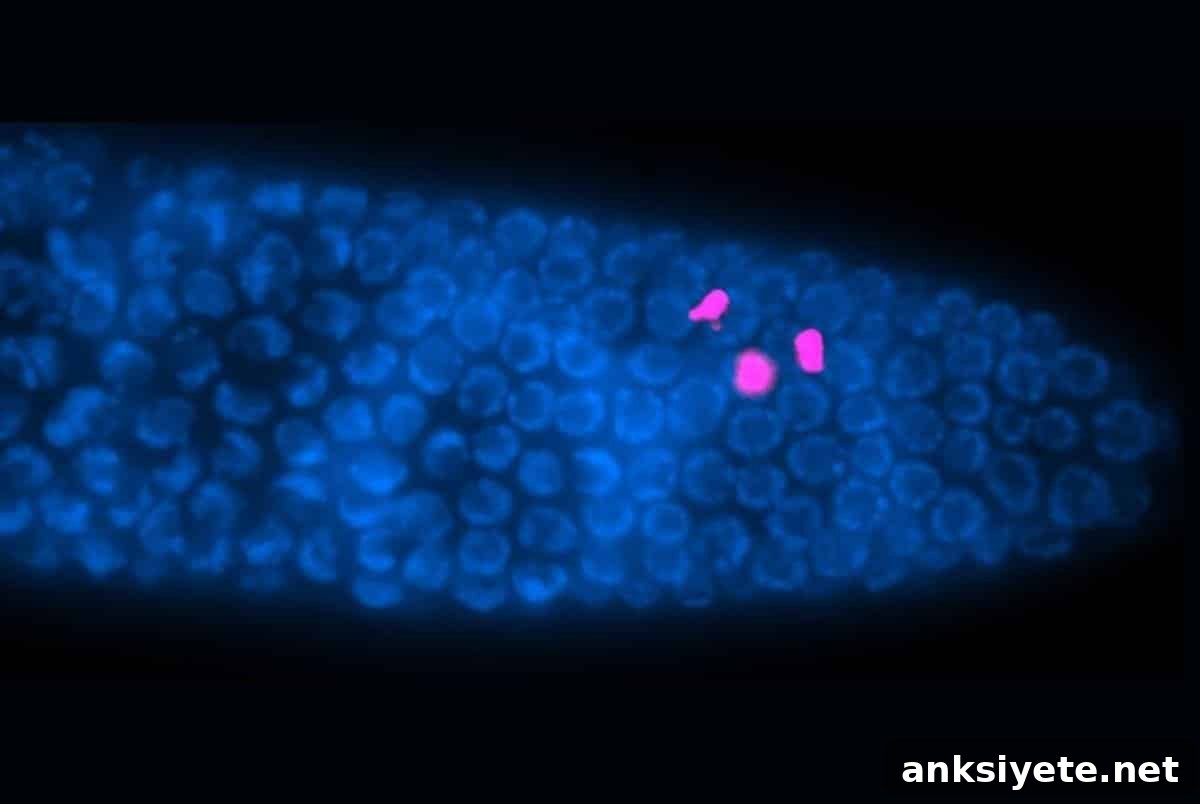
Continuous exposure proved more effective than a temporary course: when the drug was withdrawn, egg quality remained elevated only briefly before declining again, suggesting that an ongoing serotonergic signal is required to sustain the effect. The team also noted that fluoxetine increased the production of oocyte precursor cells even as more of those precursors underwent programmed cell death. This apparent paradox may contribute to improved egg quality because dead or dying precursor cells can be broken down and recycled to supply components that support the development of fewer, higher-quality oocytes.
Shared signaling across species
Reproducing the benefits of SSRIs in fruit flies strengthened the case for a conserved biological role for serotonin in reproductive aging. Although the detailed mechanisms may differ between worms and flies, the broader pattern—more serotonin-related signaling directing resources to preserve the germline—appears to hold across these distant animal groups.
“This neuronal system does more or less the same thing in various animals,” the authors noted, pointing out that serotonin influences behavior and physiology in many species. While SSRIs are unlikely to extend the human fertility window by decades, even modest gains—such as a year or two of improved egg quality—could have meaningful clinical and social implications for reproductive planning.
About this psychopharmacology research news
Author: Amanda Morris
Source: Northwestern University
Contact: Amanda Morris – Northwestern University
Image: The image is credited to Neuroscience News
Original Research: Open access. “Serotonergic signaling plays a deeply conserved role in improving oocyte quality” by Erin Z. Aprison et al., Developmental Biology.
Abstract
Serotonergic signaling plays a deeply conserved role in improving oocyte quality
Declining germline quality is a key driver of reproductive aging. Identifying regulatory pathways that maintain germline health may reveal interventions to delay reproductive senescence. Prior evidence, including the effect of a C. elegans male pheromone (ascr#10) that counteracts germline aging, implicated the nervous system in this regulation.
Motivated by serotonin’s role in mediating ascr#10 signaling, the researchers demonstrated that serotonin reuptake inhibitors reproduce the pheromone’s beneficial effects on the C. elegans germline and support healthier oocyte aging. Pharmacologically increasing serotonin signaling also stimulated developmental processes in D. melanogaster, improving oocyte quality there as well, although specific mechanisms appear to differ between species.
These results point to a broadly conserved role for serotonin in maintaining germline quality and identify SSRIs and related compounds as candidate tools for delaying reproductive aging in model organisms, motivating further research into potential translational approaches for human fertility preservation.