Researchers at Children’s Hospital Los Angeles Identify Exosome-Delivered microRNAs That Drive Chemotherapy Resistance in Neuroblastoma
Scientists at Children’s Hospital Los Angeles (CHLA) have uncovered a key mechanism in the tumor microenvironment that helps neuroblastoma — the most common solid cancer outside the skull in children — become resistant to chemotherapy. The study, led by Muller Fabbri, MD, PhD, of the Children’s Center for Cancer and Blood Diseases and The Saban Research Institute of CHLA, was published in the Journal of the National Cancer Institute on May 13.
The research focuses on exosomes: tiny vesicles released by cells that carry microRNAs (miRNAs). These miRNAs do not encode proteins but regulate gene expression and cell behavior. Exosomes mediate communication between tumor cells and nearby immune cells, and the CHLA team investigated how exosome-carried miRNAs influence therapy resistance in neuroblastoma (NBL).
Within the tumor microenvironment there is constant cross-talk between malignant cells and surrounding stromal and immune cells, including monocytes and tumor-associated macrophages (TAMs). TAMs originate from circulating monocytes and can either promote or inhibit tumor growth depending on context. In neuroblastoma, TAMs are associated with worse outcomes, prompting the researchers to examine whether TAMs contribute to chemotherapy resistance through exosomal miRNA exchange.
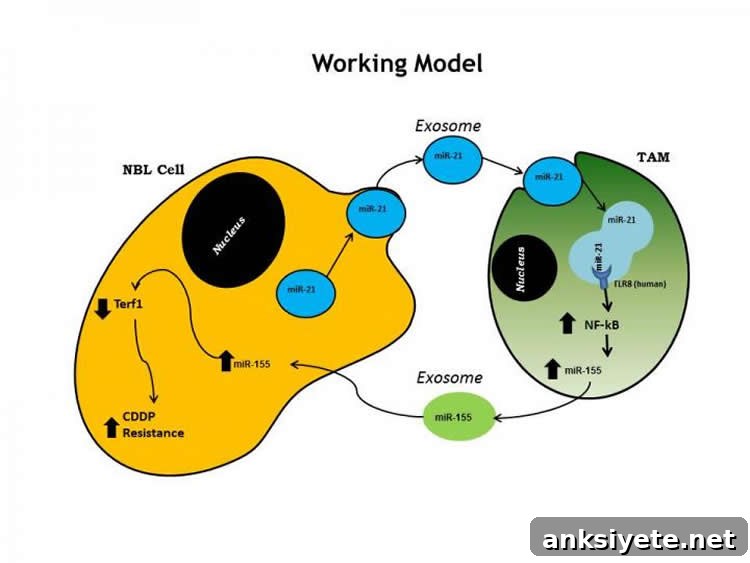
The study revealed a bidirectional transfer of specific miRNAs via exosomes between neuroblastoma cells and monocytes/TAMs. Neuroblastoma-derived exosomes deliver miR-21 to monocytes, which in turn stimulates monocytes to produce and release miR-155 back to the tumor cells. Although tumors frequently show elevated miR-155 levels, cancer cell lines often express little miR-155 intrinsically. The CHLA team demonstrated that the high miR-155 found in tumors originates from the tumor microenvironment and is transferred to cancer cells within exosomes.
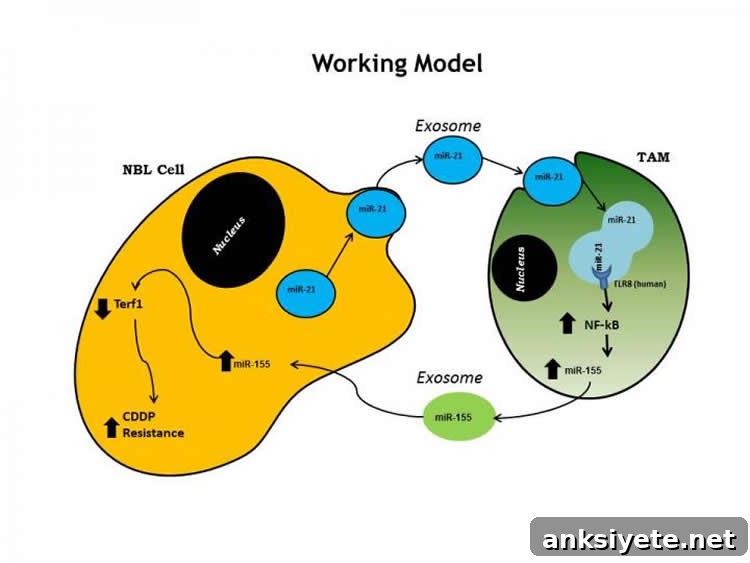
Functionally, exosome-delivered miR-155 suppresses TERF1, a telomere-associated protein that inhibits telomerase activity. Telomeres and telomerase control cellular aging and replicative potential; in many cancers, elevated telomerase activity allows cells to evade normal senescence and continue dividing. By silencing TERF1, miR-155 increases telomerase activity in neuroblastoma cells, helping them survive chemotherapy-induced stress.
Fabbri and colleagues tested whether interrupting this exosome-mediated communication could restore sensitivity to chemotherapy. Using laboratory cell models and mouse xenografts, they delivered artificial exosomes carrying miR-155 and used GW4869, a molecule that blocks exosome production, to interrupt the delivery pathway. Blocking exosome release increased tumor cell death in the presence of chemotherapy and reduced tumor growth in vivo without causing detectable toxicity in the animal models. These results support the concept that halting pathogenic exosome exchange can enhance chemotherapy effectiveness.
The study suggests a two-step signaling axis: neuroblastoma cells transfer miR-21 to monocytes, activating a miR-21/TLR8–NF-κB pathway that promotes miR-155 production in monocytes; monocyte-derived exosomal miR-155 then targets TERF1 in tumor cells, elevating telomerase activity and promoting drug resistance. Clinical correlations in primary neuroblastoma specimens showed that tumors with abundant CD163-positive macrophage infiltration had higher intratumoral miR-155 and lower TERF1 mRNA, linking this mechanism to patient samples.
Contributors to the study include investigators from Children’s Hospital Los Angeles, the Norris Comprehensive Cancer Center at the Keck School of Medicine of USC, the University of Texas MD Anderson Cancer Center, and the Istituto Scientifico Romagnolo per lo Studio e la Cura dei Tumori in Italy. Key authors include Kishore B. Challagundla, Petra M. Wise, Paolo Neviani, Haritha Chava, Mariam Murtadha, Tong Xu, Rebekah Kennedy, Cristina Ivan, Xinna Zhang, Ivan Vannini, Francesca Fanini, Dino Amadori, George A. Calin, Michael Hadjidaniel, Hiroyuki Shimada, Ambrose Jong, Robert C. Seeger, Shahab Asgharzadeh, Amir Goldkorn, and Muller Fabbri.
Funding: Research support was provided by the St. Baldrick’s Foundation, the Pablove Foundation, and multiple National Institutes of Health grants, including awards from the National Cancer Institute and a Brain SPORE grant. Muller Fabbri is supported as a St. Baldrick Foundation Scholar.
Abstract
Background: The role of exosomal microRNAs in driving drug resistance through tumor microenvironment interactions has not previously been defined in neuroblastoma.
Methods: The team performed coculture experiments to document exosomal transfer of miR-21 from neuroblastoma cells to human monocytes and miR-155 from monocytes to neuroblastoma cells. Luciferase reporter assays assessed miR-155 targeting of TERF1. Xenograft models tested tumor responses to cisplatin combined with exosomal miR-155 delivery. Expression levels of CD163, miR-155, and TERF1 were evaluated in primary neuroblastoma tissues.
Results: Neuroblastoma-derived exosomes induced a significant increase in miR-21 in monocytes, and coculture with monocytes raised miR-155 levels in neuroblastoma cells. miR-155 directly reduced TERF1 activity in reporter assays. In vivo, tumors exposed to exosomal miR-155 grew significantly larger under chemotherapy conditions compared with controls, and primary tumors with high macrophage infiltration showed higher miR-155 and lower TERF1 levels.
Conclusions: These findings support a model in which exosomal miR-21 and miR-155 mediate bidirectional signaling between neuroblastoma cells and monocytes/TAMs, promoting telomerase activation and chemotherapy resistance via a miR-21/TLR8–NF-κB → exosomal miR-155 → TERF1 pathway. Targeting this exosome-mediated communication could restore chemotherapy sensitivity in neuroblastoma.