

 Positive psychotherapy: at first glance the phrase may seem paradoxical.
The word psychotherapy often conjures images of tense patients lying on couches, a serious therapist taking notes, and lengthy explorations of childhood trauma. While that stereotype is outdated and incomplete, it can make the idea of pairing positivity and therapy feel surprising.
Traditionally, psychotherapy addresses moderate to severe emotional or behavioral issues. Positive psychotherapy, however, blends rigorous psychotherapy methods with the research and practices of positive psychology to create a strengths-focused, evidence-informed approach. Rather than concentrating only on symptoms and deficits, it helps people build wellbeing by identifying and amplifying what already works in their lives (Seligman, Rashid, & Parks, 2006).
This approach doesn’t replace clinical interventions for serious disorders, but it can complement them. Positive psychotherapy can move clients from merely coping toward flourishing. Below we outline practical exercises, tools, and a structured 15-session program that therapists can adapt for clients, students, or teams.
This Article Contains:
- 5 Positive Psychotherapy Exercises and Tools
- 15 Sessions – Exercises and Tools
- A Take-Home Message
- References
5 Positive Psychotherapy Exercises and Tools
Below are five effective, evidence-informed practices often used in positive psychotherapy to increase wellbeing and resilience.
1. Gratitude Journal
Keeping a gratitude journal is a straightforward, well-researched practice that can shift perspective and increase life satisfaction (Davis et al., 2016; Sheldon & Lyubomirsky, 2006).
Instructions for clients:
- Choose a dedicated notebook or digital file for this practice.
- Each night, write three specific things you were grateful for that day.
- Alternatively, list five gratitudes once per week if daily writing feels difficult.
- Encourage specificity: note details (for example, “the warm sunlight through the kitchen window”) rather than generalities (“the weather”).
If someone struggles to identify gratitudes, ask them to imagine life without a particular relationship, possession, or ability to highlight what they value (Marsh, 2011).
2. Design a Beautiful Day
 This exercise invites clients to plan and experience an intentionally pleasant day, combining the benefits of anticipation and mindful enjoyment.
Steps to guide a client:
- Have the client define what a “beautiful day” means to them—activities, people, settings that energize or bring joy.
- Pick a specific near-future date to implement the plan.
- Include small details but leave room for spontaneity.
- Encourage involvement of others for at least part of the day and suggest breaking routine.
- Use mindfulness during the day to fully savor each moment.
3. Self-Esteem Journal
A self-esteem journal helps clients notice daily successes and strengths, supporting gradual self-worth development. Typical prompts include:
- Something I did well today…
- Today I had fun when…
- I felt proud when…
- Today I accomplished…
- I had a positive interaction with…
- I did something for someone else…
Regularly attending to these moments builds an evidence base clients can use to counteract negative self-beliefs.
4. Mindfulness Meditation
Mindfulness meditation is an accessible tool to reduce anxiety and depressive symptoms while also supporting positive emotions. A short “mini-mindfulness” practice can be introduced in session:
- Seat the client comfortably with a relaxed, dignified posture and closed eyes.
- Invite several breaths, noticing inhalation and exhalation without changing the breath.
- Expand awareness to the whole body, noticing sensations, tension, or ease.
- Finish after a minute or two and invite reflection on the experience.
Clients can be encouraged to practice on their own and explore guided meditations if helpful.
5. Values in Action Inventory of Strengths (VIA-IS)
The VIA-IS is a widely validated assessment of 24 character strengths. Identifying signature strengths helps clients direct energy toward strengths-based goals instead of dwelling on perceived deficits (Ruch et al., 2010).
Once clients know their top strengths, discuss how to apply them intentionally in work, relationships, and daily life.
The 24 strengths are often grouped into six domains:
Wisdom and Knowledge
- Creativity, Curiosity, Judgment, Love of Learning, Perspective
Courage
- Bravery, Perseverance, Honesty, Zest
Humanity
- Love, Kindness, Social Intelligence
Justice
- Teamwork, Fairness, Leadership
Temperance
- Forgiveness, Humility, Prudence, Self-regulation
Transcendence
- Appreciation of Beauty, Gratitude, Hope, Humor, Spirituality
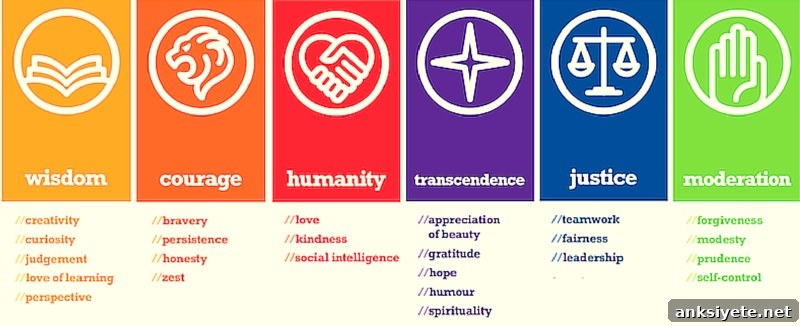
Use clients’ VIA results to plan interventions that maximize engagement and meaning by leveraging their top strengths.
15 Sessions – Exercises and Tools
The following outline presents fifteen sessions that integrate the exercises above into a coherent positive psychotherapy program. The sequence is flexible, but each session includes restorative techniques at the start and end and suggests one homework assignment to reinforce learning.
Therapists should adapt content to clients’ cultural background, readiness, and clinical needs. The outline emphasizes strengthening resources, practical action, and reflective writing.
Session I – Positive Inception
Goal: Establish a positive tone by inviting the client to share a personal story that highlights their best qualities.
Tool: Positive Introduction prompt
Rationale: Starting with positive narrative builds rapport and surfaces strengths the client can use throughout therapy.
In-session prompt: Describe a time you handled a difficult situation well and things ended positively. Tell it as a story with a beginning, middle, and positive ending.
Homework: Create tangible anchors (photos, mementos) of this memory and write additional short stories to revisit when needed.
Session II – The Powers Within
Goal: Identify signature strengths and increase engagement by using strengths in daily tasks.
Tool: Signature Strengths Assessment
Rationale: Using signature strengths supports goal progress, engagement, and wellbeing (Linley et al., 2010).
Preparation: Ask three people who know the client to report perceived strengths. During the session, circle five strengths that feel most authentic and discuss markers such as authenticity, energy, and ease of use.
Homework: Take the VIA strengths survey and notice whether using strengths increases engagement.
Session III – Amplify Your Internal Assets
Goal: Learn to calibrate strengths—recognizing when they are underused, optimally used, or overused—and translate strengths into practical actions.
Tool: Optimizing Strengths exercise
Homework: Describe a current challenge and reflect on whether it stems from under- or overuse of strengths, then plan adjustments.
Session IV – You at Your Best
Goal: Visualize and plan concrete steps toward a better version of yourself.
Tool: You at Your Best worksheet
In-session: Recall a time you were at your absolute best, write the story, highlight strengths, and identify specific actions to move toward that version of yourself.
Homework: Commit to one or two small actions for the week and name a supporter who will check in.
Session V – Positive Reappraisal
Goal: Re-evaluate open or painful memories using positive reappraisal strategies so they no longer drain emotional energy.
Tools: Open and Closed Memories Questionnaire, Positive Reappraisal exercises
In-session exercises include creating psychological distance, focusing on overlooked positives, adopting a nonjudgmental observer stance, and redirecting attention to engaging tasks.
Homework: Apply one reappraisal strategy to a new memory and reflect in writing.
Session VI – Forgiveness is Transformative
Goal: Introduce a stepwise forgiveness process and assign a forgiveness letter exercise.
Tool: REACH Forgiveness model and letter-writing
REACH: Recall the hurt, Empathize with the transgressor, give an Altruistic gift of forgiveness, Commit to emotional forgiveness, and Hold on to forgiveness when doubts arise (Worthington, 2006).
Homework: Imagine an offender apologizing and write an unsent forgiveness letter.
Session VII – Good Enough
Goal: Introduce the satisficing mindset versus maximizing and develop practical strategies to reduce perfectionistic or maximizing tendencies.
Tool: Maximizer vs. Satisficer assessment and satisficing strategies
Homework: Practice one satisficing technique during the week.
Session VIII – Count Your Blessings
Goal: Build a sustained gratitude practice using a daily journal and a planned gratitude visit.
Tools: Three Good Things exercise and Gratitude Visit
Homework: Keep a nightly journal of three good things for a week and consider expressing gratitude directly to someone important.
Session IX – Instilling Hope and Optimism
Goal: Develop hopeful, pathway-focused thinking and reframe setbacks as opportunities for growth.
Tools: One Door Closes, Another Door Opens; Learning Optimism prompts
Homework: Write a concise statement of your general outlook and monitor how daily stressors affect it; practice supporting someone else to identify positives in difficulty.
Session X – Resilience
Goal: Introduce posttraumatic growth and use expressive writing to process and integrate difficult experiences.
Tool: Expressive Writing
Clients write 15–30 minutes for several consecutive days about a distressing event to explore meaning, coping, and growth (Pennebaker & Evans, 2014).
Session XI – Taste for Life
Goal: Slow down and savor positive experiences to counteract chronic busyness and improve wellbeing.
Tool: Busy Behavior Assessment and Savoring techniques
Homework: Practice a chosen savoring strategy (sharing, memory-building, self-praise, or sharpening perception) and journal the experience.
Session XII – People Matter
Goal: Strength-spotting in relationships to cultivate appreciation, empathy, and stronger bonds.
Tool: Strengths Spotting exercise and Tree of Positive Relationships
Homework: If practical, invite close others to take the VIA survey and create a relationship-strength map to foster understanding and celebration.
Session XIII – Politics of Wellbeing
Goal: Teach positive communication through Active Constructive Responding (ACR) to strengthen connections.
Tool: Active Constructive Responding practice
Homework: Practice ACR with family and friends and reflect on responses and relationship effects.
Session XIV – Gift of Time
Goal: Use strengths to help others through time-based acts of service, enhancing meaning and social connection.
Tool: Gift of Time planning and reflection
Homework: Perform a strength-based act of service and record how it felt and its impact.
Session XV – A Life Worth Living
Goal: Integrate enjoyment, engagement, and meaning; create a sustainable plan for continued growth and a positive legacy.
Tools: From Your Past Toward Your Future and Positive Legacy exercises
In-session: Revisit the Positive Introduction, identify values and signature strengths, and outline ten-year goals and steps to achieve them. Envision the legacy you want to leave and concrete actions that align with that vision.
Homework: Keep the plan in a safe place and review progress in a year, revising goals as needed.
A Take-Home Message
Positive psychotherapy offers a practical, strengths-based complement to traditional therapeutic work. It combines validated exercises—gratitude, strengths use, mindfulness, expressive writing, forgiveness, optimism training, and relational practices—to foster resilience, engagement, and meaning.
Therapists should tailor these interventions to each client’s readiness and clinical needs while monitoring for distress when addressing painful material. When used thoughtfully, these tools can help clients move from surviving to flourishing.
We invite practitioners to adapt the exercises above and observe how clients respond—small, repeated practices often generate lasting change.
- Biswas-Diener, R., Kashdan, T. B., & Minhas, G. (2011). A dynamic approach to psychological strength development and intervention. The Journal of Positive Psychology, 6(2), 106-118.
- Bryant, F. (2003). Savoring Beliefs Inventory (SBI): A scale for measuring beliefs about savoring. Journal of Mental Health, 12(2), 175-196.
- Calhoun, L. G., & Tedeschi, R. G. (2006). The foundations of posttraumatic growth. In L. G. Calhoun & R. G. Tedeschi (Eds.), Handbook of posttraumatic growth (pp. 1-23).
- Davis, D. E., et al. (2016). Thankful for the little things: A meta-analysis of gratitude interventions. Journal of Counseling Psychology, 63(1), 20-31.
- Denborough, D. (2014). Retelling the stories of our lives: Everyday narrative therapy to draw inspiration and transform experience.
- Drigotas, S. M. (2002). The Michelangelo phenomenon and personal well-being. Journal of Personality, 70(1), 59-77.
- Emmons, R. A. (2007). Thanks! How the new science of gratitude can make you happier.
- Kahneman, D. (2011). Thinking, Fast and Slow.
- Linley, P. A., Nielsen, K. M., Gillett, R., & Biswas-Diener, R. (2010). Using signature strengths in pursuit of goals. International Coaching Psychology Review, 5(1), 6-15.
- Pennebaker, J. W., & Evans, J. F. (2014). Expressive Writing: Words that Heal.
- Ruch, W., Proyer, R. T., Harzer, C., Park, N., Peterson, C., & Seligman, M. E. (2010). Values in Action Inventory of Strengths (VIA-IS). Journal of Individual Differences, 31(3), 138-149.
- Seligman, M. E., Rashid, T., & Parks, A. C. (2006). Positive psychotherapy. American Psychologist, 61(8), 774-788.
- Sheldon, K. M., & Lyubomirsky, S. (2006). How to increase and sustain positive emotion: The effects of expressing gratitude and visualizing best possible selves. The Journal of Positive Psychology, 1(2), 73-82.
- Worthington, E. L. (2006). Just forgiving: How the psychology and theology of forgiveness and justice inter-relate. Journal of Psychology & Christianity, 25(2), 155-168.
- Yalom, I. D. (2020). Existential Psychotherapy.