
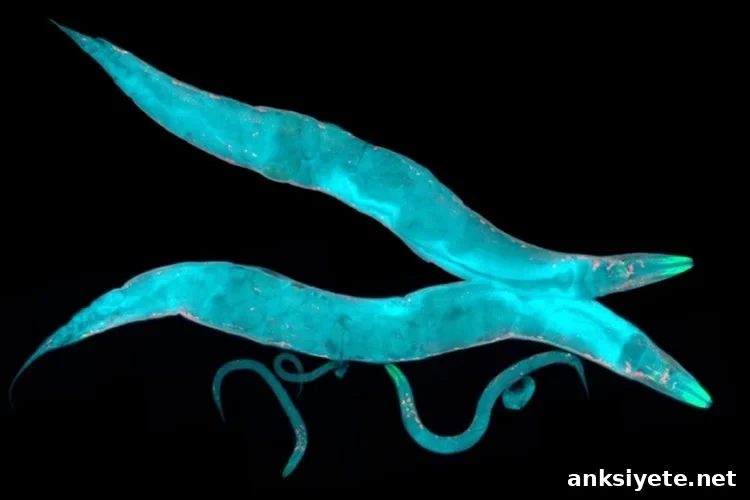
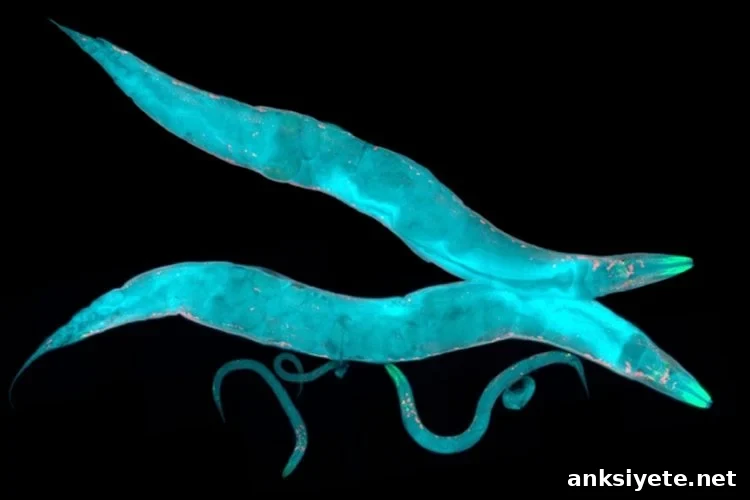
Summary: Researchers have identified gut neurons in the worm C. elegans that detect ingested bacteria and release a neurotransmitter that tells the brain to stop moving.
Source: MIT.
When a hungry worm discovers a patch of bacteria, it quickly slows its movements to feed. After it becomes satiated or the food is exhausted, the worm resumes roaming.
New research from MIT reveals how the worm’s digestive tract signals the brain to remain at a rich food source. The team found a specialized enteric neuron in the nematode Caenorhabditis elegans that senses bacterial ingestion. Upon activation, these gut neurons release serotonin, a neurotransmitter that communicates with the brain and triggers a reduction in locomotion. The investigators also identified two ion channels, DEL-3 and DEL-7, that are essential for this sensory response.
“We knew food strongly influences behavior in this animal, but the precise mechanism by which the gut communicates food ingestion to the nervous system was unclear,” says Steven Flavell, assistant professor of brain and cognitive sciences at MIT and a member of the Picower Institute for Learning and Memory. “This study fills a key gap in understanding how ingestion turns into a behavioral change.”
Flavell is the senior author of the study, published on Dec. 20 in Cell. The paper’s first author is Jeffrey Rhoades, formerly a technical assistant at the Picower Institute.
Gut-brain connection
Across animal species, the gut and brain maintain a close, bidirectional relationship. Signals from the gastrointestinal tract influence appetite and sensations of fullness through hormones and neurotransmitters. In mammals, for example, hormones such as leptin and ghrelin modulate hunger, and the gut produces a large proportion of the body’s serotonin, which affects feeding and mood.
The digestive system also contains its own semi-independent neural network, the enteric nervous system, which coordinates local digestive functions like smooth muscle contractions, secretion of enzymes, and hormonal signaling. Because the human enteric nervous system is complex, researchers often study simpler organisms to dissect basic mechanisms. C. elegans, with a small and well-mapped nervous system, serves as an effective model to explore how feeding alters behavior.
Previous work established that food strongly changes C. elegans locomotion: worms slow dramatically when they encounter a dense patch of bacteria and begin wandering again after feeding. What remained unknown was how the nervous system senses the physical act of ingestion and converts that signal into serotonergic communication to the brain.
“Behavioral evidence showed the worm’s nervous system receives information about environmental food, but the cellular and molecular details were missing,” Flavell notes.
The team focused on a group of serotonin-producing enteric neurons called neurosecretory-motor (NSM) neurons. These NSM cells line the pharynx, the worm’s feeding organ, and produce serotonin known to promote feeding-related slowdown. Using functional assays, the researchers observed that NSM neurons activate immediately when worms consume bacterial food.
NSM neurons extend a single long neurite into the gut, and the researchers demonstrated that the neurite’s tip functions as a sensory ending. Activation of that sensory ending by ingested bacteria triggers serotonin release from NSM cells, which then signals nearby neural circuits to reduce locomotion.
Acid-sensing ion channels DEL-3 and DEL-7
The team discovered two ion channels concentrated at the tip of the NSM neurite that are required for food-evoked activation: DEL-3 and DEL-7. These proteins belong to the acid-sensing ion channel (ASIC) family, a widely conserved group implicated in sensory roles such as taste and pain detection. Some ASIC family members are expressed in mammalian enteric neurons as well, suggesting a potentially broader role for similar channels in detecting bacterial populations or gut chemical cues.
How DEL-3 and DEL-7 detect bacteria remains an open question. One possibility is that the channels directly respond to a bacterially secreted molecule. Alternatively, a bacterial product might bind a nearby receptor that in turn modulates the ion channels, leading to NSM activation and serotonin release.
Many neurons, many signals
Flavell’s laboratory plans to examine other neurons that project into the gut to determine whether they function like NSM neurons—detecting additional bacterial components or other feeding-related signals. The worm genome contains roughly 30 ion channels related to DEL-3 and DEL-7; some of these may respond to distinct bacterial cues, enabling a nuanced sensory map of gut contents.
The researchers are also mapping how NSM-derived serotonin reshapes activity across the rest of the nervous system. Once the NSM ion channels open and serotonin is released, downstream neurons that express serotonin receptors change their activity patterns, ultimately producing the behavioral shift from roaming to feeding. Ongoing work aims to identify those downstream circuits and reveal how serotonergic signaling orchestrates the behavioral response.
Whether an analogous mechanism operates in humans is still unknown. The human gut hosts a complex microbiome and contains enterochromaffin cells that synthesize and release serotonin to communicate with sensory neurons projecting to the brain. Understanding the channels and receptors that enable gut cells to detect microbial or chemical cues is an active area of research, and the mechanisms uncovered in C. elegans may guide future mammalian studies.
“With the genetic and optical tools available in the worm, we can now test other gut-associated cells for food-evoked activation and identify the channels they use,” Flavell says. “This approach should reveal how different sensory inputs from the gut are integrated to control behavior.”
Funding: The research was supported by the JPB Foundation, the Picower Institute Innovation Fund, the Picower Neurological Disorders Research Fund, the NARSAD Young Investigator program, the National Institutes of Health, the Howard Hughes Medical Institute, and the National Science Foundation.
Source: Anne Trafton – MIT
Publisher: Organized by NeuroscienceNews.com
Image Source: Image credited to MIT.
Original Research: The study appears in Cell.
MLA: MIT. “Gut-Brain Connection Signals Behavioral Alterations While Eating: Worm Study.” NeuroscienceNews. 20 December 2018.
APA: MIT (2018, December 20). Gut-Brain Connection Signals Behavioral Alterations While Eating: Worm Study. NeuroscienceNews.
Chicago: MIT. “Gut-Brain Connection Signals Behavioral Alterations While Eating: Worm Study.” (accessed December 20, 2018).