
Inside Hippocampal Ripples: How CA1 Neurons Fire during Memory Events
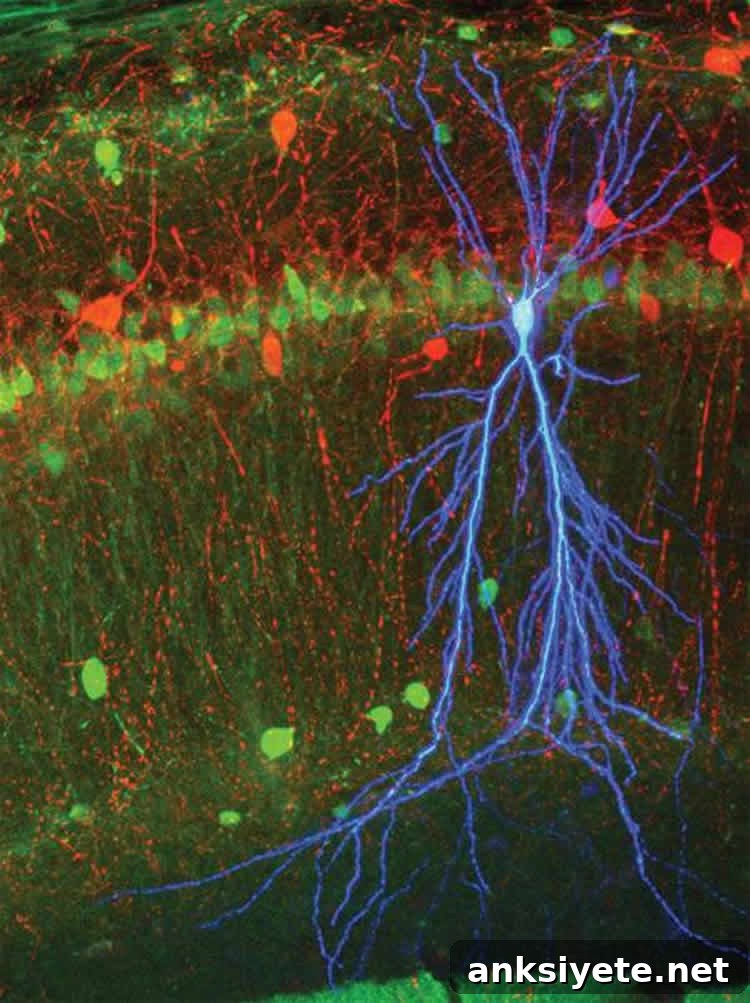
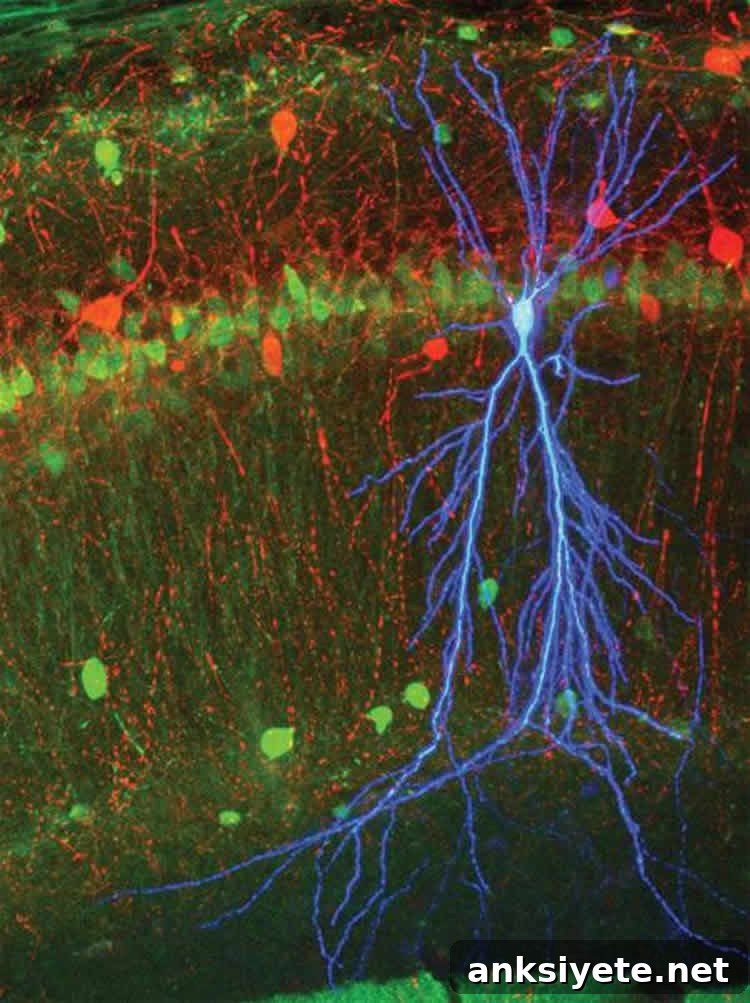
Caltech neuroscientists have peeked inside individual brain cells as they take part in rapid bursts of activity known as hippocampal “ripples,” events widely implicated in memory consolidation.
Hippocampal ripples are brief, high-frequency oscillations during which a small subset of neurons in area CA1 fire nearly simultaneously. In CA1, roughly 10 percent of pyramidal neurons become active within a tenth of a second during a ripple, while the remaining 90 percent remain silent. This raises two longstanding questions for researchers: what keeps most CA1 cells quiet, and what synchronizes the few that do fire?
In a study published in Neuron, researchers at Caltech used a combination of extracellular network recordings and in vivo intracellular measurements to reveal how excitatory and inhibitory inputs coordinate to produce the sparse, precisely timed firing characteristic of ripples. Their approach allowed them to monitor the membrane potential of single CA1 pyramidal neurons in awake mice while simultaneously recording network-wide activity, providing a direct window into the inputs that shape neuronal output during ripple events.
To measure membrane voltage inside single neurons, the team used glass pipettes with tips finer than a tenth of a human hair to perform whole-cell recordings in awake animals. Coupled with multisite extracellular electrodes, this dual-recording strategy made it possible to correlate subthreshold membrane dynamics within CA1 pyramidal cells with the timing and strength of incoming signals from upstream hippocampal area CA3.
The investigators found that CA1 pyramidal neurons depolarize during ripples, but with a surprising consistency: the magnitude of depolarization remained relatively constant regardless of the net excitatory drive from CA3. This observation implies that excitatory input during ripples is counterbalanced by proportional inhibition, preventing most CA1 neurons from crossing spike threshold. The study authors attribute that inhibition to feedforward interneurons that receive direct CA3 input and suppress CA1 pyramidal cell firing.
“There appears to be a circuit-level mechanism that balances excitation and inhibition so that, for most neurons, these forces cancel out,” said Thanos Siapas, the study’s senior author. Without such balanced inhibition, strong excitation could recruit many more CA1 neurons, risking runaway activity and potentially triggering pathological states like seizures.
So why do a minority of CA1 neurons fire during ripples? The researchers showed that the neurons that do spike receive unusually strong excitatory inputs from a subset of CA3 cells—connections that are likely strengthened during learning and behavioral experiences. In other words, it is the specific identity and strength of particular CA3-to-CA1 synapses, not the number of active CA3 neurons, that determines which CA1 neurons overcome the inhibition and produce spikes.
This arrangement creates a flexible, memory-dependent mosaic of activity in CA1: a shifting ensemble of active and silent pyramidal neurons whose composition reflects past experience. When those selected CA1 neurons fire, their membrane potential oscillates at ripple frequency with precise timing, synchronizing spikes across the population to within a few milliseconds. Such tight synchrony amplifies the impact of CA1 output on downstream targets—much like dozens of people clapping in unison are heard more clearly than the same number clapping independently.
Previous models emphasized rhythmic firing of inhibitory interneurons as the sole driver of fast ripple oscillations. However, the Caltech team’s intracellular recordings indicate a more complex interplay: ripple-frequency excitation that leads inhibition appears to shape the intracellular oscillation phase and timing. On a fine timescale, the phase relationship between intracellular and extracellular ripple waves varies smoothly with membrane potential, a pattern inconsistent with models relying exclusively on perisomatic inhibition.
Funding: The work was supported by the Mathers Foundation, the Gordon and Betty Moore Foundation, the National Institutes of Health, and the National Science Foundation.
Source: Deborah Williams-Hedges for Caltech. Image credit: T. Siapas / Caltech. Original research: “Membrane Potential Dynamics of CA1 Pyramidal Neurons during Hippocampal Ripples in Awake Mice” by Brad K. Hulse, Laurent C. Moreaux, Evgueniy V. Lubenov, and Athanassios G. Siapas, published in Neuron (published online February 17, 2016).
Abstract
Membrane Potential Dynamics of CA1 Pyramidal Neurons during Hippocampal Ripples in Awake Mice
Highlights
- CA1 pyramidal neurons depolarize during ripples in a way that is independent of net excitatory input.
- Balanced circuit mechanisms of excitation and inhibition keep most neurons silent during ripples.
- Intracellular ripple phase shifts continuously with membrane potential, linking subthreshold dynamics to spike timing.
- Findings argue against ripple generation models that rely only on perisomatic inhibition; instead, ripple-frequency excitation that precedes inhibition helps shape intracellular oscillations.
Summary
Hippocampal ripples are high-frequency oscillations associated with synchronized bursts in CA1 and are central to models of memory consolidation. While spike timing during ripples has been well studied, the subthreshold membrane dynamics of identified pyramidal neurons during these events were less clear. By combining in vivo whole-cell recordings with multisite extracellular monitoring, this study characterizes how CA1 membrane potential behaves during ripples. The main findings show that subthreshold depolarization during ripples does not scale with net excitation from CA3, whereas post-ripple hyperpolarization does. This result clarifies how balanced excitation and inhibition maintain sparsity of firing. On shorter timescales, the delay between intracellular and extracellular ripple oscillations varies systematically with membrane potential, supporting a model in which ripple-frequency excitation that precedes inhibition shapes intracellular ripple dynamics.