
How the Brain Selects Sounds: Neural Mechanisms of Auditory Attention
Summary: A neuroimaging study maps the brain mechanisms that allow auditory selective attention.
Source: Carnegie Mellon University
How can we effortlessly follow a friend’s voice in a crowded café or pick out a violin’s melody inside an orchestra?
Researchers from Carnegie Mellon University and Birkbeck, University of London have developed a new approach to understanding how the brain isolates a specific stream of sound from distracting auditory input. Using non-invasive neuroimaging and a novel experimental paradigm, the team mapped sustained auditory selective attention across human cortex. Their results, published in the Journal of Neuroscience, provide a clearer picture of how attention modulates the representation of sound frequency in the brain and establish a foundation for tracking and treating deficits in auditory attention associated with aging, brain injury, or neurodevelopmental conditions.
“Deficits in auditory selective attention can arise from concussion, stroke, autism, or even normal aging,” said Lori Holt, professor of psychology at Carnegie Mellon University and a member of the Center for the Neural Basis of Cognition. “Those deficits are linked to social isolation, depression, cognitive decline, and lower workforce participation. This study clarifies cognitive and neural mechanisms by which the brain decides what to listen to.”
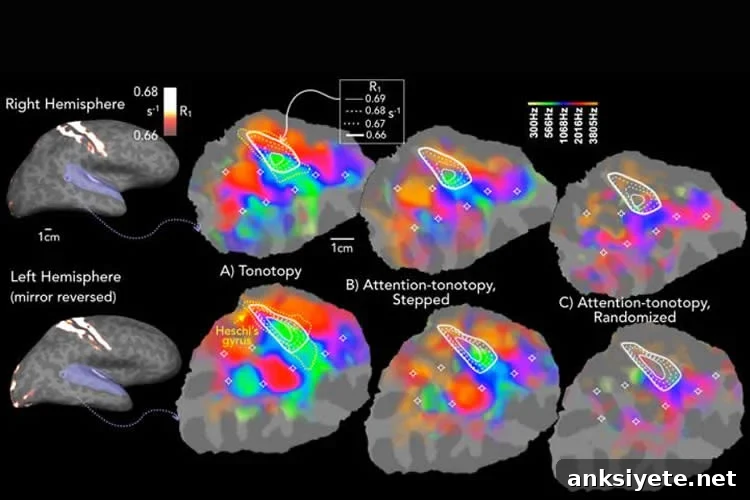
In the experiment, eight adult participants listened to two interleaved sequences of short tone melodies while undergoing MRI. They were instructed to attend to one sequence—either the higher or lower frequency melody—and ignore the other, pressing a button when they detected a repeated melody in the attended stream. This design allowed the researchers to isolate brain activity related to sustained attention on specific acoustic frequency ranges, similar to focusing on treble or bass elements in a piece of music.
The researchers capitalized on a fundamental organizational property of auditory cortex called tonotopy. Tonotopic maps arrange sound frequencies on the cortical surface much like a radio dial, with low frequencies represented on one end and high frequencies on the other. Multiple tonotopic maps are tiled across the temporal lobes and serve as the initial layout for how frequency information is encoded and processed.
When listeners heard melodies at different frequency bands, the corresponding regions of tonotopic maps became active. Crucially, the act of simply paying attention to a particular frequency produced very similar activation patterns. Attention effects were not limited to a few core auditory areas; instead, sustained attention recruited widespread portions of cortex known to receive and process sound information. This indicates that attention can selectively enhance the cortical representation of specific frequencies across a broad auditory network.
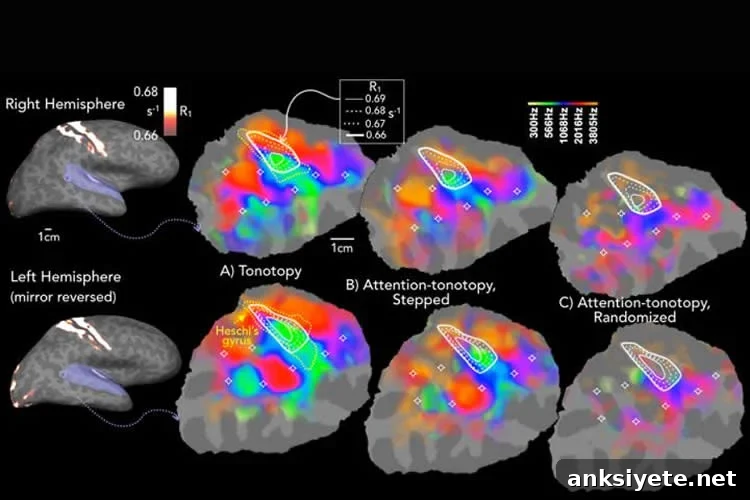
To link functional activation to brain structure, the team employed multiparameter mapping, a high-resolution imaging technique that measures tissue properties including myelination. Myelin is the insulating sheath around neuronal axons that supports efficient electrical signaling. Brain regions vary substantially in myelin content, and these structural differences can relate to functional specialization.
Across the cortical surface, the researchers compared maps of frequency preference with maps of myelin content. They found a close relationship in specific areas: small patches of cortex with greater myelination also exhibited a stronger tuning to particular frequencies. This coupling of structural and functional organization suggests that regions of higher myelination may provide a more precise or robust substrate for frequency-specific processing and for the attentional enhancement of those representations.
“This is an exciting result because it hints at shared organizational features across structure and function in auditory cortex,” said Frederic Dick, professor of auditory cognitive neuroscience at Birkbeck College and University College London. “Understanding how microstructural differences relate to functional tuning helps explain why some cortical regions may be especially well suited for learning language or musical skills and how they support focused listening.”
In addition to the lead investigators, contributors included Matt Lehet and Tim Keller from Carnegie Mellon, Martina F. Callaghan and Martin Sereno from University College London and San Diego State University, respectively. Funding for the research was provided by CMU alumnus Jonathan Rothberg.
The findings have practical implications for diagnosing and remediating auditory attention problems. By providing a non-invasive method to map how attention modulates frequency-specific representations and how those maps align with myelin distribution, this approach can be applied to study changes across the lifespan, effects of neurological injury, or outcomes of behavioral interventions aimed at improving listening abilities.
Publication: The study appears in the Journal of Neuroscience.