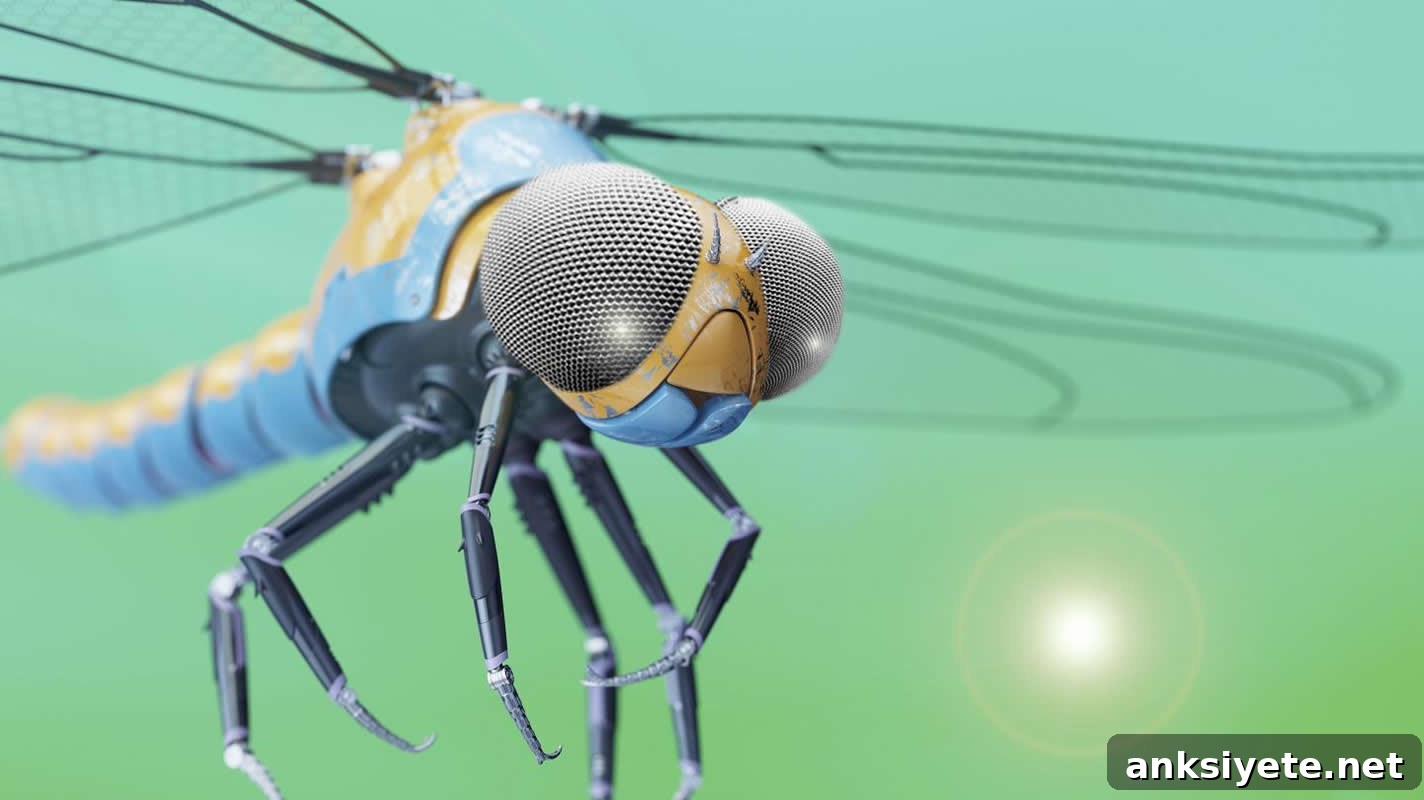
Summary: A bio-inspired compound eye has been developed to reveal how insects detect objects and trajectories with exceptional speed, and it may enable fast, lightweight 3D localization for robots and autonomous vehicles.
Source: The Optical Society
Insects react to motion with remarkable speed. A newly developed bio-inspired compound eye reproduces both the form and function of insect compound eyes, helping researchers understand how these animals quickly sense an object and its trajectory. The device could also serve as a compact 3D localization sensor for robots, self-driving cars, and unmanned aerial vehicles that require rapid detection from lightweight systems.
Researchers at Tianjin University in China report in the journal Optics Letters that their bio-inspired compound eye replicates key features of biological compound-eye systems. Natural compound eyes are composed of large arrays of repeating units called ommatidia, each acting as an individual photoreceptive element. This distributed architecture supports rapid motion detection and wide fields of view.
“By imitating insect visual systems, we found that insects may determine an object’s trajectory using changes in light intensity rather than by forming high-resolution images like human eyes,” said Le Song, a member of the research team. “This strategy requires far less information and enables extremely fast behavioral responses.”
Imitating an insect eye
To recreate the compound-eye geometry, the team used single-point diamond turning to machine an array of 169 microlenses on a curved surface. Each microlens has an approximate radius of 1 mm, and the complete component measures about 20 mm across. The array captures light over a roughly 90-degree field of view, and adjacent microlenses have overlapping fields of view similar to biological ommatidia.
One major engineering challenge is coupling a curved lens array to flat image detectors. The researchers addressed this by introducing a light guide between the curved microlens surface and a planar sensor. This intermediary guides light from different incident angles uniformly across the detector, providing an even response that more closely resembles the behavior of real compound eyes than some earlier artificial designs.
According to the authors, the component’s consistent angular response is a closer match to biological compound eyes and better replicates the biological mechanism than prior attempts.
To enable three-dimensional localization, the team added a small grid pattern to each eyelet to serve as an identifying marker, then illuminated the system with LEDs placed at known positions during testing. An algorithm analyzed the positions and intensity distribution of light detected by the array to calculate the 3D coordinates of the light sources. The algorithm leverages the spatial distribution of brightness across the curved array rather than depending on detailed image reconstruction.
The experiments showed that the system can rapidly return 3D location estimates. Accuracy decreased with increasing distance to the light source, a limitation that may be consistent with the near-sightedness observed in many insect species and the emphasis on short-range rapid detection in their ecology.
How insects see the world
“Our results demonstrate that a compound-eye design can identify an object’s location by analyzing brightness patterns instead of processing complex images,” Song said. “This highly sensitive, low-data approach fits the processing limits of insect nervous systems and supports quick avoidance or pursuit behaviors.”
The team notes potential applications in small autonomous platforms where weight, size, and processing speed are critical. A compact compound-eye sensor that extracts 3D position information from brightness distributions could enable rapid obstacle detection and tracking without heavy computational demands.
Future work will focus on embedding the localization algorithm into integrated circuits or other compact platforms so the system can be more easily incorporated into mobile devices and vehicles. The researchers are also exploring methods for mass manufacturing the microlens arrays to lower production costs and facilitate broader adoption.
Source:
The Optical Society
Media Contact:
James Merrick – The Optical Society
Image credit:
Le Song, Tianjin University.
Original Research:
“Detection of three-dimensional trajectory of object based on curved bionic compound eye.” Y. Zheng, L. Song, J. Huang, H. Zhang, F. Fang. Optics Letters. Closed access.
Abstract
Detection of three-dimensional trajectory of object based on curved bionic compound eye
Biological compound-eye systems offer unique advantages for three-dimensional positioning based on light energy distribution. The authors designed and fabricated a curved compound eye to mimic biological counterparts. To address nonuniform off-axis response and enlarge each eyelet’s effective aperture, they designed a dome-shaped light cone formed from many fiber wires of about 6 μm diameter. Building on this bionic compound-eye assembly, the team proposed an algorithm to compute an object’s 3D position by analyzing the location and intensity distribution of received light. They evaluated effects of illumination intensity, target center position, and non-repeatability, estimating a relative standard uncertainty in 3D position of 8.6%, which supports the validity of the localization approach.