
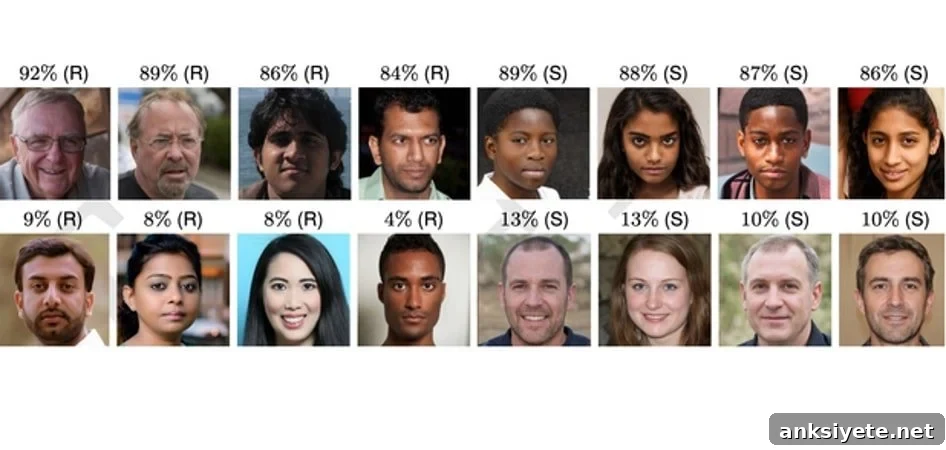
Summary: People struggle to tell apart real faces from faces synthesized by AI using StyleGAN2, and, strikingly, participants judge AI-generated faces as slightly more trustworthy than real ones.
Source: Lancaster University
Researchers report that faces created by artificial intelligence with StyleGAN2 are nearly indistinguishable from real human faces, prompting calls for stronger safeguards against misuse and so-called “deepfakes.”
Synthetic media — including AI-generated text, audio, images, and video — is already being exploited in harmful ways, such as fraud, revenge pornography, and political manipulation. As generative models improve, understanding how people perceive these synthetic images becomes essential for both policy and technology design.
Dr Sophie Nightingale of Lancaster University and Professor Hany Farid of the University of California, Berkeley, tested how well people could tell StyleGAN2-generated faces apart from real faces and whether those faces evoked different levels of trust.
Their experiments show that modern synthesis engines produce highly photorealistic faces that participants often cannot distinguish from real ones. Worse, synthetic faces were on average rated as more trustworthy than real faces.
“Our evaluation of the photo realism of AI-synthesized faces indicates that synthesis engines have passed through the uncanny valley and are capable of creating faces that are indistinguishable — and more trustworthy — than real faces,” the researchers note.
They warn that an inability to reliably identify generated images carries serious social risks.
“One of the most troubling consequences is that in a digital environment where any image or video can be fabricated, the authenticity of genuine recordings — especially those that are inconvenient or incriminating — can be readily disputed,” the authors write.
- In the first experiment, 315 participants viewed 128 faces selected from a pool of 800 and classified each as real or synthesized. Their overall accuracy was 48%, essentially at chance.
- In a second experiment, 219 new participants received training and feedback on cues for distinguishing faces, then classified a different set of 128 faces from the same pool. Training improved accuracy only to 59%.
Given these low identification rates, the researchers explored whether perceived trustworthiness could help people tell real and synthetic faces apart.
“Faces convey rapid, implicit cues about traits such as trustworthiness after only milliseconds of exposure. We investigated whether synthetic faces trigger the same trust inferences as real faces and whether such perceptions could aid detection,” they explain.
In a third study, 223 participants rated the trustworthiness of 128 faces from the same set on a seven-point scale, from 1 (very untrustworthy) to 7 (very trustworthy). Synthetic faces received, on average, a 7.7% higher trust rating than real faces — a statistically significant difference.
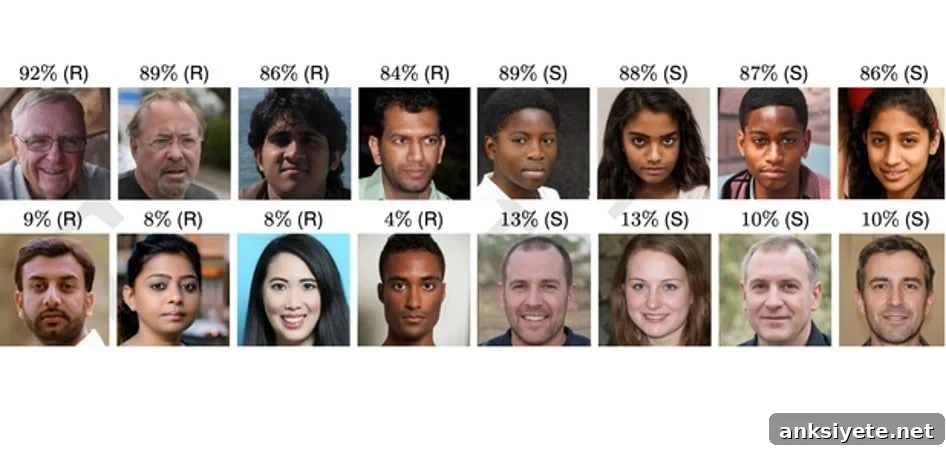
“Perhaps most interestingly, synthetically generated faces were judged more trustworthy than real faces,” the team reports.
- Among demographic effects, Black faces were, on average, rated as more trustworthy than South Asian faces, while other racial comparisons showed no consistent differences.
- Women were rated as significantly more trustworthy than men.
Facial expression played a role: smiling faces tended to be rated as more trustworthy. However, because 65.5% of the real faces and 58.8% of the synthetic faces were smiling, differences in expression alone do not fully explain the higher trust ratings for synthetic images.
The authors suggest one possible explanation: synthesized faces often resemble averaged or prototypical faces, and prior work shows that average-looking faces are perceived as more trustworthy. This tendency toward an “average” appearance in generated faces may therefore increase perceived trustworthiness.
To reduce harm from manipulated media, the researchers propose concrete safeguards and policy recommendations for the creation and distribution of synthetic images.
Recommended measures include embedding robust, hard-to-remove watermarks into image and video synthesis pipelines so that downstream tools can reliably identify synthetic content. They also urge the graphics and computer vision communities to reconsider unfettered public release of high-capability code and pretrained models, since broad access amplifies the risk of misuse.
“At this important juncture, we encourage the field to adopt community guidelines for the ethical development and dissemination of synthetic-media technologies, including responsibilities for researchers, publishers, and media distributors,” the authors conclude.
About this AI research news
Author: Gillian Whitworth
Source: Lancaster University
Contact: Gillian Whitworth – Lancaster University
Image: The image is credited to NVIDIA Corporation
Original Research: The findings will appear in PNAS