
How aging affects communication between neurons is not well understood, a gap that complicates treatment of disorders such as Alzheimer’s and Parkinson’s disease.
Researchers at the Florida campus of The Scripps Research Institute (TSRI) have published a series of studies that illuminate how aging changes neural circuitry at the level of single, identified neurons. Their work reveals age-related shifts in electrical activity and gene expression that could help explain declines in cognitive and physiological function and point toward potential therapeutic targets for neurodegenerative disease.
“Although we don’t yet know exactly why these changes occur, we do know that signaling balance shifts with age, and we captured these alterations at the single neuron level,” said Sathyanarayanan V. Puthanveettil, an assistant professor at TSRI who led the research team. “If we can identify the molecular underpinnings of this process, it may be possible to target specific mechanisms to modify or reverse aspects of neuronal aging.”
Single-neuron approach and animal model
The researchers developed a refined electrophysiological and molecular workflow for recording electrical activity and profiling gene expression from individual neurons. They applied this method to Aplysia californica, a marine snail that serves as a valuable model in neuroscience because many gene expression patterns in Aplysia have counterparts in the human genome. This single-cell strategy allowed the team to directly link physiological changes with transcriptional changes in identified neurons as the animals age.
Focus on the R15 neuron: electrophysiology and neurotransmitter response
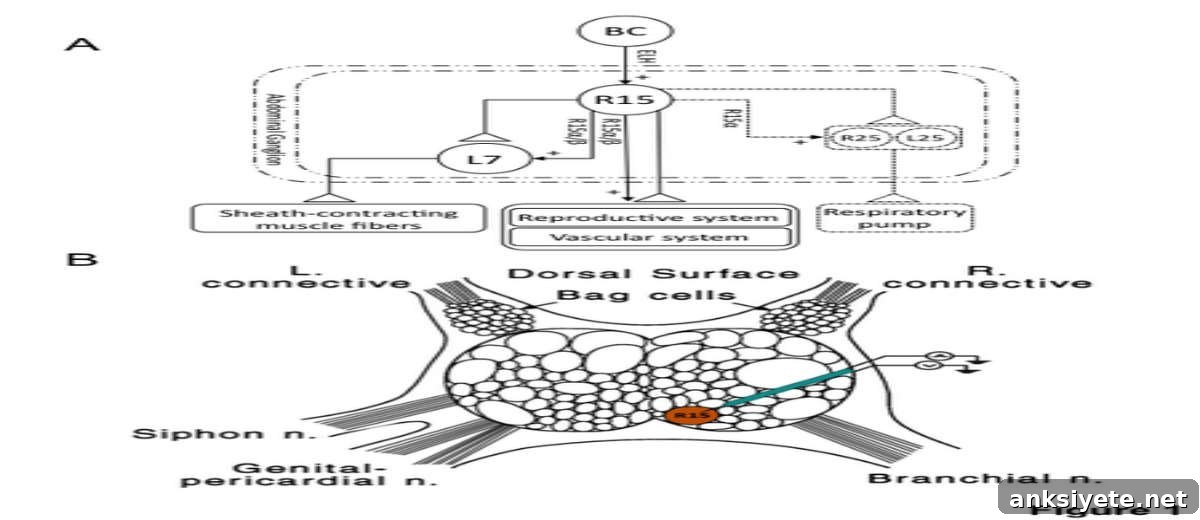
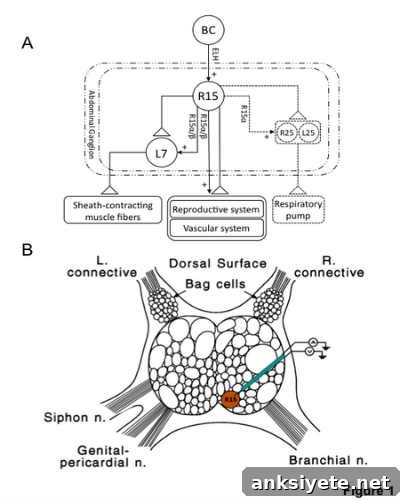
Using the new approach, the team concentrated on neuron R15, an identifiable burst-firing neuron known to contribute to the control of water balance and reproductive behaviors in Aplysia. Electrophysiological recordings showed specific, age-associated changes in burst firing and action potential characteristics—key elements of how neurons communicate. In addition, R15’s responsiveness to the neurotransmitter acetylcholine declined with age, a finding consistent with the idea that altered cholinergic signaling during aging is conserved across diverse species.
Gene expression changes with aging
Complementing the physiological observations, genome-wide analysis of single R15 neurons revealed unexpectedly complex, bidirectional changes in gene expression with age. Rather than a simple global decline, some genes increased while others decreased in expression. More than 1,000 DNA sequences were regulated differently when comparing mature and old R15 neurons. Affected biological pathways included cell signaling, skeletal-muscular system development, cell death and survival, maintenance of cellular functions, embryonic development, and pathways related to neurological and developmental disorders.
Neuron-specific aging signatures
To validate and extend their findings, the investigators isolated and profiled three additional identified neurons from Aplysia. All neurons exhibited age-related transcriptional changes, but the specific genes affected and the magnitude of change were distinct for each neuron type. These results indicate that aging effects are not uniform across neuronal types; rather, individual neurons show personalized aging signatures in both physiology and gene expression.
Implications and next steps
These studies demonstrate that aging can alter both the electrical behavior and the molecular program of single, identifiable neurons. The combined electrophysiological and transcriptomic approach helps link functional decline to underlying gene regulatory changes, offering a clearer picture of how neuronal signaling becomes imbalanced with age. By identifying pathways and genes that change with aging in single neurons, the work provides a foundation for future studies aimed at understanding why different neurons age differently and how specific mechanisms might be targeted to preserve neuronal function.
Notes about this neuroscience and aging research
The JoVE study, “Aplysia Ganglia Preparation for Electrophysiological and Molecular Analyses of Single Neurons,” lists Komol Akhmedov as first author, with Beena M. Kadakkuzha and Sathyanarayanan V. Puthanveettil among the co-authors. The PLOS ONE paper, “Decreased response to acetylcholine during aging of Aplysia neuron R15,” cites Komol Akhmedov and Valerio Rizzo as first authors and includes collaborators from TSRI, Queen’s University (Canada), and the University of Miami. The BMC Genomics article, “Age-Associated Bidirectional Modulation of Gene Expression in Single Identified R15 Neuron of Aplysia,” lists Beena M. Kadakkuzha as first author along with co-authors from TSRI and the University of Miami.
The research was supported by the National Institutes of Health (grant Number 1 R21 MH096258), the Whitehall Foundation, and the State of Florida.
Contact: Eric Sauter – Scripps Research Institute
Source: Scripps Research Institute press release
Image Source: Image credited to Komolitdin Akhmedov, Valerio Rizzo, Beena M. Kadakkuzha, Christopher J. Carter, Neil S. Magoski, Thomas R. Capo, and Sathyanarayanan V. Puthanveettil / PLOS ONE.
Keywords: aging, neuron, single-neuron analysis, gene expression, acetylcholine, Aplysia, electrophysiology, neurodegeneration, Alzheimer’s, Parkinson’s, neural signaling.