
New research led by Brown University shows that older adults retain the brain flexibility needed to learn a visual perception task, but they are less effective than younger adults at filtering out irrelevant information.
The study challenges the common assumption that aging necessarily reduces brain plasticity. Instead, it highlights a different constraint on learning with age: older learners may encode more information than is useful, making it harder to preserve important memories. Researchers describe this tension as the “plasticity and stability dilemma,” and the current findings suggest older individuals may be particularly vulnerable to it.
“Plasticity may be kept OK, in contrast with the view of many researchers on aging who have said that the degree of plasticity of older people gets lower,” said Takeo Watanabe, the Fred M. Seed Professor at Brown University and the study’s corresponding author in Current Biology. “However, we have found that the stability is problematic. Our learning and memory capability is limited. You don’t want older, existing important information that is already stored to be replaced with trivial information.”
Numerals, not dots
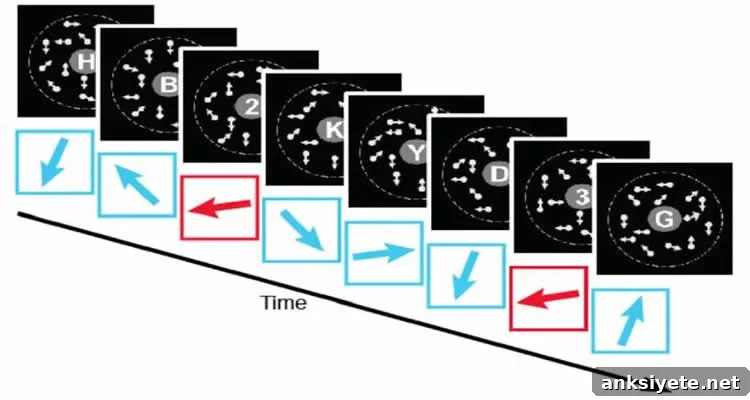
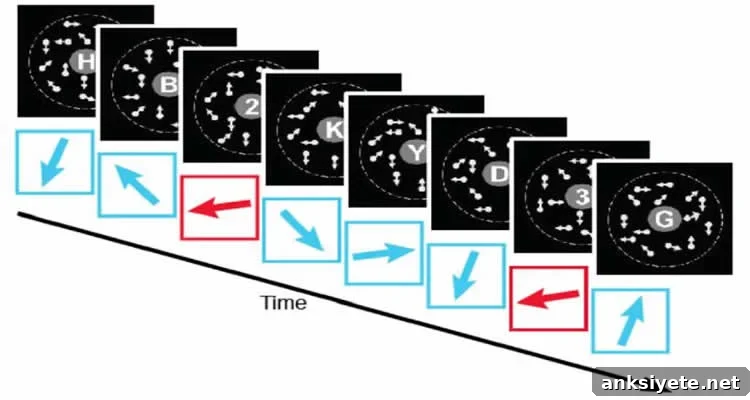
For the experiment, Watanabe and colleagues recruited two groups of volunteers: ten older adults aged 67 to 79, and ten younger adults aged 19 to 30. Over a nine-day training period participants practiced a brief visual task. Each trial presented a rapid sequence of six symbols — four letters and two numerals — and participants were instructed to report only the two numerals. Every symbol appeared against a backdrop of moving dots, and unbeknownst to participants, the dots varied in how coherently they moved.
Before and after the nine-day training, participants completed tests that included reporting both the two numerals and, on some trials, the predominant direction of the background dot motion. The design allowed the researchers to compare task-relevant learning (identifying numerals) with incidental learning of an irrelevant feature (perceiving dot motion).
Both older and younger groups showed comparable improvements in identifying the two numerals, demonstrating that older adults retained the capacity for task-relevant visual learning. “These results indicate that older subjects as well as younger subjects showed significant amounts of task-relevant learning,” the authors reported. “No evidence was obtained that indicates that older individuals have a problem with plasticity.”
However, when it came to the irrelevant feature — identifying the prevailing direction of dot motion — older participants also learned that skill, even when the dot motion was obvious. Younger participants, by contrast, improved mostly on trials where the motion signal was subtle: they tended to ignore clear, irrelevant motion and therefore did not learn it. In other words, younger adults filtered out the obvious distraction; older adults did not, and so they learned from those distractions.
This pattern suggested an attentional explanation: older adults may be less able to suppress or ignore irrelevant sensory signals, and that reduced filtering leads to greater incidental learning of unimportant information. To test this idea, the researchers gave participants an additional task designed to measure the ability to find a relevant stimulus among distractors. On that measure older adults performed noticeably worse than younger adults, supporting the view that attentional filtering declines with age. Moreover, among older participants the poorer their filtering ability, the more they had learned the irrelevant motion.
Watanabe noted the result is not necessarily disheartening. If the main issue is a drop in the ability to filter distractions, then targeted training might improve that skill and reduce unwanted incidental learning. “The hope is that maybe what older people need to do is to learn a skill to avoid learning what is not necessary,” he said.
The work was supported by the National Institutes of Health (grants R01EY019466, R01AG031941, R01MH091801).
Contact: David Orenstein – Brown University
Source: Brown University press release
Image Source: Image credited to Brown University and adapted from the press release
Original Research: Abstract for “Age-Related Declines of Stability in Visual Perceptual Learning” by Li-Hung Chang, Kazuhisa Shibata, George J. Andersen, Yuka Sasaki, and Takeo Watanabe in Current Biology. Published online November 26, 2014. doi:10.1016/j.cub.2014.10.041