
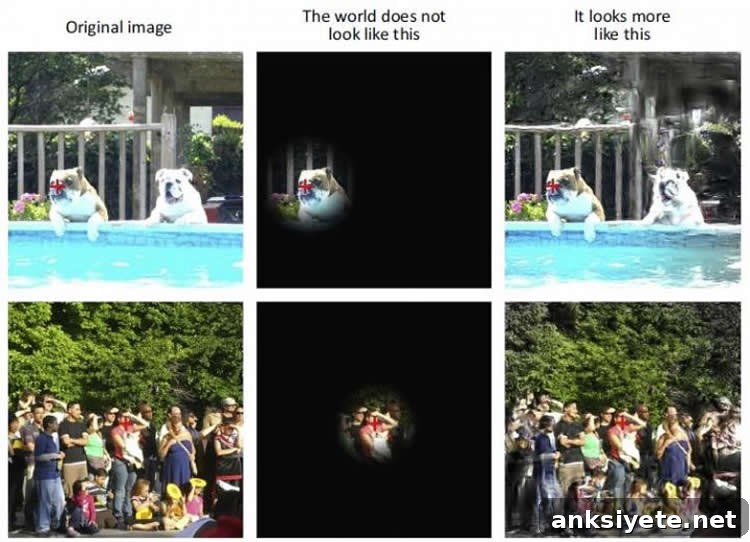
Glance out the window and then close your eyes. What did you see? Maybe you noticed rain and a man carrying an umbrella. What color was the umbrella? What shape was its handle? Did you remember those details? Probably not. Some neuroscientists have argued that, even if you recall only a few specifics from a scene, your eyes still capture everything in front of you. MIT researchers challenge that idea, arguing instead that our visual experience is often limited to the overall “gist” of a scene.
“A lot of evidence shows that the sense our visual experience is richly detailed is misleading,” says Michael A. Cohen, a postdoctoral fellow in the Nancy Kanwisher Lab at MIT’s McGovern Institute for Brain Research and the paper’s first author. “Even so, we reliably pick up enough information to understand the environment — to know the kind of scene we’re in — even if we don’t remember all the small details.”
To measure what people consciously perceive, researchers commonly use brief displays of shapes or objects on a screen and then test memory for those items. In many experiments, subjects can recall only about four or five items correctly. Performance improves when people are cued beforehand to focus on specific elements, showing how attention strongly shapes what gets encoded. That variability in what observers report contributes to disagreement among cognitive scientists about how much of the visual world we truly “see.” Sight appears too inconsistent to be explained by a single mechanism.
Cohen and his co-authors propose that conscious perception combines multiple processes — selective attention, working memory, and decision-making — that together support adaptive behavior. The brain is well adapted to grasp broad, behaviorally relevant properties of scenes almost instantly: layout, depth, navigability, openness, and other scene-level features. From a quick glance you don’t just note “man” and “umbrella,” you register that the man is holding an umbrella and that the environment is wet and navigable. But beyond these ensemble characteristics, many fine details are not reliably perceived or retained.
“One useful thing about this field is that science can reveal surprising limits in subjective experience,” Cohen says. “People are often astonished to learn how restricted their cognitive access to visual details can be.”
Evidence suggests that the same principle — capturing the gist rather than every detail — applies across senses. Auditory perception, for example, may prioritize the overall texture of sounds in the environment. From a window you might notice the falling rain, birdsong, and distant traffic, while tuning out the steady hum of streetlights or a nearby conversation. The ears, like the eyes, appear to represent broad patterns and salient events more reliably than every acoustic detail.
Not everyone agrees with Cohen, Nancy Kanwisher, and co-author Daniel Dennett about constraining consciousness in terms of memory bandwidth and decision processes. Some researchers argue for richer unconscious representations or different interpretations of the experimental data. Measuring consciousness objectively remains challenging because reportability can be conflated with subjective experience: whether someone can describe what they saw is not always a direct measure of what they experienced.
“It’s difficult to measure conscious experience without mixing up what people can report and what they subjectively experienced,” Cohen notes. “This paper aims to bridge the gap between measurable cognitive limits and the vivid impressions people have when they open their eyes.”
Funding: The research reported was supported by the National Institutes of Health.
Source: Joseph Caputo, Cell Press
Image credit: Cohen et al./Trends in Cognitive Sciences 2016.
Original research: Full open-access article: “What is the Bandwidth of Perceptual Experience?” by Michael A. Cohen, Daniel C. Dennett, and Nancy Kanwisher. Trends in Cognitive Sciences. Published online March 14, 2016. DOI: 10.1016/j.tics.2016.03.006
Abstract
What is the Bandwidth of Perceptual Experience?
Although our subjective impression is of a richly detailed visual world, many empirical findings indicate that the amount of visual information observers can perceive and remember at any moment is limited. How can this sense of richness be reconciled with objective measures of capacity? The authors argue that while observers perceive more than just a handful of individual objects — as some models of attention and working memory suggest — they still perceive far less than they intuitively believe. Ensemble or summary statistics and rapid scene processing provide broad, scene-level representations that give rise to the sense of richness, even as detailed access to many individual elements remains limited. These considerations help resolve the tension between subjective impressions and empirical data on visual capacity and illuminate the types of representations that underlie perceptual experience.
Trends: Empirical results highlight limits in visual perception, attention, and working memory, yet subjective experience feels richly detailed. Research on visual ensembles and summary statistics shows that observers have access to information across the visual field in the form of scene-level summaries. Neural mechanisms supporting ensemble and scene processing appear distinct from those supporting object-level perception, allowing partially parallel processing that contributes to broad perceptual experience. Nonetheless, new demonstrations indicate that perception is not as rich in detailed content as intuition suggests, and ensemble statistics may capture much of the content of perceptual experience.