Summary: A new mathematical model clarifies the catalytic chemical reactions that drive the formation of amyloid fibrils, including the Alzheimer’s-associated Ab40 protein.
Source: American Institute of Physics
Amyloids are large, tightly packed protein aggregates whose formation is linked to disorders such as Alzheimer’s disease and Type II diabetes.
Researchers publishing in the Journal of Chemical Physics (AIP Publishing) present a streamlined mathematical framework that captures how amyloid fibrils form and grow. The model provides a clearer explanation for catalytic behavior in protein aggregation—an aspect that previous models have struggled to represent in a compact, analytically tractable form.
The study focuses on aggregation of the Alzheimer’s-related peptide Ab40. Applying the model to laboratory data, the authors show that fibril formation for Ab40 most often begins at interfaces, such as a liquid surface or the glass wall of a test tube. This insight has important implications for how experimental results should be interpreted in studies of Alzheimer’s and related diseases.
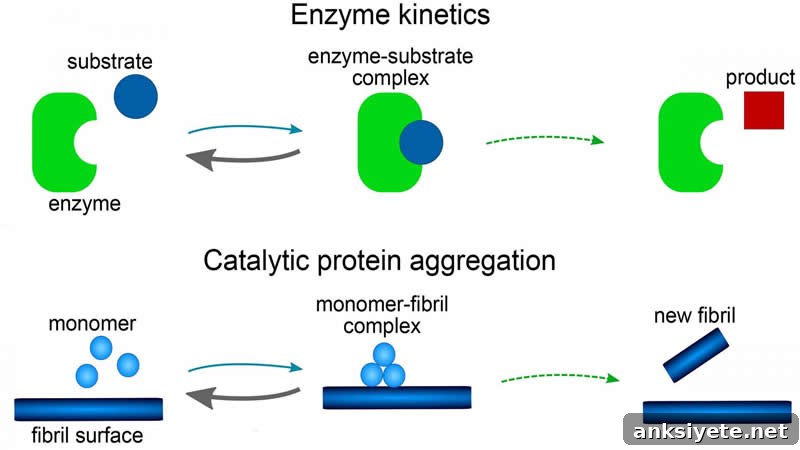
The model is built from a set of rate equations that describe how concentrations of different protein aggregates change over time. Each elementary step in the reaction network can act like a catalytic process, analogous to classical enzyme kinetics: the active “catalyst” is provided by either the tip or side of a growing fibril, or by a surface in the reaction vessel. This perspective unifies many different microscopic mechanisms under a single mathematical description.
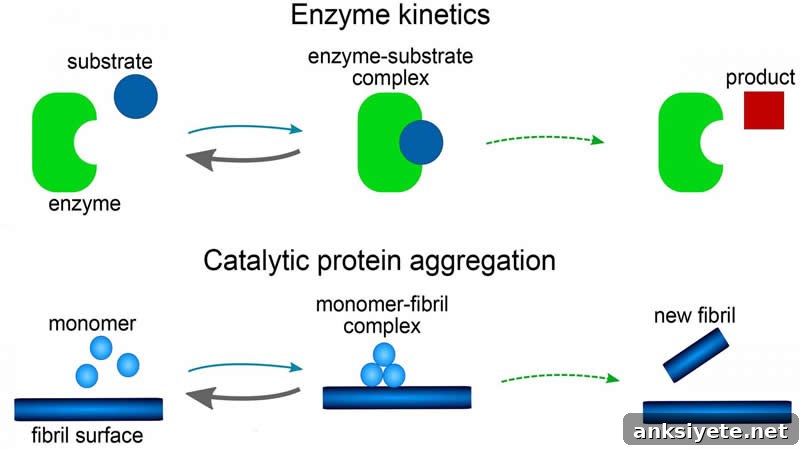
Mathematically, the form of the model relates closely to the well-known Michaelis–Menten equations, which have been used for over a century to describe enzyme-catalyzed reactions. The authors highlight that their kinetic description is far simpler than many earlier models of amyloid formation, and that it admits closed-form solutions. These analytic solutions make it possible to interpret experiments without depending solely on numerical simulation, enabling clearer insight into the role of catalytic processes and saturation effects in aggregation kinetics.
“We expect the methodology developed in this paper will underpin future efforts to model new amyloid formation phenomena,” co-author Alexander Dear said.
A central prediction of the Michaelis–Menten–style equations is the occurrence of saturation: when protein concentrations are high, catalytic sites become occupied and the reaction rate no longer increases linearly with concentration. In the Ab40 experiments analyzed by the authors, signatures of saturation indicate that the earliest nucleation events are heterogeneous—occurring at interfaces—rather than homogeneously in bulk solution. In other words, surfaces such as the container wall or an air–liquid interface play a critical role in starting the aggregation process.
The study’s findings do not claim direct equivalence with in vivo biology, but they do provide a rigorous framework for extending laboratory analyses to more biologically complex environments. Co-author Tuomas Knowles commented that this work will be “central in facilitating the study of amyloid formation in the presence of other species found in body fluids,” by allowing researchers to account for catalytic and saturation effects introduced by additional molecules or surfaces.
Co-author Sara Linse emphasized the practical consequences for therapeutic research: “This work takes the analysis of experimental data to a new level that will be essential for deriving potent inhibitors of amyloid formation.” By clarifying which microscopic steps are dominant and how they respond to concentration and surface effects, the model can guide the development and evaluation of compounds intended to prevent or slow aggregation.
Source:
American Institute of Physics
Media contacts:
Larry Frum – American Institute of Physics
Image credit:
Alexander J. Dear
Original research (open access):
“The catalytic nature of protein aggregation.” Alexander Dear, Georg Meisl, Thomas C. T. Michaels, Manuela R. Zimmermann, Sara Linse and Tuomas P. J. Knowles. Journal of Chemical Physics. DOI: 10.1063/1.5133635.
Abstract summary
The paper presents a universal kinetic model for biofilament formation in which each fundamental process can act catalytically. The authors derive a single closed-form expression capable of describing a wide range of aggregation mechanisms and the interplay of multiple saturated reaction processes. The model’s simplicity allows clear interpretation of how increasing saturation affects overall kinetics. Applying the model to in vitro Aβ40 aggregation data reveals that primary nucleation becomes saturated, supporting the conclusion that nucleation is heterogeneous and occurs at interfaces rather than uniformly in solution.