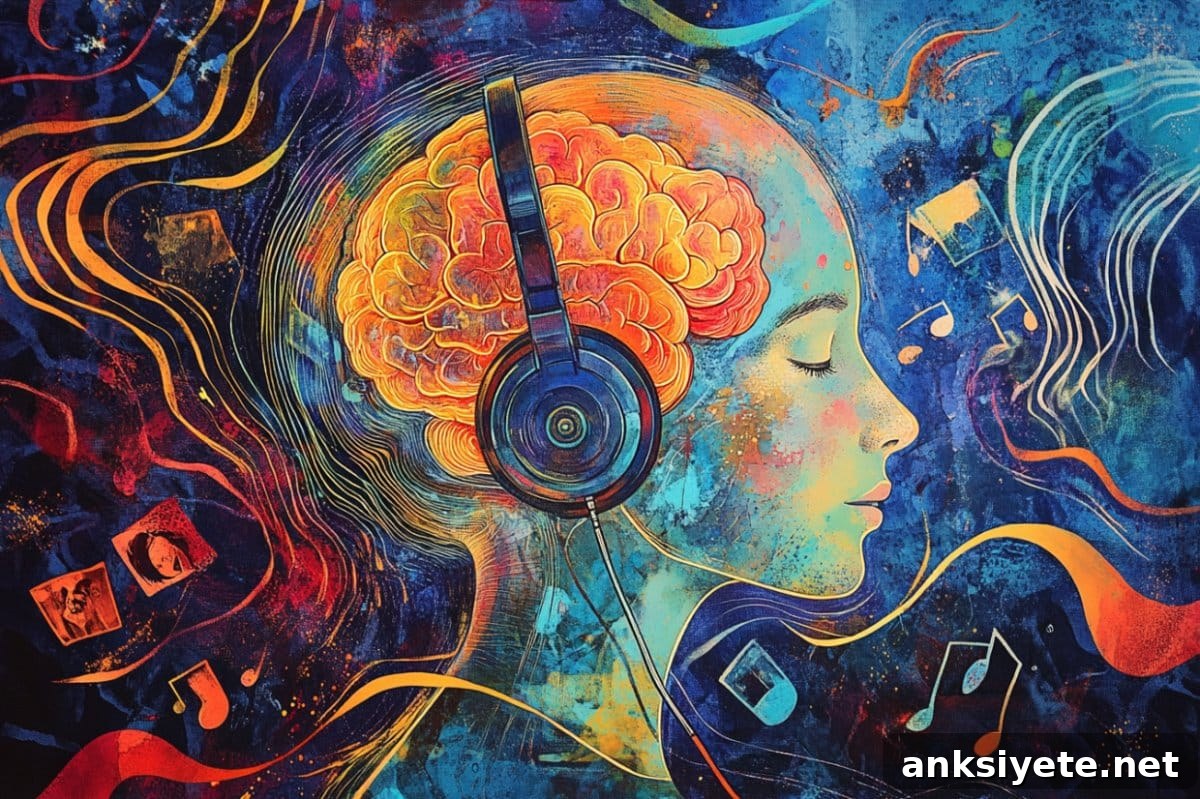
Summary: A recent neuroscience study finds that listening to emotional music while recalling neutral events can change the emotional tone of those memories. Participants who heard positive or negative music during recollection later remembered the same neutral stories with emotional details that matched the music’s mood.
These memory changes were not short-lived: follow-up testing showed the updated emotional content persisted at least one day later. Functional MRI scans recorded during the music-paired recollection revealed heightened activity and increased connectivity in regions that support emotion and episodic memory, including the amygdala and hippocampus.
Key Facts:
- Memory updating: Emotional music played during recollection shifted the remembered emotional tone of originally neutral stories.
- Persistent effects: One day later, participants still reported memories colored by the music’s emotional valence.
- Neural signatures: fMRI showed greater amygdala engagement and stronger connectivity with frontal and visual cortical areas when recollection was paired with affective music.
Source: Neuroscience News
Music not only moves us in the moment; it can also reshape how we remember past events.
Researchers tested whether emotional music played while people recall past events can introduce new emotional elements into those memories. The study builds on the well-established idea that memories are malleable and can be modified each time they are retrieved—a process known as memory reconsolidation.
Across a controlled three-day protocol, participants first encoded a series of emotionally neutral stories. On a later day, they were asked to recall the same stories while listening to music that had either a positive or negative emotional tone. A final memory test took place the following day, with no music played, to assess whether the emotional content of the memories had changed.
Behavioral results showed a clear pattern: when recollection took place with emotionally congruent music, participants were more likely to incorporate new emotional details consistent with that music. Positive music led to more upbeat reinterpretations, while sad music produced more negative recollections. Importantly, these alterations were still detectable in memory reports taken one day after the music-paired session, indicating that music can create durable changes in the emotional coloring of memories.
Neuroimaging provided converging evidence. During recollection with affective music, activity increased in emotion- and memory-related brain areas, including the amygdala and the anterior hippocampus, which are critical for emotional salience and episodic memory, respectively. The study also observed elevated involvement of the inferior parietal lobule, a region linked to recollective experience and attention to internal representations.
Connectivity analyses revealed that the amygdala showed stronger coupling with frontal regions and visual processing areas during music-paired recollection. This pattern suggests the brain was integrating the emotional tone supplied by music with visual imagery and narrative details of the remembered story, potentially explaining how neutral content becomes infused with affective meaning.
These findings advance understanding of the interaction between music, emotion, and memory. While previous work has documented that music can evoke emotional responses and trigger autobiographical memories, this study demonstrates that music can actively modify the emotional content of memories when it coincides with retrieval. Such effects have implications for therapeutic approaches that rely on memory reconsolidation, for the role of soundtrack and ambient music in everyday life, and for how autobiographical memories may acquire emotional coloring over time.
Whether someone is revisiting childhood moments with a playlist or replaying a breakup through a particular song, this work suggests that the soundtrack accompanying recollection can shape not only how the memory feels in the moment but also how it is stored afterward.
About this music and emotional memory research news
Author: Neuroscience News Communications
Contact: Neuroscience News Communications
Source: Neuroscience News Communications – Neuroscience News
Image: Image credited to Neuroscience News
Original Research: Closed access.
“Affective music during episodic memory recollection modulates subsequent false emotional memory traces: an fMRI study” by Yiren Ren et al., published in Cognitive, Affective, & Behavioral Neuroscience.
Abstract
Affective music during episodic memory recollection modulates subsequent false emotional memory traces: an fMRI study
Music is a compelling medium that engages emotional, reward, and memory systems in the brain. This study asked whether introducing affective music during the retrieval of neutral episodic memories can lead to the incorporation of novel emotional content into those memories. Using a three-day episodic memory paradigm with distinct encoding, recollection, and retrieval phases, researchers hypothesized that emotional music paired with recollection would increase the incidence of false emotional elements consistent with the music’s valence.
Behavioral data supported this hypothesis: participants exposed to music during recollection were more likely to introduce emotional details congruent with the music, and memories tested 24 hours later bore stronger emotional tones aligned with the music heard during the recollection phase. fMRI results showed altered engagement of the amygdala, anterior hippocampus, and inferior parietal lobule during recollection with music. Increased functional connectivity between the amygdala and fronto-visual cortical regions was also observed, which may help explain the creation of more emotionally vivid reconstructions.
Together, the behavioral and neural findings illuminate how music can modulate the emotional content of episodic memories, clarifying mechanisms that link affective cues, memory retrieval, and subsequent reconsolidation.