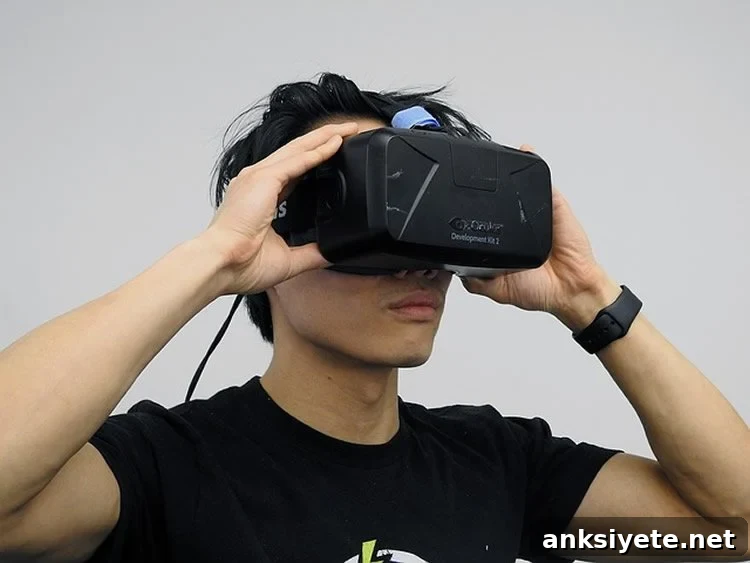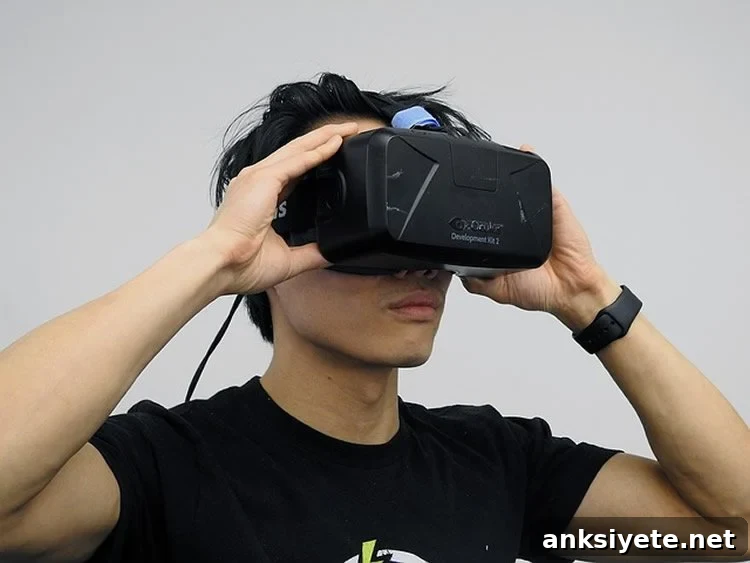
Summary: Virtual reality can be used to recalibrate time perception and sensorimotor actions. Researchers suggest this approach may have therapeutic potential for conditions such as autism spectrum disorder, Parkinson’s disease and schizophrenia.
Source: University of Waterloo
Playing games in virtual reality (VR) may offer a promising tool to help treat neurological disorders that alter how people perceive time, including autism, schizophrenia and Parkinson’s disease.
A study conducted by researchers at the University of Waterloo found that immersive VR experiences can change how people estimate elapsed time by linking the timing of visual events directly to a user’s body movements. Because several neurological conditions are associated with atypical timing and sensorimotor integration, the researchers propose that VR could be developed into a rehabilitation strategy to help recalibrate a person’s internal sense of time.
“The ability to estimate the passage of time with precision is fundamental to our ability to interact with the world,” says co-author Séamas Weech, a post-doctoral fellow in Kinesiology. “For some individuals, however, the internal clock is maladjusted, causing timing deficiencies that affect perception and action.
“Studies like ours help us to understand how these deficiencies might be acquired, and how to recalibrate time perception in the brain.”
The study recruited 31 participants (18 females and 13 males) who had normal vision and no reported sensory, musculoskeletal, or neurological disorders. Researchers used the VR first-person shooter game Robo Recall to create a naturalistic, dynamic environment. The key experimental manipulation was a movement-contingent time-flow (MCTF) condition: when participants moved in the real world, the speed and duration of visual events in the virtual world were coupled to their movements, creating a novel action–perception relationship. A comparison group experienced a standard, “normal-time” VR task without movement-dependent temporal coupling.
Participants completed time perception tests both before and after exposure to the VR content. The tasks measured how accurately participants reproduced the duration of a moving visual probe using either continuous motor responses or discrete motor actions. Some participants also performed non-VR control tasks, such as throwing a ball, to check whether effects were specific to VR and continuous movement.
Analysis of perceived versus actual probe durations revealed a clear effect: exposure to the movement-contingent VR reduced participants’ duration estimates by roughly 15 percent. This temporal underestimation was specific to tasks involving continuous motor control and did not appear in discrete motor tasks or in the normal-time control condition. Control tasks performed both inside and outside VR produced results similar to the normal-time group, confirming that the MCTF manipulation drove the observed recalibration.
“This study adds valuable proof that the perception of time is flexible, and that VR offers a potentially valuable tool for recalibrating time in the brain,” Weech says. “It offers a compelling application for rehabilitation initiatives that focus on how time perception breaks down in certain populations.”
The senior author, Michael Barnett-Cowan, professor of neuroscience in the Department of Kinesiology, notes that virtual reality technology has advanced enough to meaningfully alter people’s experience of space and time. He emphasizes that these capabilities allow researchers to investigate basic perceptual mechanisms and apply that knowledge to improve function in healthy, injured, aging, or diseased brains.
While the study demonstrates robust short-term effects, the authors caution that further work is required to translate these findings into clinical practice. Key questions remain about the duration of the recalibration—whether effects persist for minutes, hours, days, or weeks—and whether corresponding neural signals can be detected. Longitudinal research and neural measurements will be necessary to determine how to design effective therapeutic protocols based on movement-contingent VR.
Source:
University of Waterloo
Media Contacts:
Matthew Grant – University of Waterloo
Image Source:
The image is credited to University of Waterloo.
Original Research: Open access
Title: “Movement-Contingent Time Flow in Virtual Reality Causes Temporal Recalibration”
Authors: Ambika Bansal, Séamas Weech & Michael Barnett-Cowan.
Journal: Scientific Reports, volume 9, Article number: 4378 (2019). DOI: 10.1038/s41598-019-40870-6
Abstract
Movement-Contingent Time Flow in Virtual Reality Causes Temporal Recalibration
Virtual reality provides a powerful platform for manipulating sensorimotor feedback and studying how action–perception relationships influence time perception. In this study, 31 participants performed time reproduction tasks using either continuous or discrete motor methods before and after exposure to dynamic VR content. One group experienced standard VR timing, while another group experienced movement-contingent time flow (MCTF), in which real-world movements were mapped to the flow of time in the virtual environment. The researchers predicted that introducing this novel temporal relationship would alter performance on continuous motor timing tasks but not on discrete ones. Results showed duration-dependent recalibration specific to continuous movement: probe intervals were underestimated by about 15% following exposure to the MCTF condition. Control tasks in VR and non-VR contexts yielded results comparable to the normal-time VR group, supporting the specificity of the MCTF effect. These findings highlight how VR can induce sensorimotor recalibration and suggest potential applications for rehabilitation strategies that target timing dysfunctions.